 Widely read:


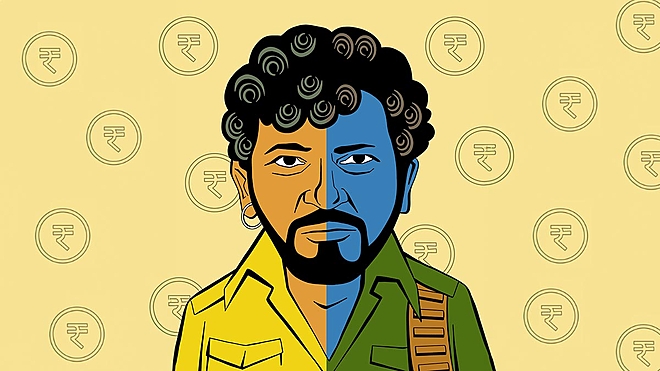
Summary: As Sholay turns 50 and Mutual Fund Insight turns 23, we revisit the film’s iconic dialogues—not to celebrate cinema, but to decode investor behaviour. From fear and greed to overconfidence and cluttered portfolios, this feature shows how timeless investing mistakes are—and how discipline, like Thakur’s, is still your best weapon.
Summary: As Sholay turns 50 and Mutual Fund Insight turns 23, we revisit the film’s iconic dialogues—not to celebrate cinema, but to decode investor behaviour. From fear and greed to overconfidence and cluttered portfolios, this feature shows how timeless investing mistakes are—and how discipline, like Thakur’s, is still your best weapon. Fifty years ago, Sholay stormed into theatres and never left our national consciousness. Twenty-three years ago, Mutual Fund Insight set out on its own long run, trying to make sense of a different kind of spectacle: the market. Both have stood the test of time, each in its own way. When we put together our second anniversary issue in 2004, we asked 50 fund managers about their favourite film. Many of them, unsurprisingly, said Sholay. Two decades later, the film has turned 50, and its lines still echo, not just in living rooms but in investment portfolios. This year, we decided to give those dialogues fresh work. Not as a tribute to cinema, but as a reflection on investor behaviour. Each familiar dialogue highlights a blind spot: the wrong questions we ask, the fears we exaggerate, the rewards we chase for the wrong reasons. Because while markets have changed, from the Harshad Mehta scam to Covid meltdown, investor behaviour largely hasn’t. Fear, greed, envy, overconfidence. These traits return in every cycle, like villains in different costumes, ready to ruin the plot. But the real skill is recognising them when they show up. Once you can do that, you don’t need perfect timing, the flashiest funds or the smartest forecasts. You just need to stay in the right role. Or, as Gabbar might have put it if he invested in mutual funds: markets will forgive crashes, but compounding never forgives mistakes. Too many cooks: Why stuffing funds doesn’t make you richer Gabbar’s seminal dialogue lives rent-free in our heads. Investors fall for the same trap with their portfolios. They assume more funds mean more safety, more diversification, more growth. A tidy three-fund setup feels amateurish. Ten funds feel professional, like armour against uncertainty. The chart ‘The Gabbar portfolio test’ shows otherwise. Both portfolios had the same mix: 65 per cent equity, 15 per cent international equity and 20 per cent debt. The only difference was how complicated the investor made it. The clean portfolio kept things simple: one flexi-cap fund, one NASDAQ-tracking ETF and one short-duration debt fund. Three funds, job done. The cluttered portfolio looked like a buffet plate. Equity alone was split across seven funds: one flexi-cap (15 per cent), two large-caps (10 per cent each), two mid-caps (10 and 5 per cent) and two small-caps (10 and 5 per cent). Debt wasn’t spared either: 10 per cent each in a gilt fund and a short-duration fund. The international slice was the same. In total: 10 funds. To keep it fair, these weren’t random picks. We chose from the top three performers in each category. The outcome? Virtually identical. Rs 1 lakh grew to Rs 5.06 lakh in the clean portfolio and Rs 5.13 lakh in the cluttered one. All that extra paperwork and mental load for just a slightly higher amount. In fact, once your asset allocation is set, piling on more funds just creates duplication. Two large caps, both own Infosys and Reliance Industries. Two flexi-caps both chase the same benchmarks. What looks like variety is often the same dish, served in different bowls. And clutter isn’t just a maths problem, it’s a mental one. A crowded portfolio makes it harder to track progress, harder to prune and harder to see if your goals still align. Like having 15 browser tabs open, you forget why you clicked half of them. In chasing diversification, you lose direction. The real question isn’t “How many funds?” but “Do these funds serve a purpose?” Growth from equity, stability from debt and balance from a dash of international. Tick those boxes and stop adding. Fear test: Even the best funds look terrifying half the time If there was ever a mutual fund that could quote Gabbar with a straight face, it’s the Sundaram Small Cap Fund (the older small-cap fund). Since its launch in February 2005, it has rewarded long-term investors handsomely. A Rs 5,000-a-month SIP would have grown to Rs 84 lakh by September 2025, yielding an annualised return of 16.1 per cent. And yet, almost no one has enjoyed that ride peacefully. Small-caps are the bull market’s show ponies and the bear market’s punching bags. They soar when optimism reigns but crash harder when fear takes over. To see just how wild the journey can get, we mapped every fall since inception. The picture that emerged was pure Sholay: chaos, courage and long stretches of despair before redemption. The fund has fallen more than 50 per cent 11 times in
This article was originally published on October 28, 2025.
This story is not available as it is from the Mutual Fund Insight November 2025 issue
Read other available articlesAdvertisement
 New episodes every Friday











 New Process Alert
 Seems like you've uploaded a wrong QR code. Please upload the QR code downloaded from MF Central platform.


