




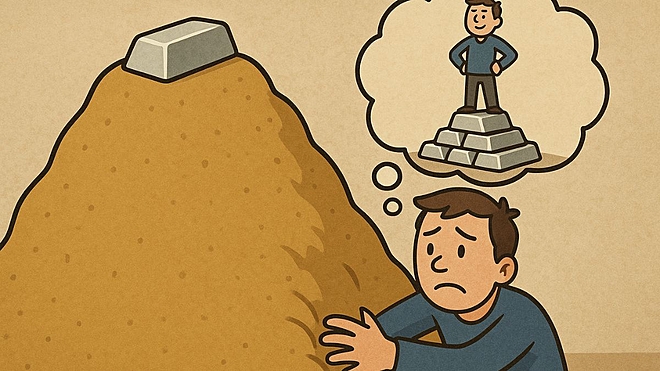
 Aditya Roy/AI-Generated Image

Summary: The silver mania is real. But before you jump in, let’s look at what 100 years of history reveals about its glitter and its gloom.
When silver surges more than 50 per cent in a year, it’s easy to think you’ve missed the bus or that a new era for the white metal has begun. But if history is any guide, such explosive rallies often come with a hangover.
Silver has been on a tear lately, touching record highs due to high industrial and retail demand. Unlike gold, which is largely driven by investor sentiment and central bank buying, silver’s demand is now dominated by industry. It’s a crucial component in solar panels, electric vehicles, semiconductors and even 5G networks. The ongoing clean-energy transition has made silver indispensable.
This year’s nearly 90-per-cent price surge isn’t purely industrial. It’s also about scarcity. Global mine production has struggled to keep up with demand. Combined with speculative interest and rising lease rates, this has created what traders are calling a real silver squeeze.
So, what does history tell us? How does silver react after generating over 50 per cent returns in a single calendar year?
To find the answer, we went back a full century of silver price data, and what we found is both fascinating and familiar. The metal’s relationship with euphoria is pretty formulaic.
1946: The post-War pop
The first major surge came right after World War II, as per Macrotrends. In 1946, silver jumped a robust 53.9 per cent. But the excitement was short-lived. The following year, prices fell 10 per cent, and over the next four years, silver oscillated between mild gains and small losses—rising 2.8 per cent one year only to fall 2.7 per cent the next. It wasn’t until 1951 that the metal finally posted another double-digit gain.
1967: The boom that burned out
Fast forward two decades. The year 1967 was sensational for silver, up a dazzling 72.6 per cent, one of its biggest single-year moves in the 20th century. But the hangover was swift. Prices tumbled 13.5 per cent in 1968, followed by -8.2 per cent in 1969 and -8.9 per cent in 1970.
1973: The two-year wonder
In 1973, silver once again became the market’s darling, surging over 60 per cent amid the oil shock and inflation fears. Unlike previous booms, the rally extended for one more year, as 1974 added another 37 per cent gain. But just as investors started believing “this time is different”, 1975 wiped out confidence with a 7 per cent drop.
1979: The mania of the century
Then came the mother of all silver rallies. In 1979, silver prices went absolutely ballistic—soaring 435 per cent in a single year—as the infamous Hunt brothers tried to corner the global silver market. The frenzy sent prices to nearly $50 per ounce.
But when regulators stepped in and exchanges imposed trading limits, the bubble burst overnight. In 1980, silver crashed 51.9 per cent, triggering an extended bear phase. Over the next 13 years, the metal spent 11 years in the red, erasing nearly all the speculative gains of 1979.
2009–2010: The modern echo
The next big boom came after the Global Financial Crisis. In 2009, silver gained 57.5 per cent, powered by low interest rates and stimulus-fuelled liquidity. But unlike earlier episodes, the rally didn’t stop there. 2010 brought another 80 per cent surge.
Then came the reckoning. Between 2013 and 2018, silver crashed repeatedly, down 35 per cent in 2013, 18 per cent in 2014, and 13.6 per cent in 2016.
The cycle of boom and bust
Every major silver rally in the past century, whether in 1946, 1967, 1973, 1979 or 2009, was followed by a cooling phase.
In fact, one of the most painful aspects of silver investing is how long it can take to recover from a crash. When silver crossed Rs 10,000 per kg in January 1980, investors might have assumed the metal had entered a new era. Instead, they waited 24 years—until April 2004—for silver to cross the same level again.
And if that feels like ancient history, remember the more recent drought. After peaking in 2011, silver spent nearly eight years struggling to reclaim those highs.
What you should remember
So, while today’s rally is fuelled by genuine industrial demand, not pure speculation, it doesn’t make silver immune to volatility. Yes, the long-term story around renewable energy, electronics and EVs supports higher structural demand. But history suggests we brace for volatility.
You can invest in silver to diversify, but don’t chase it at the peak of frenzy. Unlike gold, silver lacks the same depth of institutional buying and often sees sharp corrections once speculative sentiment fades.
At Value Research, we prefer gold as a steadier hedge against inflation and currency weakness. Even then, it shouldn’t exceed 10 per cent of your total portfolio.
So, while silver’s story right now may look shiny and unstoppable, remember: every silver lining comes with its share of clouds.
And if you want to know where you should invest your money instead, we suggest you explore Value Research Fund Advisor. Because it can help you choose funds that truly fit you, based on your goals, risk appetite and time horizon. It doesn’t just tell you what’s performing well right now; it helps you build a long-term, well-balanced portfolio that actually works for you.
Also read: A premium too far
Ask Value Research 
 New episodes every Friday









 New Process Alert
  Seems like you've uploaded a wrong QR code. Please upload the QR code downloaded from MF Central platform.


