




 Anand Kumar/AI-Generated Image
Summary: Numbers alone don’t reveal the full story of investing. Two funds may deliver similar returns, but their risk profiles and investor experiences can be worlds apart. Ratios help decode these nuances, showing how consistently and efficiently a fund converts risk into reward.
Ask 10 people what they fear most about investing and you’ll hear 10 different answers. One worries about losing money, another about missing an opportunity. Some notice the market going up and down, while others barely pay attention to the years that pass. The numbers on the page remain unchanged, yet each person experiences them differently. Psychologists call this the ‘affect heuristic’ – how feelings shape our perception of risk more than numbers do.
Some pull back at a drop, others wait it out. Small gains thrill one investor and pass unnoticed by another – the same returns can feel entirely different. Even when results are similar, the experience differs. One fund may put investors through sudden swings, while another moves more even-handedly. The difference lies in how gains and losses are felt, in the choices made along the way. Paying attention to these details – not just the totals – helps make sense of the numbers.
Where force meets foresight
Most people still see kabaddi as a contest of strength and flexibility – raiders lunging in, defenders locking arms, tackles that shake the mat. But if you’ve followed professional kabaddi, you know it’s no longer just reflex. There’s planning, match analysis and what players call ‘reading the game’, sensing what’s coming before it happens.
A raider pauses at the line, testing angles. A defender leans just enough to bait the move they have been waiting for. What looks immediate is built on hours of study, knowing a raider’s favoured side, how a chain loosens, how hesitation tilts the point.
Ratios serve a similar purpose in investing, helping you move beyond sheer muscle. While it’s tempting to focus only on the obvious, such as past returns, rankings or performance charts, the real edge comes from noticing small signals, judging risks and planning the next step. Ratios don’t predict outcomes, but they show how a fund responds, highlight potential risks and indicate whether it aligns with your goals. They provide direction without replacing judgment.
Two funds can deliver the same returns, yet one throws you off balance at every twist, while the other carries you along with smooth consistency. Noticing the difference separates raw force from thoughtful play.
“Strength can score points, but understanding sets the pace.”
The picture behind the peaks
Numbers alone can mislead. Strong returns say little about how efficiently, or at what cost, they came. This is where ratios help, offering a lens to weigh risk and reward together. On the risk side, beta, standard deviation and downside measures like the Sortino ratio capture how volatile a fund has been and how sensitive it is to market swings. On the return side, Sharpe, Treynor, Jensen’s alpha, R-squared and information ratio show how well a fund converts risk into reward and how consistently it outperforms its benchmark.
Understanding ratios isn’t about memorising numbers, but about reading dynamics that reveal a fund’s true character. A high Sharpe ratio with low Sortino signals exhibits an upside bias but poor downside protection. Information ratio with R-squared separates skill from luck; Treynor and beta show efficiency against market fluctuations. Read together, they can reveal whether performance rests in resilience or on chance.
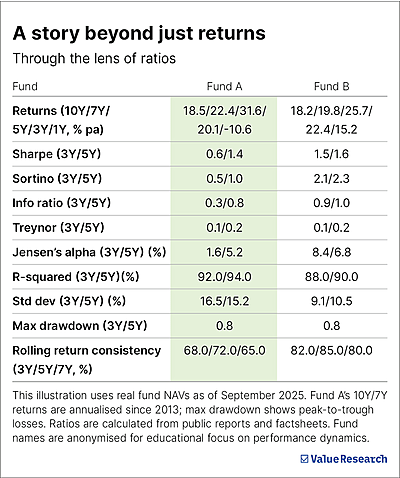
When most people see data, they start with 10-year returns (refer to the table). Fund A at 18.5 per cent edges Fund B at 18.2 per cent; across seven, five and three years, they’re nearly identical. Last year, Fund A dipped while Fund B stayed positive. Yet for many investors, that one negative year does little to change their perception: long-term returns still dominate their choice, and Fund A remains the obvious pick.
But ratios tell a new story. Fund A catches the eye: Sharpe rises from 0.65 to 1.45, while Fund B moves up to 1.48-1.62, showing efficiency per unit of risk. On Sortino, Fund B is about two times Fund A, with stronger downside protection. Standard deviation jumps above 16 per cent for Fund A, almost double that of Fund B’s 9-10.5 per cent. Fund A’s higher R-squared shows it shadows the benchmark yet surges more wildly, while Fund B keeps a calmer stance.
Information ratio adds contrast: 0.35 / 0.78 for Fund A versus 0.92 / 1.05 for Fund B, suggesting Fund B’s returns lean more on skill than luck. Treynor and Jensen’s Alpha echo it: Fund A moves with market waves; Fund B manages risk with more control. Max drawdowns dip deeper in Fund A, shallower in Fund B and rolling returns tell the same tale – 68-72 per cent versus 82-85 per cent. From a distance, the picture looks one way, but a closer view reveals something else.
The point isn’t that one fund is better than the other. Fund A may thrill one investor and exhaust another; Fund B may comfort one and bore another. What matters is whether the risks behind returns align with your temperament, risk appetite and patience.
Guided, yet uncertain
Ratios are often mistaken for answers when, in truth, they are instruments. They highlight tendencies, flag potential pitfalls and outline efficiencies, but they do not determine outcomes. A raider in kabaddi knows instinctively: the mat shows distance, boundary and angles, but it cannot reveal exactly when a rival will strike. That moment belongs to instinct and judgment, where anticipation meets action.
Patience can reward, and gut feeling can guide, but both work only in the hands of those who use them well. The real challenge lies in the space between intention and outcome – a ‘behavioural gap’ where plans meet reality, something no ratio can fully resolve.
Mathematics has its limits. Ratios cannot foresee every turn, nor can metrics capture conviction or the subtleties of timing. Yet within those limits lies their strength: they help us navigate uncertainty, guard against being blinded by the sky of the highest returns and keep us mindful of the unseen challenges beneath our feet.
Investing, like kabaddi, is a dialogue between observation and temperament, data and discretion, movement and restraint. Victory rarely comes from a single move; it comes from understanding the balance between risk taken and risk endured.
Arpit Nayak is part of the sales team at WhiteOak Capital Mutual Fund. He enjoys writing to simplify investing by providing clear insights and focusing on the behavioural aspects of financial decisions. He believes that smart choices come from clarity, not complexity.
Ask Value Research 
 New episodes every Friday











 New Process Alert
  Seems like you've uploaded a wrong QR code. Please upload the QR code downloaded from MF Central platform.


