




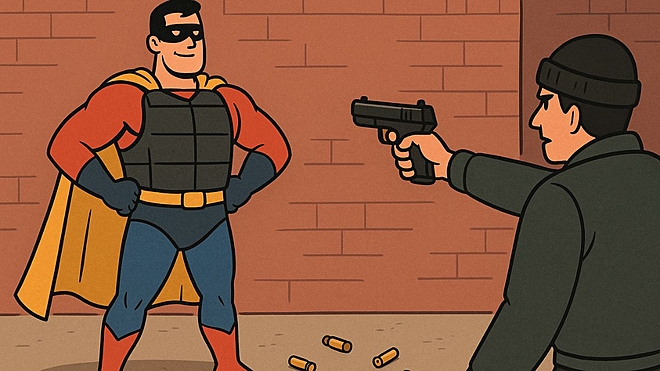
 Aditya Roy/AI-Generated Image

Summary: We recently did a piece on how there are three small-cap funds that beat the Nifty 250 Smallcap TRI index 100 per cent of the time based on five-year rolling returns. But we didn’t stop there today. We have now checked how these three funds held up when the market went into freefall, through six major crashes since 2015.
Small-cap funds can make you feel like a genius one year and break your heart the next. But what if there was a small-cap fund that has not only delivered outstanding returns but also protected you better than most when markets crashed?
In a recent article, we analysed five-year daily rolling returns for all 13 active small-cap funds with a 10-year history between September 21, 2020, and September 19, 2025.
For the uninitiated, rolling returns simply mean checking returns for every possible five-year period, not just one fixed start and end date. It basically removes the effect of luck or perfect timing and shows which funds deliver no matter when you invest.
Coming back to the article’s findings, we observed that the Nifty Smallcap 250 TRI, which tracks the entire small-cap universe, delivered a strong 18.07 per cent annualised return during this period. Impressively, 12 out of 13 active funds beat this average, and 10 of them delivered over 20 per cent annualised returns.
Even more impressive was the fact that three funds beat the index’s five-year returns 100 per cent of the time, no matter which day one withdrew their investments between September 2020 and September 2025.
Those three funds are:
But how do they handle the pain?
High returns are one thing. Another test of a small-cap fund is how it behaves when markets tank.
This is where drawdown comes in. Drawdown is the measure of how far your portfolio falls from its peak before it recovers. If your investment hits Rs 1 lakh and falls to Rs 70,000, that’s a 30 per cent drawdown.
So, we looked at the six biggest corrections (15 per cent-plus falls) in the Nifty Smallcap 250 TRI since 2015, including the early 2025 correction, and compared them with the three funds.
| Period | Nifty Smallcap 250 TRI | HDFC Small Cap | HSBC Small Cap | Nippon India Small Cap |
|---|---|---|---|---|
| Jan–Feb 2016 | -22.1% | -18.8% | -20.6% | -22.1% |
| Sep-2018 | -16.6% | -9.5% | -11.3% | -12.4% |
| Jun–Aug 2019 | -17.0% | -14.7% | -12.2% | -15.8% |
| Feb–Mar 2020 | -38.1% | -35.3% | -36.9% | -35.6% |
| May–Jun 2022 | -14.7% | -10.4% | -9.3% | -10.0% |
| Jan–Feb 2025 | -12.60% | -10.47% | -14.02% | -11.90% |
Our takeaways
- All three funds, barring just on one occasion, fell less than the index during a market drawdown exceeding 15 per cent.
- HDFC Small Cap Fund was the most resilient of the trio, falling less in four out of six major drawdowns.
- HSBC’s scheme was the second-most resilient, though it was the only fund to ever underperform the index during the early 2025 correction.
Apart from the fact that the three small-cap funds have been strong long-term performers, they also have an edge over the index for two reasons:
- Flexibility: They can invest up to 20 per cent in large- and mid-cap stocks, which can act as comparatively better shock absorbers in a market crash.
- Quality filter: The small-cap index holds every company in the segment, including weaker names. Active funds can stick to businesses with better balance sheets, governance and growth prospects.
The last word
If you want a small-cap fund that has delivered both stellar returns and a smoother journey, HDFC Small Cap Fund stands out as the most “bullet-proof” among the three.
But does it mean HDFC’s small-cap scheme makes it to our Analyst’s Choice?
For that, we suggest you visit Value Research Fund Advisor. Our seasoned analysts have drawn up a list of small-cap funds that have stood the test of time.
Also read: Is investing in an active small-cap fund still a good idea?
Ask Value Research 
 New episodes every Friday











 New Process Alert
  Seems like you've uploaded a wrong QR code. Please upload the QR code downloaded from MF Central platform.


