





With rising global risks and constant volatility, instincts can mislead. This piece explores how quality investing and dynamic asset allocation can help you stay invested without panic.
Markets rarely crash with notice. Nor do they rise with courtesy. Instead, they lurch, mislead and confuse. The last few years have delivered an unrelenting cocktail of volatility: Trump-era tariffs, war in Ukraine, turmoil in Gaza, India-Pakistan tensions, inflation spikes, interest rate shocks and now, renewed political uncertainty in the US.
In such a backdrop, investor behaviour often follows a tired script: panic at lows, euphoria at highs. Buy late, sell early. Rinse, repeat. While headlines change, emotional reflexes don’t. That’s what makes volatility so dangerous—not just because prices fall, but because fear drives decisions.
Which raises the question: how does one stay invested when everything screams uncertainty? The answer lies in two time-tested principles. One, stick to quality; two, let asset allocation do the heavy lifting. Together, these form an effective defence against both market swings and one’s own impulses.
Weatherproofing with quality: The quiet power of good businesses
Investing in high-quality companies isn’t glamorous. But it works, especially when volatility rises. Quality businesses with strong balance sheets, consistent profitability and pricing power tend to fall less and recover faster.
In both the 2008 global crisis and the Covid-led 2020 crash, high-quality portfolios suffered smaller drawdowns and bounced back faster than lower-quality peers and even the broader market (Nifty 500 TRI). When the tide went out, you knew who wasn’t swimming naked.
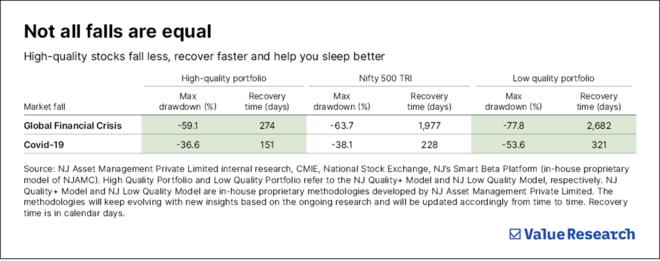
That’s no coincidence. Quality companies are inherently more resilient, don’t need capital at worst times, don’t cut corners to meet numbers and don’t rely on macro tailwinds. They’re a source of stability when others are flailing.
Why dynamic asset allocation deserves more attention
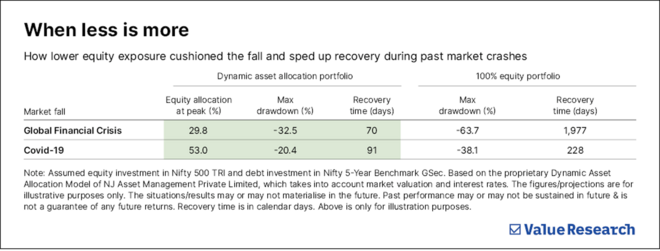
Even the best companies can’t prevent portfolios from falling when equity markets crash. That’s where dynamic asset allocation (DAA) comes in.
DAA adjusts the balance between equity and debt based on market conditions using factors like valuations or macro indicators, like interest rates. Think of it as portfolio rebalancing on autopilot, but smarter and more responsive.
Here’s the catch: the bigger the fall, the steeper the climb to recovery. A 30 per cent drop needs a 43 per cent gain just to break even. At 50 per cent, you need 100 per cent. Avoiding these drawdowns is where DAA shines—not by beating markets every year, but by helping you stay invested through the years.
By removing emotion and introducing a rule-based rebalancing framework, DAA acts as a behavioural guardrail. It helps investors avoid the classic mistakes: buying into momentum at the top and panicking at the bottom. And in volatile, geopolitically fraught markets, that kind of discipline isn’t just helpful, it’s essential.
NJ BAF: Defence and offence, by design
Enter NJ Balanced Advantage Fund (NJ BAF). A rare combination of the two defences investors truly need today.
Unlike most hybrid funds that blend asset classes but depend on human discretion, NJ BAF is a fully rule-based, data-driven DAA strategy. It adjusts its equity and debt mix based on pre-defined signals like valuation levels and macro trends. There’s no gut feel, no manager bias, no heroics.
On the equity side, it sticks to high-quality stocks, ensuring the portfolio remains resilient even in drawdowns. On the allocation side, it responds dynamically to market conditions, dialling up or down risk as the environment demands.
Together, these two layers, quality selection and dynamic rebalancing, create a portfolio that is robust by design. Not reliant on forecasts. Not reactive to fear. But quietly intelligent.
The final word: Rules over instincts
In turbulent markets, panic is no strategy. Quality investing smooths the ride, dynamic allocation smartens it. Together, they offer clarity and control, helping investors focus on process, not prediction, and achieve what matters most: peace of mind.
Nirmay Choksi is the Director and Head of Investment at NJ Asset Management Private Limited. The views expressed above are his own.
When markets panic, your portfolio shouldn’t.
At Value Research Fund Advisor, we help you build resilient portfolios—grounded in quality and backed by research. No guesswork. No emotional decisions. Just disciplined, data-backed investing designed to weather every storm.
Invest with clarity, not chaos.
Ask Value Research 
 New episodes every Friday











 New Process Alert
  Seems like you've uploaded a wrong QR code. Please upload the QR code downloaded from MF Central platform.


