 Widely read:


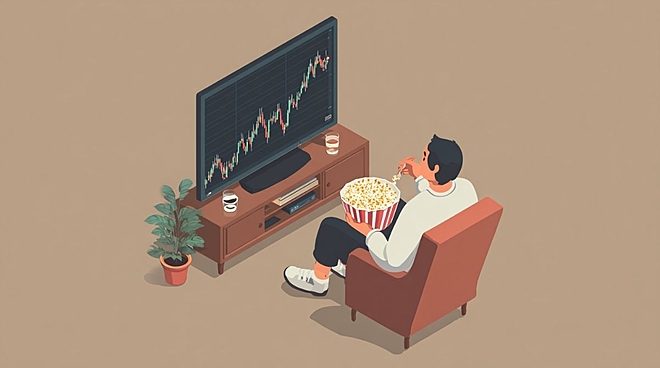
Six months into a new investment? Feeling underwhelmed? Don’t worry. It’s just the plot thickening. This story’s payoff takes time, and the real action happens much later. In this piece, we explore why patience pays — and how long-term investing is the real binge-worthy hit.
You begin watching a new Netflix series. The production quality is stellar. The reviews are enthusiastic. Friends say it gets “really good” eventually.
But two episodes in, you are sceptical. The plot feels scattered, the characters underdeveloped and the pacing off. You start to wonder if you should abandon it and pick something else.
This is exactly how many investors feel after six months in the market. The initial excitement fades. The results appear underwhelming. And that quiet thought surfaces: “Maybe this just is not working.”
Six months: All drama, no clarity
Judging the stock market after just six months is like reviewing a Netflix series after two episodes. You are reacting to the noise, not the narrative.
From January 2005 to June 2025, the Nifty 50 delivered negative returns 27.97 per cent of the time, based on all six-month rolling periods. Nearly three in 10 investors saw red, simply because volatility dominates the early stretch.
Even on the upside, only 40.03 per cent of six-month periods produced returns above 10 per cent. Most others were muted or muddled, offering more confusion than conviction.
That is because in the short term, markets are driven not by fundamentals but by sentiment.
The payoff comes mid-season
Every worthwhile series takes time to reveal its brilliance. Subplots connect. Themes deepen. Characters evolve. And then, somewhere along the way, you realise it was worth sticking with.
Investing follows a similar arc.
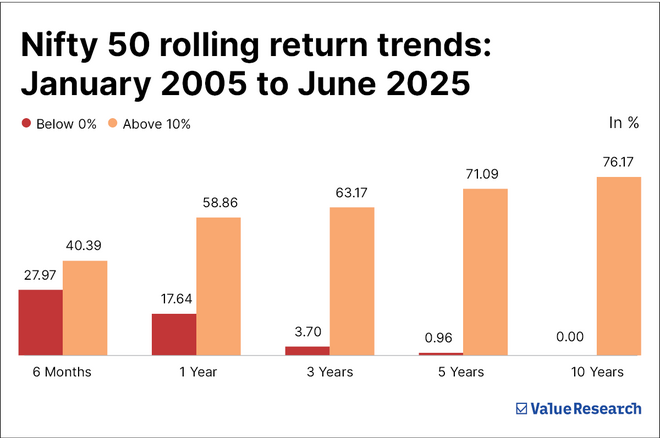
In the short run, markets can feel like a gamble. Over any six-month stretch, there’s a 28 per cent chance of loss and just a 40 per cent chance of earning over 10 per cent. Not the kind of odds that build conviction.
But give it more time, and the odds quietly shift. At the one-year mark, the chances of making a loss drop to 18 per cent. At three years, it falls below 4 per cent. By 10 years, it disappears entirely.
Meanwhile, the probability of double-digit returns keeps rising. From 40 per cent in six months to 59 per cent in one year, then 63 per cent, 71 per cent and eventually 76 per cent over a decade.
Much like a great show that takes a few episodes to find its rhythm, investing begins to deliver once you let the full arc play out. What starts as noise becomes a story—and the longer you stay, the better it tends to end.
The last word
The real mistake is not entering the market at the wrong time. It is leaving before the story matures.
Six months of volatility often feels like failure. But that is not a verdict. It is a test. A test of patience, perspective and your willingness to trust a process that only rewards those who stick around.
We are wired to seek quick feedback. But in investing, early uncertainty is not a flaw. It is a feature designed to filter out the impatient.
The payoff belongs to those who stay long enough. The compounding, the conviction, the real outcomes, they come in the back half of the second season. So, stay invested. Let the story unfold.
An investor education and awareness initiative of Nippon India Mutual Fund.
Helpful Information for Mutual Fund Investors: All Mutual Fund investors have to go through a one-time KYC (know your Customer) process. Investors should deal only with registered mutual funds, to be verified on SEBI website under 'Intermediaries/Market Infrastructure Institutions'. For redressal of your complaints, you may please visit www.scores.gov.in. For more info on KYC, change in various details and redressal of complaints, visit mf.nipponindiaim.com/InvestorEducation/what-to-know-when-investing.
Mutual fund investments are subject to market risks, read all scheme related documents carefully.
Also read: The one simple rule to become wealthy
This article was originally published on July 15, 2025.
Disclaimer: This content is for information only and should not be considered investment advice or a recommendation.
For grievances: [email protected]
Ask Value Research 
 New episodes every Friday









 New Process Alert
 Seems like you've uploaded a wrong QR code. Please upload the QR code downloaded from MF Central platform.


