




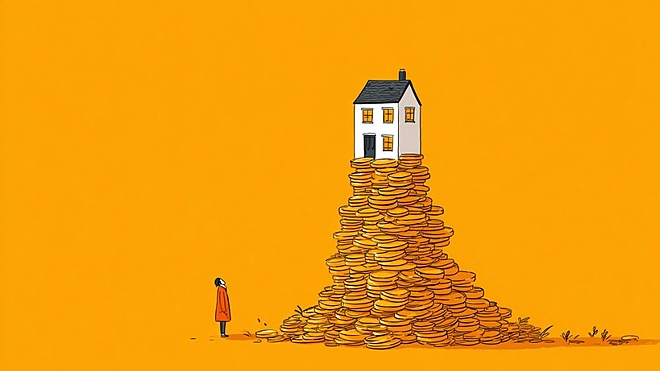
 Aditya Roy/AI-Generated Image
Let’s understand what EMI-to-income ratio is and why a 61% ratio makes your home poor
"When are you buying a house?"
That’s often the first question thrown at young earners, especially after they start their first job or get married. In India, owning a home is still seen as a rite of passage into adulthood, stability and even success.
But as everyone by now knows: housing affordability is shrinking fast.
In fact, the average EMI-to-income (EMI/I) ratio in India hit 61 per cent in 2024, up from 46 per cent in 2020, as per Finology. In other words, 61 per cent of household income is getting dedicated to paying the monthly instalments.
And with property prices (9.3 per cent annual growth) having risen at almost double the pace than household income (5.4 per cent) between 2020 and 2024, the EMI-to-income ratio may get worse. Which means, for aspiring homeowners, buying a home today means sacrificing lifestyle, savings, and, in some cases, even necessities.
Which is why it’s time we took a hard look at the maths behind homeownership, especially when property is treated as an “investment”.
Property as an investment
Let’s be clear: owning a house to live in is very different from buying one to “grow your wealth”.
Unlike in developed countries, rental yields in India are dismally low, often in the 2–3 per cent range, even in metro cities. And while many proudly point to how their family home appreciated 30x over 50 years, that translates to an annualised return of just around 7 per cent, before accounting for inflation or transaction costs.
Worse, if you’re using a home loan to buy that “investment property,” the interest burden often drags your net return into negative territory.
Don’t let the EMI sink you
At Value Research, we recommend that your EMI should ideally not exceed 30 to 35 per cent of your monthly income.
Because, with India’s average already at 61 per cent, it’s easy to fall into the trap of over-borrowing. And don’t forget the add-ons: stamp duty, interior costs, municipal fees. If your dream home busts your budget, downsize the dream.
To understand why this matters, look at the impact of rising EMI burdens on a monthly budget (based on Rs 1 lakh income): At 50 per cent EMI burden, you’re saving just Rs 5,000 a month. At that pace, it’ll take 40 years to build a retirement corpus that’s 10 times your current annual expenses. But with a 30 per cent EMI, you could hit the same goal in 25 years, thanks to a higher savings rate.
Higher the EMI, bleaker the future
Based on assumed expenses, spending and savings
| EMI/I Ratio | EMI (Rs 1 lakh income) | Fixed expenses | Discretionary | Savings |
|---|---|---|---|---|
| 20% | Rs 20,000 | Rs 35,000 | Rs 25,000 | Rs 20,000 |
| 30% | Rs 30,000 | Rs 35,000 | Rs 20,000 | Rs 15,000 |
| 40% | Rs 40,000 | Rs 35,000 | Rs 15,000 | Rs 10,000 |
| 50% | Rs 50,000 | Rs 35,000 | Rs 10,000 | Rs 5,000 |
| 60% | Rs 60,000 | Rs 35,000 | Rs 5,000 | Rs 0 |
| 70% | Rs 70,000 | Rs 30,000 | Rs 0 | Rs 0 |
Plan for the down payment early
For most homebuyers, the down payment is the biggest upfront hurdle. Typically, you are expected to pay at least 20 per cent of the property price from your own pocket.
But that’s not the whole story. Given how real estate prices have risen in recent years, it’s wiser to plan for 25 per cent of your target property value to account for inflation and additional upfront costs like registration, brokerage, among other miscellaneous charges.
That means if you’re aiming to buy a Rs 1 crore home five years from now, your goal shouldn't just be Rs 20 lakh. You should ideally aim for Rs 25 lakh or more to stay comfortably funded and avoid last-minute borrowing or liquidating long-term investments.
That said, owning your home still makes sense
While property may not be the multibagger it’s made out to be, buying a roof over your head can still be a sound financial move. Here’s why:
- You save on rent.
- You get tax breaks on home loan interest and principal.
- And, most importantly, you get peace of mind.
Just don’t confuse home ownership with investing. One is a lifestyle choice. The other is about building wealth.
Our take
Buying a home isn’t just a financial decision, it’s emotional and deeply cultural. But when it comes to your long-term wealth, discipline and affordability must trump sentiment.
In today’s environment of rising property prices and high EMI burdens, the wise homeowner isn’t the one who buys early—it’s the one who buys right.
If you’re working towards home ownership in the next five-plus years, consider flexi-cap funds for long-term growth. For moderate timelines (three to five years), opt for aggressive hybrid funds. Choose based on your time horizon, risk appetite and non-negotiable deadlines. Because in personal finance—just like in real estate — timing isn’t everything. Preparation is.
Also read: SIP investor? Your fund returns may be misleading you
This article was originally published on July 04, 2025.
Ask Value Research 

 New episodes every Friday








 New Process Alert
  Seems like you've uploaded a wrong QR code. Please upload the QR code downloaded from MF Central platform.


