 Widely read:


 AI-generated image

Imagine owning a piece of India’s top companies like Reliance, Infosys, HDFC Bank and others for just Rs 500 a month. It might sound too good to be true, but with index funds, this is a reality.
The power of Rs 500
A Rs 500 Systematic Investment Plan (SIP) allows you to invest in an index fund tracking the Nifty 50 index, which is home to the 50 largest companies in India, such as Reliance Industries, Infosys, HDFC Bank, and more. Instead of putting all your money in a single stock, your Rs 500 is distributed across 50 companies. This diversified approach reduces risk and gives you exposure to India’s top economic drivers.
Simple and cost-effective
What makes this even better is the simplicity. Index funds track the performance of the Nifty 50. Your Rs 500 is distributed according to the index's structure, meaning your money is invested across all 50 companies without you having to pick individual stocks or constantly monitor the market.
You don’t need to worry about deciding which company to invest in or when to make changes. As market conditions change, the fund automatically adjusts your portfolio to align with the current index composition. This keeps your investment in line with the market’s performance without any effort on your part.
With just Rs 500, you gain exposure to the top 50 companies in India, something that would otherwise require a much larger investment. For example, buying one share of each Nifty 50 company as of June 23, 2025, would cost you a shade over Rs 1.16 lakh. And even then, you wouldn't replicate the index's exact composition and weightage.
This makes index funds a powerful tool for anyone wanting to start with a small investment while benefiting from broad diversification. Instead of being limited to a few stocks, you invest in all the top companies across sectors, building a diversified portfolio without needing significant capital.
Low-cost, high-return potential
Another key benefit of index funds is their low management fees compared to actively managed funds. With lower fees, more of your Rs 500 stays invested, allowing it to grow over time. This efficient structure ensures that a larger portion of your money works for you, instead of being eaten up by high charges.
Hands-off investment
Investing in an index fund is incredibly hands-off. Once you set up your Rs 500 SIP, the fund automatically tracks the index, reallocates your investments as needed and adjusts for market changes without you having to monitor individual stocks or make complex decisions. It’s a completely passive way to invest, freeing you from the constant effort of managing your portfolio.
For example, let’s say Reliance makes up 10 per cent of the index when you start investing. Over time, if Reliance’s weight in the Nifty 50 decreases to 5 per cent due to market shifts, your Rs 500 SIP will automatically adjust. Instead of Rs 50 going to Reliance, only Rs 25 will be invested there, and the rest will be distributed to other companies in the index, like Infosys or HDFC Bank, which may have gained more weight. This ensures that your investment remains aligned with the performance of the overall market, without you needing to do anything.
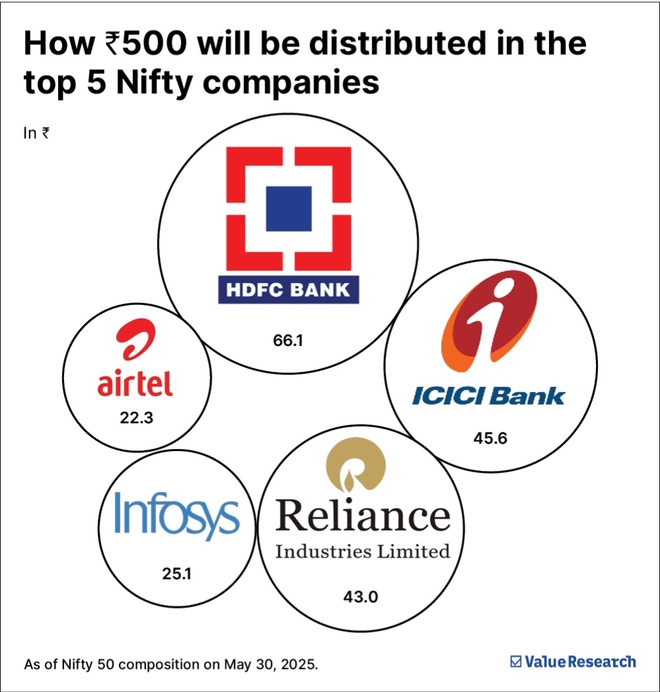
To give you a clearer picture, here's how your Rs 500 will be currently distributed among the top 5 companies in the Nifty 50:
Long-term growth potential
Investing Rs 500 each month might seem modest, but over time, the power of compounding can turn it into a significant sum. For instance, if you had started investing Rs 500 monthly in a Nifty 50 regular index fund 20 years ago and increased your investment by 10 per cent each year, your total contribution of Rs 3.4 lakh would have grown to Rs 9.83 lakh. By sticking to a regular SIP, your money would have steadily benefited from compounding and market gains, building wealth even through market fluctuations.
So, start investing with just Rs 500 today and own a piece of India’s top companies.
An investor education and awareness initiative of Nippon India Mutual Fund
Helpful Information for Mutual Fund Investors: All Mutual Fund investors have to go through a one-time KYC (know your Customer) process. Investors should deal only with registered mutual funds, to be verified on SEBI website under 'Intermediaries/Market Infrastructure Institutions'. For redressal of your complaints, you may please visit www.scores.gov.in. For more info on KYC, change in various details and redressal of complaints, visit mf.nipponindiaim.com/InvestorEducation/what-to-know-when-investing.
Mutual fund investments are subject to market risks, read all scheme related documents carefully.
Also read: How to get rich with less stress: The index fund way
This article was originally published on June 24, 2025.
Disclaimer: This content is for information only and should not be considered investment advice or a recommendation.
For grievances: [email protected]
Ask Value Research 
 New episodes every Friday









 New Process Alert
 Seems like you've uploaded a wrong QR code. Please upload the QR code downloaded from MF Central platform.


