 Widely read:



Diversification is investing’s most overused cliché and its most misunderstood principle. “Don’t put all your eggs in one basket” is repeated so often that it’s lost all meaning. Yet the core idea remains sound: markets are unpredictable, and prudent investors must prepare for multiple outcomes.
But how we diversify must evolve. For decades, mutual fund investors have followed a formulaic playbook—spreading capital across large-cap, mid-cap, small-cap, sectoral, and thematic funds. Add some international or passive funds, and you’ve ticked every conventional box.
Yet portfolios built this way often end up more concentrated than intended—thanks to hidden correlations, overlapping holdings and the false comfort of quantity. Welcome to the era of naive diversification.
Quantity ≠ quality
Investors often confuse more schemes with better diversification. However, holding 12–15 funds with similar benchmark stocks often leads to higher correlation and lower differentiation.
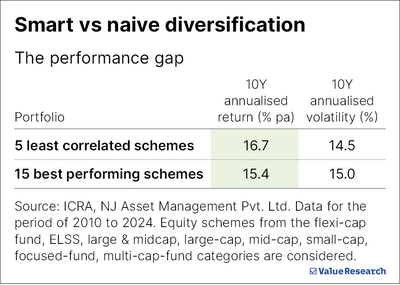
Consider the data. A portfolio of 15 best-performing mutual funds delivered a 10-year median return of 15.4 per cent. But a smaller, sharply constructed portfolio of just five least-correlated schemes delivered 16.7 per cent, highlighting the inefficiency of blind diversification.
The lesson: the illusion of diversity is costly. Smart diversification means selecting truly distinct funds.
Tools for smarter diversification
Investors serious about avoiding overlap must move from surface-level variety to structural differentiation. This means evaluating schemes through three underappreciated lenses:
- Correlation matrices: Understand how funds behave relative to each other during different market cycles.
- Portfolio overlap analysis: Identify how two or more schemes share common holdings with one another.
- Active share: Quantify how much a fund deviates from its benchmark. The higher, the better.
In this framework, smart diversification is not about owning more funds; it’s about owning non-redundant ones. And one of the most effective tools for that? Rule-based investing.
The strategy layer: Where smart diversification begins
While traditional diversification focuses on categories—large-cap, flexi-cap, etc., smart diversification adds a second layer: investment strategy.
Rule-based, factor-driven funds shine here. Unlike traditional active funds influenced by manager views and biases, rule-based funds follow set models. They select stocks based on proven factors like value, momentum, quality and low volatility—free of emotions and noise.
This strategy unlocks three critical advantages:
- Bias elimination: Removes the human tendency to chase performance, herd into familiar names, or overreact to short-term noise.
- Structural differentiation: Rule-based portfolios are often benchmark-agnostic, sector-agnostic and market-cap-agnostic, making them genuinely distinct from traditional funds.
- Alpha potential: By diversifying across uncorrelated factors, such funds can outperform benchmarks over the long term, even if they sometimes lag in momentum-driven rallies (think PSU banks or lending-heavy Nifty stocks).
Smart diversification in action
Let’s look at what smart diversification looks like in practice.
As of April 2025, most flexi-cap mutual funds, including the top 10 performers and the largest by assets under management (AUM), showed 25-36 per cent portfolio overlap with each other and the Nifty 500. These portfolios may differ in name but not in substance.
In contrast, NJ Flexi Cap Fund stands out with:
- Just 16 per cent overlap with the Nifty 500
- Only about 9 per cent overlap with flexi-cap peers
- An active share exceeding 80 per cent, a strong proxy for genuine differentiation
This is enabled by a 100 per cent rule-based active smart beta strategy focused on quality stocks and zero human bias. For investors tired of duplicating exposure while pretending to diversify, this is true strategic diversification.

Final thought
True diversification isn’t about scattering your chips. It’s about thinking differently. In an environment where most mutual funds converge on the same market darlings, standing apart is not just wise, it’s essential.
Rule-based funds, like those from NJ Mutual Fund, offer investors a way out of the redundancy trap. By focusing on uncorrelated factors, high active share, and process-driven rigour, they enable smart diversification that actually works.
After all, when everyone’s building portfolios in a similar fashion, the only real edge is doing it differently and doing it with discipline.
Nirmay Choksi is the Director and Head of Investment at NJ Asset Management Private Limited. The views expressed above are his own.
Also read: The importance of a financial plan
Ask Value Research 
 New episodes every Friday











 New Process Alert
 Seems like you've uploaded a wrong QR code. Please upload the QR code downloaded from MF Central platform.


