




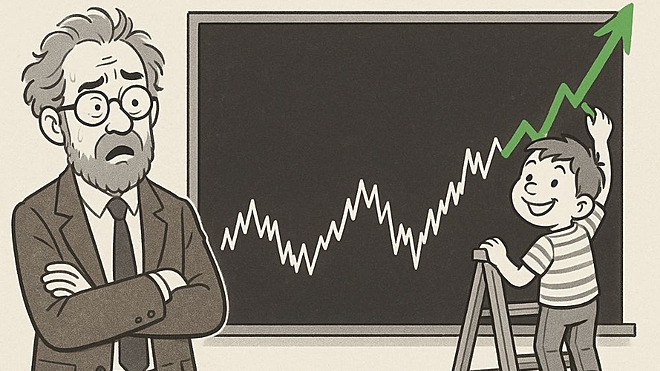
 Aditya Roy/AI-Generated Image

Few mornings in monetary history unfold like this one. In its third policy meeting under the new governor, the Reserve Bank of India defied the consensus call for a token 25-basis-point trim and swung its axe twice as hard – slashing the repo rate by 50 bps to 5.50 per cent and the CRR by a full percentage point, while flipping its stance to “neutral.”
With liquidity already flush and inflation docile, the move is being hailed as rocket fuel for capex pipelines and equity valuations; social-media feeds are aflutter with “virtuous-cycle” charts and back-slapping forecasts of an unstoppable boom. Yet history suggests that when policy surprises morph into perfectly choreographed stories, investors should reach for a pinch of salt. The column that follows steps back from today’s euphoria to ask a quieter question: how much of what now seems inevitable was truly visible yesterday, and how dangerous is it to invest as though tomorrow’s script is already written?
Suggested read: Value, boom, and bust
I recently came across an X post that perfectly illustrated an age-old truth about markets and human nature. The author enthusiastically declared that India's macroeconomic indicators are looking splendid – GDP growth exceeding estimates, inflation under control, currency stability, and room for rate cuts. The conclusion? We're entering a "virtuous cycle" of prosperity. It's a compelling narrative, and like most compelling narratives during good times, it suffers from a familiar problem.
"Success has many fathers, but failure is an orphan," as the old saying goes. And nowhere is this more evident than in the way we construct stories about economic cycles and market movements.
When economic indicators align favourably – as they apparently are now – the explanations flow like the early monsoon rain. Suddenly, everyone can connect the dots. Lower food prices lead to increased consumer spending, which boosts corporate margins, thereby strengthening the currency, creating room for monetary easing, and further stimulating growth. It's all so logical, so inevitable, so perfectly choreographed.
But here's what's curious: if these relationships were so clear and predictable, why wasn't everyone positioning for this virtuous cycle months or years ago? Why weren't all the economic forecasters unanimous in their predictions? The answer, of course, is that they weren't. Economic outcomes always appear more logical in hindsight than they do in real time.
Suggested read: Not just the day’s numbers
This phenomenon extends far beyond macroeconomic analysis. Every bull market produces its share of retroactive visionaries who can explain exactly why the rally was bound to happen. The same sectors that were ignored or dismissed suddenly become attractive investment themes. The stocks that doubled become the ones that "everyone saw coming."
Yet when these same economic indicators were mixed or negative, the explanations were equally compelling in the opposite direction. Rising food prices were clearly going to crush consumer demand. Currency weakness was obviously going to fuel inflation. High interest rates were inevitably going to slow growth. Each narrative seemed just as logical when it was being constructed.
The danger for individual investors lies not in the narratives themselves but in believing them too completely. When we read about virtuous cycles and positive momentum, it's tempting to assume that the good times will continue indefinitely. When we hear about economic headwinds and challenging conditions, it's equally tempting to assume that difficulties will persist.
Both assumptions can lead to poor investment decisions. During apparent virtuous cycles, investors often become overconfident, taking on more risk than they can handle and paying prices that assume perfection will continue. During challenging times, they become overly cautious, missing opportunities when conditions eventually improve.
The reality is that economic cycles are far more complex and unpredictable than any narrative suggests. The same factors that create virtuous cycles can just as easily reverse and create vicious ones. Lower crude prices boost margins today, but they can also signal weakening global demand. Controlled inflation provides room for rate cuts, but it also indicates slowing economic activity.
Suggested read: The cycle inside your head
This doesn't mean we should ignore economic indicators or dismiss positive developments. GDP growth, controlled inflation, and currency stability are indeed positive developments. But we should resist the temptation to extrapolate these trends indefinitely or to assume that current conditions have eliminated future risks.
For practical investors, the lesson is to maintain perspective during both good times and bad. When you hear about virtuous cycles and positive momentum, certainly take note, but remember that cycles have a habit of cycling. When you hear about economic challenges and market difficulties, remember that these conditions also change over time.
More importantly, base your investment decisions on your own financial goals and risk tolerance rather than on prevailing economic narratives. Whether we're in a virtuous cycle or facing headwinds, the fundamental principles of investing remain the same: diversify your risks, invest only what you understand, maintain a long-term perspective, and avoid making dramatic changes based on short-term conditions.
Market commentators will always have compelling explanations for whatever is happening right now – and that often includes me. Success will always have many fathers eager to claim credit for their foresight. But the smartest investors are those who recognise that today's virtuous cycle might be tomorrow's cautionary tale and plan accordingly.
Also read: Keep calm and invest on
Ask Value Research 

 New episodes every Friday





 New Process Alert
  Seems like you've uploaded a wrong QR code. Please upload the QR code downloaded from MF Central platform.


