




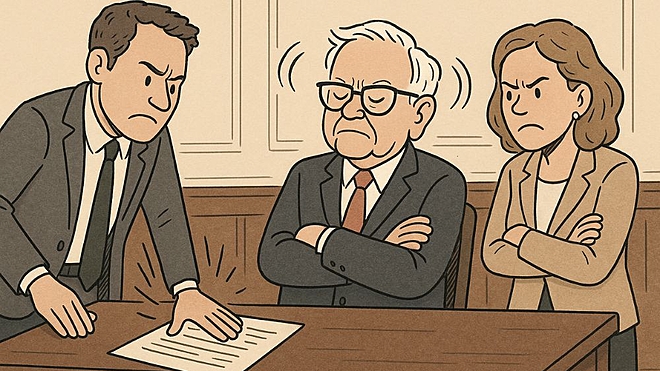
 AI-generated image
Beyond the Q&A spotlight on Buffett, the formal afternoon meeting provides a platform for shareholders to voice their specific concerns and priorities through proposals. This segment represents a direct, albeit structured, engagement between the company's owners and its management, often highlighting areas where external expectations diverge from current company practice. Shareholders had various avenues to cast their votes on these matters - via internet, telephone, mail, or by attending and voting in person. The full details of each proposal are laid out in the 2025 proxy statement, readily available on Berkshire's website.
This year, seven distinct shareholder proposals made it onto the ballot, reflecting a range of contemporary corporate governance concerns. They touch upon environmental accountability, executive compensation, diversity and inclusion practices, and the burgeoning risks associated with artificial intelligence.
Here's a summary of the proposals shareholders are considering:
| Proposal Topic | Proposer | Berkshire's Recommendation & Rationale (Brief) |
|---|---|---|
| Disclose Berkshire Hathaway Energy's environmental costs exceeding regulations | National Legal and Policy Center | AGAINST: Already provides detailed environmental reports |
| Disclose pay ratio for highest named executive officer | Jing Zhao | AGAINST: Does not believe disclosure would improve executive compensation program |
| Evaluate civil rights practices' impact on employees | American Conservative Values ETF (ACVF) | AGAINST: Denies promoting divisive concepts; emphasizes compliance with the law |
| Audit legal/reputational risks from subsidiaries' race-based initiatives | National Center for Public Policy Research | AGAINST: Each business develops programs legally and appropriately for its specific circumstances |
| Create board committee for diversity and inclusion strategy | Meredith Benton, Whistle Stop Capital, Myra K. Young | AGAINST: Audit committee already oversees relevant risks; decentralized approach preferred |
| Disclose clean energy financing ratio | As You Sow Foundation | AGAINST: Not a bank; metric not widely used or appropriate; BHE already invests heavily |
| Create committee for AI risks | Tulipshare Capital | AGAINST: Subsidiaries already manage operational risks, including those related to technology like AI |
| Source: Summarized from Berkshire Hathaway 2025 Proxy Statement details | ||
Berkshire Hathaway's board, however, presents a united front in opposition. Their recommendation is a clear and consistent "NO" vote on every single one of the seven proposals. The rationale provided generally follows familiar themes: the proposals are deemed unnecessary because the issues are already addressed through existing reporting or governance structures, they wouldn't provide meaningful benefit, or they attempt to apply metrics or structures ill-suited to Berkshire's unique, decentralized operating model. For instance, the call for a clean energy financing ratio is dismissed partly on the grounds that Berkshire is not a bank, while concerns about subsidiary-level diversity initiatives or AI risks are countered by emphasizing the autonomy of individual business units to manage such matters legally and appropriately.
Taken together, these proposals paint a picture of evolving shareholder priorities, with a clear emphasis on Environmental, Social, and Governance (ESG) factors. Proponents are pushing for greater transparency on environmental impacts (NLPC, As You Sow), fair treatment and diversity (ACVF, NCPPR, Benton/Young/Whistle Stop), and executive pay equity (Zhao). The inclusion of a proposal specifically targeting Artificial Intelligence risks (Tulipshare ) is particularly noteworthy. It signals that investors are increasingly demanding board-level attention to the potential ethical, operational, and societal risks posed by cutting-edge technologies, even within a conglomerate known more for its traditional industrial and insurance roots. This suggests a broadening definition of corporate responsibility and necessary risk oversight in the eyes of activist shareholders.
Berkshire's blanket opposition underscores a fundamental philosophical difference. The proposals largely advocate for more centralized oversight, standardized reporting, and formal board structures dedicated to these emerging areas. Berkshire, in contrast, steadfastly defends its long-held decentralized model, built on trusting subsidiary managers to handle operational risks and social responsibilities within their specific business contexts. The annual vote on shareholder proposals thus becomes a recurring referendum on these competing visions of effective corporate governance - the push for modern, standardized frameworks versus the adherence to a proven, albeit more traditional and trust-based, system.
Also read: It's a long way to Omaha: How politics disrupts a pilgrimage
This article was originally published on May 03, 2025.
Ask Value Research 
 New episodes every Friday











 New Process Alert
  Seems like you've uploaded a wrong QR code. Please upload the QR code downloaded from MF Central platform.


