 Widely read:


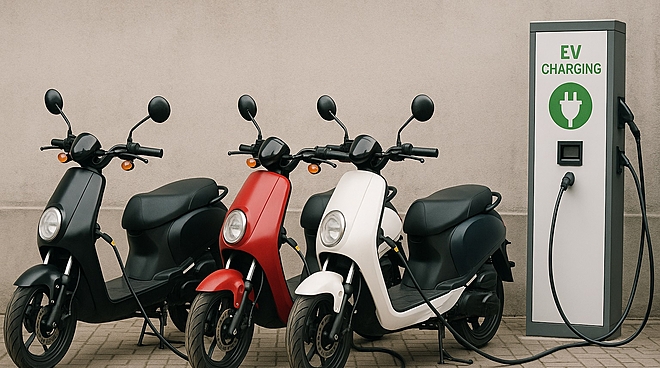 AI-generated image
Ather Energy IPO (initial public offering) will open for subscription on April 28, 2025, and close on April 30, 2025. Below is a breakdown of the electric two-wheeler maker's strengths, weaknesses and growth prospects to help investors make an informed decision.
Ather Energy IPO in a nutshell
-
Quality:
Between FY22 and FY24, Ather Energy reported an average
return on equity (ROE) and return on capital employed (ROCE)
of around -181 and -71 per cent, respectively.
-
Growth:
Between FY22 and FY24, its revenue grew 107 per cent and net losses widened 76 per cent annually, respectively.
-
Valuation:
At the upper price band of Rs 321, the stock is expected to be valued at a
P/B
ratio of 4.4 times. The
P/E
ratio can't be calculated since the company is loss-making.
- Overview: India is the world's largest two-wheeler market by volume. Of this, the electric two-wheeler (E2W) segment is projected to clock a healthy 41 per cent annual growth with EV penetration expected to reach 35 per cent of two-wheeler industry sales by FY31. These tailwinds support the outlook for Ather Energy. However, the intense competition in the industry and the growing market share of incumbents remain key risks.
About Ather Energy
The company is India's third-largest electric two-wheeler player by volume (as of FY24). It also supplies EV charging infrastructure and smart accessories. The company manufactures battery packs in-house, while portable chargers, motors, etc., are outsourced to suppliers for manufacturing.
The company has a total annual installed capacity of 4.2 lakh units, which currently operates at 39 per cent capacity utilisation. Apart from vehicle sales, Ather earns a small 6 per cent chunk of revenue from its Atherstack software for ride-assist features to customers.
Strengths of Ather Energy
- Dominant market position: Despite the entry of incumbents in the E2W space, Ather Energy has managed to steadily increase its market share from 7.9 per cent in FY22 to 11.5 per cent in FY24. This suggests a strong market presence and brand recognition.
Weaknesses of Ather Energy
-
Geographic concentration:
As of FY24, almost 68 per cent of the company's sales volume were concentrated in South India. This reliance on one particular region exposes it to risks such as economic disruptions, political or social unrest, or changes in state-specific policies that could impact its financials.
- Expensive pricing: Ather's pricing is relatively higher than competitors' due to a few hi-tech features like smart helmet integration and inter-city trip planners. Its starting price point is Rs 1.1 lakh compared to Ola Electric's Rs 80,000. Such a price differential could impact sales in a market that's highly competitive. Ather's sales from April to December 2024, for instance, was 1 lakh compared to Ola's 3 lakh units.
Ather Energy IPO details
| Total IPO size (Rs cr) | 2981 |
| Offer for sale (Rs cr) | 355 |
| Fresh issue (Rs cr) | 2626 |
| Price band (Rs) | 304 - 321 |
| Subscription dates | April 28-30, 2025 |
| Purpose of issue | To fund capital expenditure, research & development and marketing initiatives |
Post-IPO
| M-cap (Rs cr) | 11,956 |
| Net worth (Rs cr) | 2,734 |
| Promoter holding (%) | 42.1 |
| Price-to-earnings ratio (P/E) | - |
| Price-to-book ratio (P/B) | 4.4 |
Financial history
| Key financials (Rs cr) | 2Y annual growth (%) | TTM December '24 | FY24 | FY23 | FY22 |
|---|---|---|---|---|---|
| Revenue | 107.1 | 2102 | 1754 | 1781 | 409 |
| EBIT | 64.3 | -811 | -831 | -820 | -308 |
| PAT | 75.5 | -861 | -1060 | -865 | -344 |
| Net worth | 55.8 | 108 | 546 | 614 | 225 |
| Total debt | 14.4 | 1285 | 478 | 672 | 365 |
|
EBIT is earnings before interest and taxes (excluding other income)
PAT is profit after tax TTM is for 12 months ending December 2024 |
|||||
Key ratios
| Ratios | 3Y average | TTM December '24 | FY24 | FY23 | FY22 |
|---|---|---|---|---|---|
| ROE (%) | -180.6 | -797.2 | -182.8 | -206.2 | -153.0 |
| ROCE (%) | -70.6 | -58.2 | -72.0 | -87.5 | -52.3 |
| EBIT margin (%) | -62.9 | -38.9 | -67.3 | -46.1 | -75.4 |
| Debt-to-equity | 1.2 | 11.9 | 0.9 | 1.1 | 1.6 |
|
ROE is return on equity ROCE is return on capital employed |
|||||
Risk report
Company and business
-
Did Ather Energy report earnings before tax of Rs 50 crore or more in the last 12 months?
No. The company reported losses (before tax) of Rs 861 crore for 12 months ending December 2024. -
Will the company be able to scale up its business?
Yes. The Indian electric two-wheeler market is expected to grow at a handsome 41 per cent annually till FY31, indicating a favourable market environment that could support the company's growth. -
Does the company have recognisable brands with client stickiness?
Yes. Ather Energy is India's third-largest electric two-wheeler maker by market share, suggesting a strong market presence and brand recognition. -
Does the company have a credible moat?
No. The Indian electric two-wheeler market is highly competitive with many established players vying for market share.
Management
-
Do any of the company's founders still hold at least a 5 per cent stake? Or do promoters hold over a 25 per cent stake in the company?
Yes. After the IPO, the promoters will have a 42 per cent stake in the company. -
Do the top three managers have over 15 years of combined leadership at Ather Energy?
Yes. CEO Tarun Mehta and CTO Swapnil Jain have been with the company since its incorporation in 2013. -
Is the management trustworthy? Is it transparent in its disclosures, which are consistent with SEBI guidelines?
Yes. There is no information to suggest otherwise. -
Is the company's accounting policy stable?
Yes. There is no information to suggest otherwise. -
Is Ather Energy free of promoter pledging of its shares?
No. The promoters have pledged 2.07 per cent of the total share capital.
Financials
-
Did Ather Energy generate a current and three-year average return on equity of more than 15 per cent and a return on capital employed of more than 18 per cent?
No. It has a three-year average ROE and ROCE of around -181 and -71 per cent, respectively. In FY24, it reported an ROE and ROCE of -183 and -72 per cent, respectively. -
Was the company's operating cash flow positive during the last three years?
No. It reported negative cash flow from operations during the last three years. -
Is the company's net debt-to-equity ratio less than one?
No. As of December 2024, the company's net debt-to-equity ratio was a steep 8.7 times. -
Is the company free from reliance on huge working capital for day-to-day affairs?
No. It operates in a capital-intensive industry and has a history of raising short-term debt frequently to meet its working capital requirements. -
Can the company run its business without relying on external funding in the next three years?
No. Ather Energy is loss-making and has negative cash flows. It appears incapable of operating without needing external funding for the next three years. -
Is the company free from meaningful contingent liabilities?
Yes. The company's contingent liabilities were 2 per cent of its net worth as of Q3 FY25.
Valuations
-
Does the stock offer an operating earnings yield of more than 8 per cent on its enterprise value?
No. The stock offers a negative operating earnings yield of 6 per cent on its enterprise value. -
Is the stock's price-to-earnings less than its peers' median level?
The stock's P/E ratio can't be calculated due to its losses. However, listed peers trade at a median P/E of 33 times. -
Is the stock's price-to-book value less than its peers' average level?
Yes. The stock is valued at a P/B ratio of 4.4 times compared to its peers' average level of 7.6 times.
Before you leave
Assessing an IPO requires a careful evaluation of a company's strengths, weaknesses, and growth potential, just like we've outlined for Ather Energy. But wealth creation can only be achieved through a well-researched, balanced stock portfolio.
Our Value Research Stock Advisor can help with that. What do you get? Meticulously researched stock recommendations and ready-to-invest portfolios, updated every month. Subscribe to Value Research Stock Advisor today and take charge of your financial future.
Disclaimer: This story is not a stock recommendation. Investors should do their due diligence before investing.
Also watch: Should you invest in IPOs?
Disclaimer: This content is for information only and should not be considered investment advice or a recommendation.
For grievances: [email protected]
Ask Value Research 
 New episodes every Friday













 New Process Alert
 Seems like you've uploaded a wrong QR code. Please upload the QR code downloaded from MF Central platform.


