




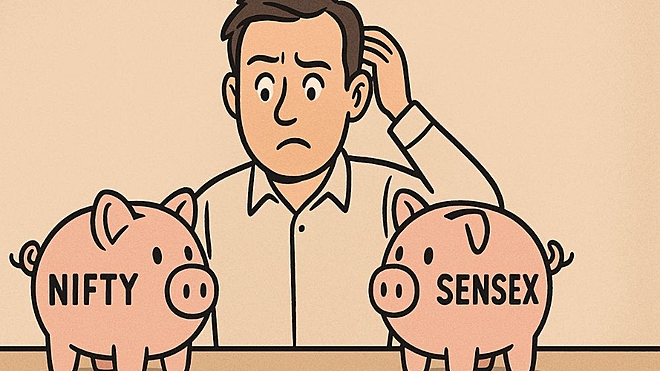
 AI-generated image
Index funds are no longer niche. They're mainstream — and for good reason. They're simple, low-cost and deliver what most investors need: reliable long-term exposure to the Indian stock market.
And when it comes to index investing, the two names that dominate the conversation are funds investing in either Nifty 50 or the Sensex, which are the two most popular benchmarks in the country.
That brings us to the natural next question: Are Nifty index funds better than the Sensex index funds?
Let's settle this debate with data.
Why Nifty and Sensex rule the roost
If you're investing in an index fund in India, chances are it's tracking either the Nifty 50 or the Sensex. In fact, the two account for a whopping 73 per cent of all money invested in equity index funds and ETFs. Which means these two types of index funds have over a lick over 6 lakh crore invested in them.
That's no accident.
These indices represent the biggest and most widely traded companies in India. They get round-the-clock media coverage. They offer high liquidity. And they span key sectors — financials, IT, energy, FMCG. For most investors, they tick all the boxes.
The difference between the two
For starters, the names are different.
Two, the Sensex tracks 30 stocks listed on the BSE. The Nifty 50 tracks 50 stocks listed on the NSE.
But here's the twist: almost all Sensex stocks are also in the Nifty. The overlap, as of March 31, 2025? A massive 85 per cent.
In short, the Nifty and the Sensex are 85 per cent similar.
The additional 20 stocks in the Nifty tend to be smaller, and their impact on the overall index is limited. Which means: from a portfolio perspective, the difference is marginal at best.
What about performance?
Here's where it gets even clearer. The difference in median return between the Nifty and Sensex over any five-year period in the last decade is just 0.12 per cent.
Yes, you read that right — not 12 per cent, just 0.12.
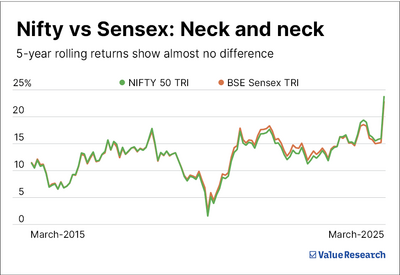
There are months when the Sensex edges ahead. Other times, the Nifty takes the lead. But in the long run, the two move in almost perfect sync.
Their five-year rolling returns, which is a better indicator of long-term consistency, are also virtually identical.
So, which one should you pick?
Here's the honest answer: It doesn't matter.
Don't waste time debating between Nifty and Sensex index funds. Since they are 85 per cent similar and have a return gap of just 0.12 per cent, the difference is academic.
What truly matters is that you start investing, stay consistent and keep costs low to build long-term wealth creation.
This article was originally published on April 15, 2025.
Ask Value Research 












 New Process Alert
  Seems like you've uploaded a wrong QR code. Please upload the QR code downloaded from MF Central platform.


