




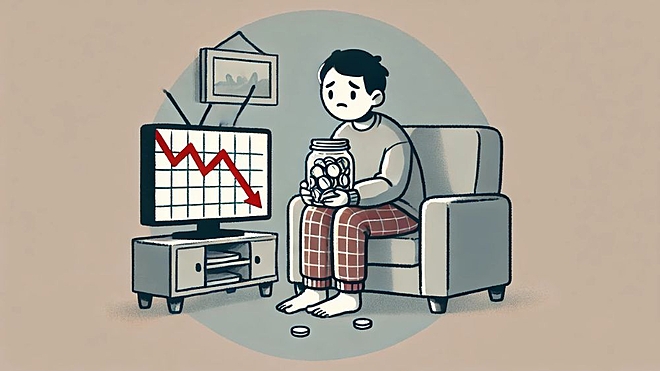
 AI-generated image

We often receive panicked queries from investors who see their portfolios in the red and wonder if they should cut their losses. Recently, an investor wrote to us: "I started investing in December and I am already down by Rs 70,000. Should I exit all my equity investments?"
If you are in the same boat, take a deep breath. What you are experiencing is completely normal. Short-term volatility is part and parcel of equity investing, but exiting now could be the worst mistake you make.
Investing a lump sum at the wrong time? This is why SIP works better
From what we gather, the investor probably invested a lump sum in December. When you invest a large sum all at once, your returns are entirely dependent on that particular entry point. If markets fall soon after, your portfolio takes an immediate hit.
Now, consider another approach. Suppose instead of investing a lump sum, the investor had opted for a monthly SIP (systematic investment plan) of Rs 1 lakh over a period of 12 months, totalling Rs 12 lakh. In this scenario, by now, they would have only invested Rs 3-4 lakh (Rs 1 lakh per month), meaning the market downturn would have impacted only this portion of their investment - not the entire amount.
Suggested read: SIP vs lumpsum: There's one clear winner!
This strategy, known as rupee cost averaging , helps in two ways:
-
Reduces risk from poor timing:
Instead of investing all at once at a high market level, the investor buys at different price points, averaging out the cost over time.
- Controls anxiety during market downturns: Since only a fraction of the total investment is exposed in the initial months, losses remain contained. The investor is not staring at a massive decline on a large corpus, making it easier to stay invested.
By continuing the SIP, the investor automatically buys more when markets are lower, setting themselves up for stronger gains when the market eventually recovers. This approach ensures that short-term volatility does not derail the investment plan.
Equities are meant for the long term, not for months
A loss in just three months may feel alarming, but it shouldn't be. Equities are not meant for short-term investing. Markets can be highly volatile over brief periods, but history shows that staying invested for the long haul significantly reduces the risk of losses.
Let's look at past data from flexi-cap funds :
Historical probability of losses in flexi-cap funds
| Holding period | % of times negative returns (Flexi-cap funds) |
|---|---|
| 3 months | 34.4 |
| 1 year | 22.7 |
| 3 years | 2.8 |
| 5 years | 0.5 |
| The above data represents the category average of flexi-cap funds (regular plans), calculated using daily rolling returns over the last decade. | |
As the numbers indicate, the probability of making a loss shrinks dramatically with time. While one in three investors may experience losses over a three-month period, the chance of losses over five years is nearly zero.
This underscores a key investing principle: the longer you stay invested, the higher your chances of earning positive returns. Markets may fluctuate in the short term, but they have historically rewarded patience over time.
Markets fall, but they also recover
History has shown that market downturns are temporary, but recoveries are permanent. Despite sharp corrections in the past, the equities have always bounced back, rewarding investors who stayed invested.
-
March 2020 (Covid crash):
The Sensex plunged by 23 per cent in just a month, causing panic among investors. However, by the end of 2020, it had fully recovered and returned over 20 per cent in the following year.
- 2008 Global Financial Crisis: The Sensex crashed by over 50 per cent, wiping out years of gains. Yet, within two years, it had regained all its losses.
If you exit now, you make your losses permanent
Right now, your loss is only on paper. The moment you sell, you convert it into a real loss, one that cannot be recovered. But if you stay invested, you give your investments time to bounce back.
If your money was meant for a long-term goal, exiting now means you are letting short-term market noise dictate your investment decisions - which is a costly mistake.
What should you do?
-
If you need this money in the next few months or a year, equity is not the right place.
- If your investment horizon is five years or more, stay invested. Markets go through cycles, and downturns are temporary. Your best bet is to remain patient.
Also read: How to sleep easy during this volatile market
This article was originally published on March 17, 2025.
Ask Value Research 

 New episodes every Friday











 New Process Alert
  Seems like you've uploaded a wrong QR code. Please upload the QR code downloaded from MF Central platform.


