




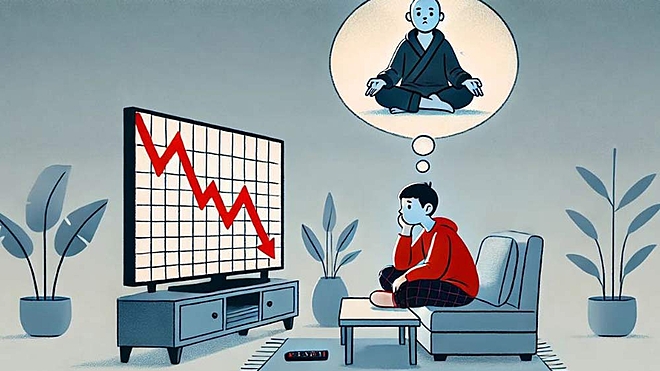
 AI-generated image

Each time markets correct, we see investors get into a review, questioning and introspection mode. This is accompanied by common refrains and questions expressed in multiple ways, but the underlying essence doesn't change.
- Am I in the right funds? Should I get out of what I hold? Retrace back to the fork in the road where there were other choices I didn't take?
- Should I buy gold?
- Will the market fall further? Where is the bottom? Should I sell everything and buy it back when it is lower?
- Should I stop my SIPs while the market is on the way down and invest at the bottom?
- I will grit my teeth and stay put, but I am out of here when this gets back to par.
- OMG, my Rs 100 has become Rs 60. That's 40 per cent on the way down, but for me to get whole, I need 66 per cent on the way up! There is no chance that that will happen!
Humans make most decisions based on emotions and then figure out the data to back those decisions to convince themselves more than anyone else that they are rational and logical. We are emotional and psychological, but we like to see and present ourselves as cold, calculative, left-brained, intelligent, objective and practical, worldly wise 'econs'. These are mind games we play with ourselves. I have another way that might help invoke the right response, which will almost always be better served if contrarian. The 'Others' in Be Greedy When Others Are Fearful and Be Fearful When Others Are Greedy are the ones who fail to break away from the herd and involve the right emotion in a situation.
I believe our response or reaction to a situation depends on how we visualise it. Portfolio values presented in numbers, returns tables, charts, graphs and account statements are not the best form of visualisation; hence, they evoke the worst reaction or response. What is the correct visualisation?
Markets as a pendulum
The thing about pendulums is that if you observe one swinging to the left and you think it will swing back, it surprises you by swinging further to the left. The further it swings to the left, you can be sure that it will swing to the right. Then, the same story of expectation and surprise will play out again. Having stopped on the right extreme, it is bound to return to the centre, but when it reaches the centre, it won't stop. It will swing to the left extreme. Similarly, markets are cyclical too. Whenever the market rewards you with much more than what you initially thought, but later attributed to your exemplary skills, the market will take it back. Ultimately, you will get an average return if you stay invested. If you are not part of 'others', i.e. you show exemplary courage by investing in the left extreme, you will get much above average returns provided you are not part of 'others' when the pendulum swings to the right extreme. i.e., you show exemplary foresight by taking some money off the table and rebalancing your asset allocation. Why not take all the money off the table at the right extreme? Because the pendulum is physics, markets are not. Markets rhyme but don't replicate the same movement. At the right extreme, 'others' cause it to swing further right; at the left extreme, 'others' make you believe it will never return. You will never be able to be fully out at the right extreme and fully in at the left extreme. So, always keep a core allocation there and keep rebalancing the excess out as you move towards the right extreme. This will also ensure you have something in your pocket to re-enter as it swings left.
Markets as a car wiper
Want to buy gold now? Unfortunately, when it is time to buy gold, everyone is sure equity will take them to the moon. When equities disappoint, everyone wants to buy gold.
I have been telling investors not to behave like windscreen wipers - maybe Mumbai's heavy rainfall and stock markets being centred there have interfered with our investing DNA. While the downpour wets the whole windscreen, the wipers oscillate left to right and back in their own kind of quarter-circular cyclical path. But what's obvious is there's never a moment where the screen is wiped dry with the vision for the driver being completely clear. When the wiper is at one end of its trajectory, the water wets the other end, and by the time the wiper comes back at that end, the former end will be wet again. Water keeps pouring, and the wipers keep moving tirelessly from one end to the other.
Markets and spring action
The most common arithmetic that psyches investors in down-trending markets is that if a Rs 100 investment becomes Rs 60, it's 40 per cent on the way down, but for Rs 60 to become Rs 100, it needs to recoup by 66 per cent. I always ask people to visualise a spring. If you compress a 10 centimetre spring by 50 per cent, it will become 5 centimetre. If you release it, how much will it recoil? When a spring is compressed, it is valuable because it stores more energy. When stock prices fall, and market capitalisation gets compressed, more earnings are stored per unit of NAV or stock prices for diversified portfolios and companies with good earnings profiles and cash flows. As long as companies haven't lost their earnings power and long-term sustainability, the spring will recoil; do not get caught up with percentages. Of course, this doesn't apply to every individual company, but it works well with portfolios.
Markets and elevators
In cities like Mumbai, Gurgaon, Pune, etc., we often visit offices in skyscrapers; some live or work in them. Nowadays, there is a queue just to get into the elevator, especially in commercial towers. It has happened to all of us. Often, when your turn comes, you enter the elevator and realise it's headed down. You say, "Never mind, eventually it will head up." Imagine when the elevator heads down to the basement parking, it hits B4, and there is a power outage. You are stuck in darkness for 3-4 minutes with little air to breathe. The worst thoughts come to your mind, you are scared! After what felt like an hour, the elevator comes back to life and resumes its journey on the up and reaches the ground floor.
Now a question: how many of us will rush out of the elevator when it hits the ground floor and how many will keep standing thinking we have to go to the 40th floor? Usually, one has a tendency to complain when NAVs go down or even stop investing when NAVs go down, and a huge temptation to take money off the table the moment the elevator comes to ground level and is just about to commence a new uptrend.
These pitfalls are avoidable. Correct visualisation will help you respond to market conditions and avoid being part of the 'others'.
Aashish P Somaiyaa spearheads WhiteOak Capital Asset Management Limited as their CEO.
Ask Value Research 

 New episodes every Friday










 New Process Alert
  Seems like you've uploaded a wrong QR code. Please upload the QR code downloaded from MF Central platform.


