




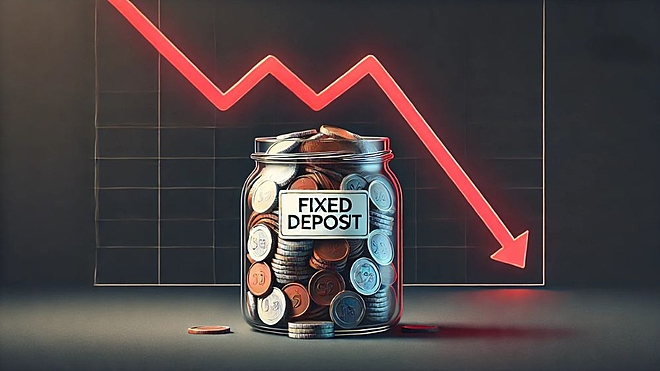

With the Reserve Bank of India (RBI) cutting the repo rate from 6.5 per cent to 6.25 per cent , fixed deposit (FD) rates are likely to decline. Since the repo rate—at which RBI lends to commercial banks—determines lending and deposit rates, banks may lower interest rates on new FDs.
In this context, the key question for those contemplating putting money in FDs is whether to lock in current rates before they dip further or explore better alternatives.
Key considerations in FDs
Fixed deposits offer guaranteed returns and capital protection, making them a preferred choice for risk-averse investors. However, before committing money, consider:
-
Penalty on premature withdrawals
: If you withdraw before maturity, banks typically impose a penalty of 0.5 per cent to 1 per cent. Additionally, interest may be recalculated based on the actual holding period. For instance, an FD booked for five years at 7 per cent but withdrawn after two years may earn only the two-year FD rate (say, 6 per cent) minus the penalty.
- Taxation : FD interest is added to your taxable income and taxed annually as per your slab.
Currently, FD rates across leading banks range between 6.5 per cent and 7.4 per cent for tenures of one to five years. Small finance banks offer up to 9 per cent, though with slightly higher risk.
What are the alternatives?
Debt funds, particularly short-duration funds and target-maturity funds (TMFs), provide viable alternatives to FDs.
Short-duration funds invest in bonds with maturities of one to three years. Target-maturity funds invest in bonds with a defined maturity date and hold them until maturity, making their returns relatively predictable.
Debt funds offer the below advantages:
-
Tax deferral advantage
: Like FDs, debt funds are taxed as per your income slab. However, taxation on debt funds is deferred until redemption, allowing potential compounding benefits and improving post-tax returns.
- No premature exit penalty : Unlike FDs, debt funds offer liquidity. You can withdraw money anytime without a penalty for early withdrawal.
Historically, short-duration debt funds have outperformed FD rates in nearly 70 to 80 per cent of cases over one- to three-year periods, based on rolling return analysis over the last five years.
Short-duration funds vs Fixed deposits (FDs)
| Investment period | Percentage times outperformed FDs | Outperformance of 0.01-1% | Outperformance of 1-2% | Outperformance over 2% |
|---|---|---|---|---|
| 1 year | 70.90% | 30.60% | 23.60% | 16.70% |
| 2 years | 77.90% | 47.20% | 27.00% | 3.80% |
| 3 years | 72.40% | 55.20% | 17.20% | 0.00% |
| Based on daily rolling returns of average short-duration fund against the SBI FD rates, over the last five years. | ||||
The yield to maturity (YTM) of target-maturity funds—the estimated annual return if held until maturity—currently ranges between 6.9 to 7.1 per cent, making them competitive against fixed deposits.
Risk factors to consider with debt funds
Before opting for debt funds, be aware of potential risks:
-
Interest rate risk:
When interest rates rise, bond prices fall, negatively impacting the existing debt funds.
However, shorter-duration funds experience less impact than long-term ones.
- Credit risk: Some funds invest in lower-rated bonds, which carry default risk. Higher-rated bonds (AAA or AA) are safer but may yield slightly lower returns.
Our take
- If you prioritise capital safety and guaranteed returns, locking in a long-term FD at current rates before they drop further is your best option, especially if you don't anticipate needing the funds before maturity.
- If you seek a combination of flexibility, potential for higher returns and tax efficiency, debt funds (particularly short-duration funds for liquidity and target-maturity funds for predictable returns) offer advantages over FDs despite their slightly higher risk profile.
Also read: How to go from Rs 1 cr to Rs 5 cr in 14 years, with zero SIP
This article was originally published on March 03, 2025.
Ask Value Research 

 New episodes every Friday







 New Process Alert
  Seems like you've uploaded a wrong QR code. Please upload the QR code downloaded from MF Central platform.


