




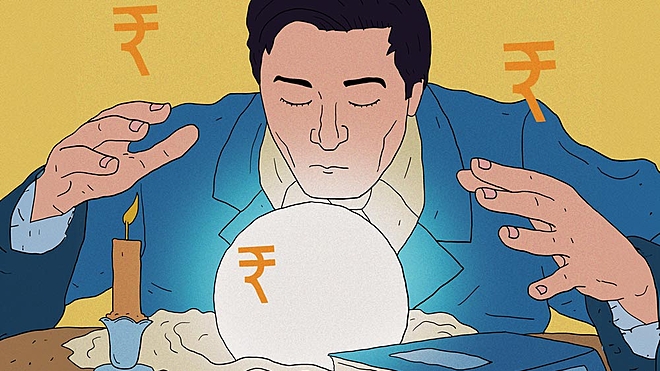

By now, we all know that macroeconomics and, more so, market reaction to changes in macroeconomic conditions is uncertain and unpredictable. Human beings don't function too well amidst uncertainty, so market participants spend a lot of time making predictions to endear themselves. In fact, some brands are built on making predictions.
Something I once read said that the art of making predictions is to make many of them frequently and at regular intervals, too. Even a broken clock is correct at least twice a day, if not more. So, occasionally, a prediction will come right, and that's the one that one should amplify, shout and scream about from rooftops in different forms of "I told you so" expressions while others get forgotten and lost in the noise.
The fact that so many people are making predictions makes the job of every predictor easier because no one needs to do much to keep erasing public memory of failed predictions as they get lost in the Teflon-coated resilience, the unscathed hubris of myriad predictors and platforms on which they predicted. The other smart way is to act like you are making it by merely catching a trend which already started to play out. Still, you say it loudly, agonisingly and make it so personal and soul-stirring for the audience you point it out to everyone and his uncle, so what if you are late and it's not going to help anyone's cause? At least you are right; you ostensibly had their best interest at heart!
The other favourite I have discussed in the past is giving perfect explanations after events have happened. It sounds intelligent and insightful and even makes listeners believe that they have understood the past very well and will be able to preempt better in the future instead of being surprised. But the correct lesson to learn from surprises is the world and economic phenomena and, more importantly, markets are, well, surprising. The learning is not we should use past surprises as a guide to forecasting or hypothesising the future and planning our actions before the next 'surprise', but that we should use past surprises as an admission that we have no idea what might happen next.
We must worry about being effective and relevant rather than right or wrong. One of my five-year-old son's many tough questions was, "Papa, what is whiter than white?" As I fumbled to cobble up a "nothing" but harmless response, he followed it up with, "Papa, what is blacker than black?". The quest for seeking certainty and absolutes is not just a penchant for my five-year-old son. It applies to everyone. In fact, kids are willing to learn and be more open-minded than us, but for grownups, the search for absolutes, for something certain and for the whitest of whites and blackest of blacks is never-ending.
We love fund managers whose portfolios go up even when markets fall or just about make do with fund managers whose portfolios at least don't fall when markets fall. We would love it if the 14 per cent CAGR of Sensex TRI since liberalisation in 1991-92 showed up as 14, 14, 14, instead of a weird sequence of big positives followed by some small or not-so-small negatives. We love to have managers who predict markets will fall and sell your equities NOW; we love managers who have 50 per cent of their portfolio in cash waiting for the next crash; at least the guy is doing 'something' to save us!
Let me tell you, for every manager who saw the market go down after they took 50 per cent of the portfolio into cash, there is at least one other manager who saw the market going up inexorably for another three years. For every maximising manager who showed up number one on the alpha charts, there is another whom Mr Market has minimised to the bottom of the alpha charts. You don't need managers who maximise alpha and maximise returns only to be wrestled back and minimised by Mr Market. You need managers and strategies that will optimise for you and negotiate with Mr Market to stay in the game consistently. You need managers who are always in the game, not scoring hat-tricks in one match and irrelevant in the next. You need managers who are always in the top two quartiles or top of the third quartile at worst; you don't need managers who are "kabhi jannat, kabhi jahannum" or, as one of my friends on X recently quipped, "arsh pe ya farsh pe". You need wealth managers who help you stay in play and advise you on how to balance and re-balance your portfolios in the face of extreme situations; you don't need wealth managers who make extreme predictions about getting in or getting out of market cap buckets or sectors or asset classes.
There is no use of predictions; they are no guide to accuracy; the world is not all physics as there is nothing called certainty or maximising and the better you optimise and prepare for uncertainty, the better you will do in life and portfolio management. The sooner you accept there are only shades of grey and stop looking for the whitest or blackest of extremes, the more you will move ahead. If there is anything I wish my son would pick up as early as possible in life, it is that there is no whiter than white, and there is no blacker than black, the world is just a spectrum of grey, and we need to negotiate our affairs accordingly. But I also hope he is human, after all! This is why asset allocation is essential; betting too much on any one security, fund or asset class is not suitable and diversification is key to sustainable investing. This is why lump sum investing is inadvisable, and the mutual fund industry recommends systematic investing to spread the investment at all levels. Timing the markets is impossible, and an investment manager saying that upsets many investors.
Let me clarify: I said timing is impossible, not unimportant. Timing is important, so the next best thing is not to predict the timing of entry or exit; the next best thing is to accept that it is IMPOSSIBLE AND spread the money over time to optimise OUTCOMES. The quest for maximising results in the subject opportunity turning around and minimising us, so best is to ab initio build a plan around optimising. There is a reason why I call 'SIP' a 'Stay in Play' and 'asset allocation' a mix of asset classes; it's called chemistry.
Aashish P Somaiyaa spearheads WhiteOak Capital Asset Management Limited as their CEO.
Ask Value Research 

 New episodes every Friday











 New Process Alert
  Seems like you've uploaded a wrong QR code. Please upload the QR code downloaded from MF Central platform.


