 Widely read:


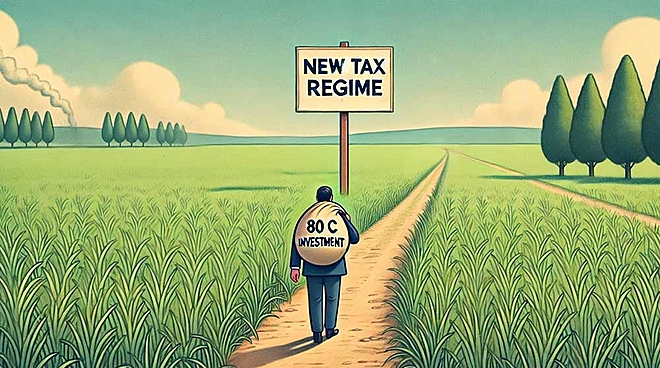 AI-generated image
Summary: Unlike the old tax regime, which provided exemptions like 80C, the new tax regime doesn’t have many such benefits. Yet, certain 80C investments still hold value, even for taxpayers under the new regime. We look at three such options.
The last quarter of the financial year often feels like tax-saving time. For years, January to March saw a flurry of activity as taxpayers rushed to make last-minute investments under Section 80C – a move that not only saved taxes but also helped build long-term wealth.
However, times have changed. With the government's push towards the new tax regime, which offers lower tax rates but removes popular exemptions like 80C, the earlier rush to hunt for the ideal tax-saving investments seems to be fading. In fact, approximately 72 per cent of tax filers have already shifted to the new tax regime, according to government data.
But here's the twist: some 80C investments still hold immense financial value, even without tax breaks. Let's explore three such options that can strengthen your portfolio.
#1 ELSS: The three-year lock that unlocks smart investing
For new investors, the equity market's volatility can feel intimidating. Many panic during market dips and exit too soon, missing out on long-term wealth creation.
That's where Equity Linked Savings Scheme (ELSS or tax-saving mutual funds) stand out. The three-year mandatory lock-in period forces investors to stay committed, giving their investments enough time to grow and helping them to start experiencing the benefits of long-term equity investing.
Why it still belongs in your portfolio
- Encourages long-term investing by preventing impulsive redemptions
- Provides market-linked returns with exposure across sectors and market caps
- An average ELSS fund has returned over 13 per cent in the last 10 years
Even if it does not provide tax benefits under the new regime, ELSS remains an excellent tool for inculcating the habit of staying invested in equities for the long-term.
#2 NPS: The retirement fortress you can't break into (easily)
Saving for retirement sounds simple, until life gets in the way. Lifestyle, emergencies and unforeseen expenses often force us to dip into our long-term savings.
However, the National Pension System (NPS) prevents this by locking your investments until age 60, ensuring you can't touch the funds until retirement. While limited withdrawals are allowed, they come with strict conditions, making it a reliable long-term investment tool.
Why it still belongs in your portfolio
- Built-in retirement discipline with strict withdrawal restrictions
- Balanced equity-debt allocation
- Employer contributions (up to 14 per cent of basic salary) still get tax benefits under the new regime
NPS provides a blend of wealth creation and retirement security, making it valuable beyond just tax-saving.
#3 PPF: The boring but brilliant safety net
It may not have the thrill of equity investing, but the Public Provident Fund (PPF) is the definition of stability.
Offering a government-backed 7.1 per cent interest rate, PPF provides guaranteed, tax-free returns, making it a perfect addition for risk-averse investors and those seeking stability near retirement.
Why it still belongs in your portfolio
- Safe and stable: Government-backed returns with no market risk
- Tax-free earnings: Interest earned remains tax-free
- Long-term stability: An ideal choice for long-term fixed-income allocation of your portfolio
Caution: PPF isn't suitable for short-term liquidity needs, so consider it for long-term stability rather than flexible portfolio adjustments.
Comparing the three investments
|
Investment option
|
Returns | Lock-in period | Tax benefits under new regime | Why they still make sense |
|---|---|---|---|---|
| ELSS (Tax-saving mutual funds) | 13.62%* | 3 years | Not available | Encourages long-term equity investing and wealth creation with market exposure. |
| NPS (National Pension System) Tier I | 11.77%* | Until the age of 60; partial withdrawals and premature closure allowed with stringent conditions | Only on employer contributions (14% of basic salary) | Promotes retirement savings discipline with balanced growth and limited access. |
| PPF (Public Provident Fund) | 7.1% tax-free^ | 15 years; pre-mature closure allowed in certain specified situations | Not available | Provides stable, risk-free returns with government backing and long-term security. |
| *10-year category average as of January 8, 2025. For NPS, we have assumed a 75% allocation in equities and 12.5% each in corporate debt and govt debt. ^For January to March 2025. | ||||
Final takeaway
Even if 72 per cent of taxpayers have shifted to the new regime, ELSS, NPS and PPF can remain critical pillars of a smart, long-term investment strategy.
This article was originally published on January 09, 2025.
Disclaimer: This content is for information only and should not be considered investment advice or a recommendation.
For grievances: [email protected]
Ask Value Research 
 New episodes every Friday










 New Process Alert
 Seems like you've uploaded a wrong QR code. Please upload the QR code downloaded from MF Central platform.


