 Widely read:


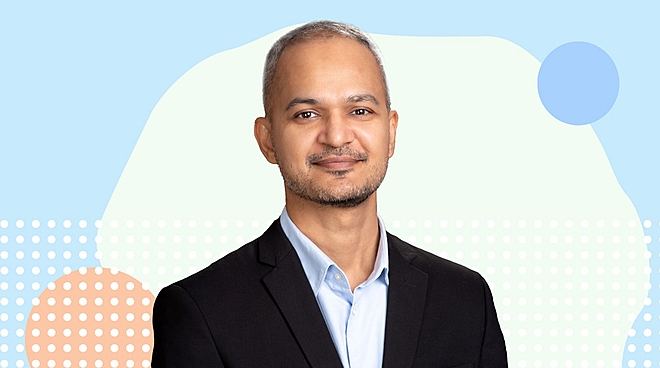

An IIT Kanpur graduate, Abhishek Singh brings over 14 years of experience in the financial markets. Starting his career as a risk manager, Singh joined DSP Investment Managers in 2021 as Assistant Vice President of equity.
Now, as the Vice President and Fund Manager, he oversees three hybrid schemes and one equity scheme—DSP Top 100 Equity Fund—with total assets of approximately Rs 17,300 crore. All four schemes are rated three stars by Value Research. His inclination to think about "things that can go wrong" has shaped his investment approach—focusing on downside protection while letting the upside take care of itself.
In this interview, Singh shares how his journey from an options trader to a fund manager has influenced his investment philosophy. He also offers valuable advice to investors, encouraging them to focus on products and categories they can hold for the long term. Below is the edited transcript of our discussion.
What drew you to financial markets in the first place?
I wish I could tell you that this is something that I have wanted to do since I was 10 years old. But unfortunately, that is not the case. Science always drew me in, and I possessed a strong aptitude for mathematics. When I was in school, my neighbours (a couple of brothers in a family) studied at IIT Kanpur, and they told me the Joint Entrance Examination (JEE) exams are the best, and IIT is the best place to study engineering.
Consequently, I took the JEE exam and was fortunate enough to receive acceptance. But again, after four years, there was this question: What do you do again? Everyone told me to write the Common Entrance Test (CAT), and I did, gaining admission into IIM. However, while doing my post-graduation in IIT, I read a book called Fooled by Randomness. This Nassim Taleb's book deeply captivated me. The concept of non-linear payouts attracted me and held my attention. After graduating from college, I began searching for trading or investment management jobs, which I believe initiated this journey.
You've worked with Edelweiss Securities and Kotak Securities before joining DSP. Could you share how those roles shape your approach to fund management?
I was very fortunate on that front. Kotak Securities hired me from the campus primarily to oversee risk management for their options trading desk. So, I started as a risk manager in proprietary trading at Kotak Securities.
Eventually, I started trading options and later set up their structured products book. I also traded in currencies and commodities. So it was a very diverse exposure early on, and basically, even today, when I hire somebody new, the focus is always to start with risk management. To start, I ask them about things that can go wrong, then start thinking about how to build portfolios, which eventually go to individual sectors and balance sheets. I had the good fortune to unknowingly embark on that journey. So, unknowingly and unconsciously, I started as a risk manager, then started back-testing strategies and thinking about portfolios.
Later, I managed a long-short strategy for Kotak Securities, and that is when I started looking at individual stocks, businesses and sectors.
What were the key learnings from that period?
I keep telling people that active funds are reflections of a fund manager's personality. You will always see two different people managing funds very differently. I'm naturally inclined toward thinking about things that can go wrong. In your personal life, it can be a curse because you're always thinking about what horrible thing can hit you, your finances, or your family at times.
Even as a risk manager, that is primarily your job: to think about what all can go wrong in the business. In my opinion, the fund managers—before being fund managers or money managers—are the risk managers. So, that thought is very well ingrained.
Even in terms of building portfolios, the way I think about portfolios, individual businesses or individual stocks is to start with the downside—what can go wrong? At least, my experience has been that it's very hard to predict the upside in businesses, even when you speak to promoters or management. My idea is to focus on the downsides, and eventually, the upsides take care of themselves. That was the key to learning again, inspired a lot by the writings of Taleb.
How would you summarise your investment philosophy for managing hybrid and pure equity funds? What are the core principles that guide your decision-making process when selecting investments?
I have a few core beliefs. One is to make consistent money without being lucky; you have to buy something for less than its intrinsic worth. You are trying to buy a $1 bill for, let's say, 80 cents or 60 cents, so you have to buy cheap, and that's the first belief.
The second belief is that nobody knows. At DSP, we publish a document called 'transcript,' and we end the document with a slide where an expert predicted something that turned out horribly wrong. So, life and markets have a habit of surprising the consensus. If you put one and two together, then the only intelligent way to operate, in my belief, is to buy low-impact expectations. You buy stuff where the market is building in very benign growth or has very benign expectations of improvement in profitability.
When a significant amount of pain has already been reflected in the price, the market can surprise you positively. This is the fundamental methodology I employ when creating and managing portfolios. This approach is pretty consistent, whether it's an equity fund or a hybrid fund, and you have one single portfolio in your mind that you try to express in different funds.
I also believe that structure beats activity. The structure should be such that, over time, it should end up giving you satisfactory outcomes. If you try to go for very high upsides, you also take the risk of ending up with a very bad performance.
The other way of looking at this is that I think investment returns go to those people who are not chasing them too vigorously. For example, if an individual investor starts targeting 20-25 per cent returns, they will most likely end up making lower than debt returns. But if you are really happy with 10-13 per cent returns, which is typically what an investor in India should expect over time, then your actual returns could be higher because you will not make mistakes. You will not get into strategies that are too complex or volatile. Basically, one should adopt simplicity in investing.
What's your take on equity markets in the near and long term? And how do these factors influence your investment strategy moving forward?
In the near term, it's difficult to say for sure. As an expectation, we use 10-year rolling returns of 13-odd per cent in the medium term. Now, one caveat here is that when you are looking at history, these are nominal returns. So, you have to factor in that we were running much higher inflation earlier.
No matter how you look at markets today, in India, it's challenging to come to the conclusion that they are cheap. So, your return expectation over the medium term should be slightly lower than what you have made historically. So historically, if you have made, say, 12-13 per cent, maybe you should expect, on an index basis, 10-11 per cent over the medium term, which is 5-10 years.
Thankfully, India has been a little isolated from the global nuances at this point in time. I mean, it will get impacted, but hopefully, we will weather that volatility slightly better than a lot of other emerging markets.
What advice would you give first-time investors looking at hybrid or equity funds?
I consistently advise investors to invest in a product or category they can invest in for the longest duration. The reason is that now we have taxation, even long-term equity taxation. So if, let's say, your investment horizon is 30 years, and you keep churning your portfolio every three years, you will end up paying a substantial amount of tax.
If someone is too cynical or sceptical about choosing an active fund manager, then pick an index fund, and they will do okay. Keep on doing systematic investment plans (SIPs) and keep on doing investments for 30 years. Alternatively, choose two or three people you'll stay with, even if they're underperforming - and stay with them for the longest possible time.
A large number of Indians have 60-70 per cent of their overall net worth in equity portfolios. The rest of the money is either in fixed deposits or debt funds. In such a scenario, just pick up three hybrid funds and don't churn the portfolio. From a post-tax perspective, this approach will yield superior returns. A long investment horizon takes care of many investing mistakes, so that is one piece of advice or suggestion that I'll offer retail investors.
Also read: Recent inflation spikes don't worry us: ICICI Prudential AMC CIO
Disclaimer: This content is for information only and should not be considered investment advice or a recommendation.
For grievances: [email protected]
Ask Value Research 
 New episodes every Friday






 New Process Alert
 Seems like you've uploaded a wrong QR code. Please upload the QR code downloaded from MF Central platform.


