




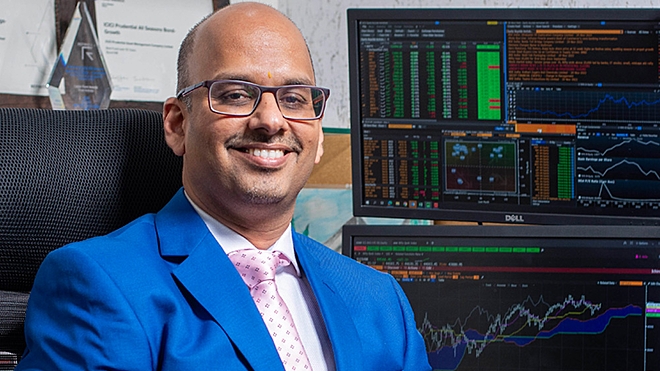

Armed with nearly two decades of experience, Manish Banthia is currently overseeing ICICI Prudential Asset Management Company's entire debt fund strategy as its Chief Investment Officer (Fixed Income). A Chartered Accountant by qualification, Banthia joined the fund house in October 2005 in their product team, eventually finding his way to fixed income.
In a chat, Banthia talks about what's shaping the current debt market, emerging risks in the credit environment and his investment philosophy. Edited excerpts:
You chose fixed income over equities after completing your CA. What drew you to this field, and how has it shaped your career so far?
During my MBA in Delhi, I was keen to join an investment management firm, without a specific preference for equities or fixed income. In 2005, I started with ICICI Prudential Mutual Fund in the product department, which eventually led to an opportunity in the fixed income team.
As I advanced in the fixed income space, my interest in exploring equity also grew. Fixed income offers immense depth, particularly in terms of macroeconomic thinking and credit research. Over the last two decades, this journey has been incredibly enriching and a valuable learning experience for me.
You've spent nearly two decades at ICICI Prudential Mutual Fund, witnessing events like the global financial crisis and credit challenges. What lessons have you drawn from navigating such turbulent times?
The past two decades have been a tremendous learning journey. One of the key takeaways is recognizing that credit, as an asset class, carries tail risks that cannot be fully priced in. While the probability of tail risks materializing is often perceived as low, their impact can be significant when they do occur. This reinforces the importance of being cautious when dealing with high-yielding assets or credit investments.
Risk tends to arise when it is underestimated or ignored, often driven by overconfidence during certain cycles. For instance, in 2018, the credit market was overly confident due to a prolonged absence of significant corporate credit events. This misjudgment led to heightened risk-taking at a systemic level. Such cycles serve as reminders to stay vigilant, especially when markets appear overly optimistic.
Another crucial lesson is the importance of thorough research before investing in credit. Exiting certain investments can become extremely challenging under adverse conditions. Lastly, understanding that markets are cyclical and adapting investment processes to these cycles is vital for long-term success.
You mentioned distinct market phases. In recent years, we've seen no major credit crises. What's different this time?
Market behavior is often driven by different narratives at different times. Currently, there's a perception that high flows will sustain market performance. However, history shows that market peaks are often accompanied by high flows.
When markets move ahead of fundamentals, it's essential to heighten risk awareness. As prices rise, risks tend to increase, while falling prices often reduce risks—assuming all other factors remain constant. This counterintuitive nature of risk is something investors must keep in mind.
What is your core investment philosophy in fixed income, and how has it evolved over the years?
Interest rates largely move in alignment with economic or business cycles. Monetary policy plays a critical role in either supporting or restraining these cycles, and this forms the foundation of our fixed-income investment approach. Assessing domestic and global business cycles is crucial for devising strategies and constructing portfolios.
At ICICI Prudential Mutual Fund, our broader philosophy revolves around three pillars: safety, liquidity, and returns. By conducting robust research, maintaining safety and liquidity, and following disciplined processes, we believe returns will naturally follow over the medium term.
When evaluating credit quality, what factors do you focus on to assess an issuer's creditworthiness?
Two factors are paramount in credit evaluation: willingness and ability. "Willingness" pertains to promoter quality and governance standards. Poor governance can overshadow otherwise sound fundamentals, which is why assessing this aspect is critical.
"Ability" focuses on the company's financial health, sector dynamics, and the cyclicality of its business. Cash flows play a central role, as they directly impact the borrower's capacity to repay. Unlike equity analysis, which emphasizes the profit and loss statement, credit analysis gives more weight to the balance sheet. Combining these two perspectives provides a holistic understanding of creditworthiness.
The average maturity of some of ICICI Prudential Mutual Fund's debt funds is lower than the industry average. Was this influenced by early rate calls, and what is your current strategy?
Our interest rate strategy is rooted in understanding business cycles. India is currently in a mid-cycle phase, where interest rates typically remain stable unless the economy overheats or slows down significantly. This phase calls for balanced positioning rather than aggressive stances.
In a mid-cycle environment, focusing on accrual benefits from credit papers aligns well with our strategy, and we've positioned our portfolios accordingly.
What are your expectations for rate cuts, and how much is already priced in?
I expect a rate cut of 25-50 basis points at most. If economic growth improves in the third and fourth quarters of this fiscal year, the RBI may not need to cut rates. However, if the economy slows, a shallow rate-cut cycle could materialize.
Could you explain your credit risk assessment process for corporate bonds?
At ICICI Prudential Mutual Fund, our credit risk function operates independently, reporting directly to the CEO rather than the CIO. This ensures unbiased decision-making. While the investment team conducts its own research, the credit risk department has the final say on onboarding credits.
Our process involves multiple approval levels depending on the risk associated with a credit. This includes approvals from the credit risk manager, CIO, fund manager, and in some cases, the board and investment committee. This robust structure has helped us navigate market risks effectively over the past decade.
How are you managing durations given persistent inflation and US rate adjustments?
We are currently in a mid-cycle phase, with growth nearing its potential and inflation stabilizing within the RBI's comfort zone of 4-6 per cent. Recent inflation spikes, largely driven by vegetable prices, are expected to normalize, so I'm not overly concerned.
In the US, however, expansionary policies and tight labor markets could create significant market volatility. Policies like tariffs and restrictions on immigration may increase consumption costs and wage pressures, adding to economic complexity. This makes the US market an intriguing and volatile space.
What funds would you recommend as versatile "all-weather" debt schemes?
Our All-Seasons Bond Fund offers flexibility in duration and credit allocation, ranging from one year to over 10 years, with investments in sovereign and corporate bonds. This flexibility allows us to adjust based on market cycles. However, we manage this fund with a process-driven approach, guided by an in-house proprietary model.
In today's environment, how should investors allocate between fixed income and other asset classes?
Investors should rebalance allocations across fixed income and equities in line with valuations and market cycles. While moderate returns are expected from both asset classes, achieving high returns requires assets to become significantly undervalued, which is not currently the case.
What role do you play in managing the ICICI Prudential Business Cycle Fund, and how does it align with your expertise?
The Business Cycle Fund adopts a top-down approach, focusing on macroeconomic factors and sectoral trends aligned with different stages of the business cycle. My background in macroeconomics aids in identifying sectors that are likely to outperform in specific cycles.
While my role primarily involves top-down sector selection, I also contribute to specific areas like banking and commodities, which have strong links to fixed income and macroeconomic trends.
What risks in the credit environment are you currently monitoring, and how are your funds positioned?
One area of concern is unsecured retail credit, where delinquencies, particularly in microfinance, are rising. The RBI has highlighted potential stress in this segment, prompting tighter governance and credit conditions. From a corporate credit perspective, however, we remain comfortable for now.
What's your perspective on target maturity funds in the current environment?
Target maturity funds remain attractive for their liquidity, even after taxation changes. While tax advantages have diminished, the ease of liquidity continues to make them appealing compared to traditional fixed deposits. For investors seeking flexibility and accessibility, these funds remain a viable option.
Also watch: Is Motilal Oswal's Nifty Capital Market Index Fund your gateway to India's financial boom?
Ask Value Research 
 New episodes every Friday









 New Process Alert
  Seems like you've uploaded a wrong QR code. Please upload the QR code downloaded from MF Central platform.


