




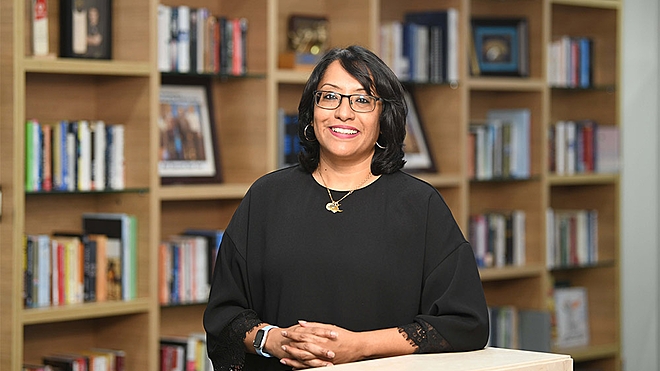

It is because Shibani Kurian has nearly 25 years of experience that she can manage two funds with polar opposite investment strategies. As the Head of Equity Research and a Fund Manager at Kotak Mahindra AMC, she oversees five equity funds, with total assets exceeding Rs 9,600 crore. Among them, the Kotak India EQ Contra Fund and Kotak Focused Equity Fund stand out - two funds that, while both carrying a four-star rating from Value Research, follow very different approaches to investing.
During our conversation, Kurian shares how she navigates managing these two contrasting funds and provides a glimpse into Kotak AMC's investment strategy. Below is an edited transcript of the interview, where Kurian also offers insights into her investment approach and her journey in the industry.
Looking back, what key lessons or pivotal moments have defined your career?
When I look back on my career, there have been times when markets have been volatile. A few of these events, like Y2K issue, occurred when I first entered the markets in 2000. The global financial crisis then struck in 2007-08, just when I joined Kotak Mahindra AMC. Subsequently, we experienced the Taper Tantrum and the Covid crises, among others.
I believe the most valuable lesson I've learned from these periods of volatility is that, while as a fund manager or research analyst, we constantly strive to identify stocks that have the potential to generate significant returns, at the same time, we must not lose sight of downside risk. Avoiding pitfalls is as important as evaluating ideas that can help you create alpha.
Remember, creating alpha is not only about upsides; it's also about managing your downside risk. Therefore, risk management and taking a risk-adjusted approach to a portfolio is my biggest takeaway from having lived through these periods of volatility. The long-term trend in the equity markets is upward, but how you navigate these periods of sharp volatility ultimately shapes your portfolio performance over the long term.
How would you summarise your investment philosophy, and how has it evolved with changing market conditions?
The investment philosophy and process at Kotak Mutual Fund have greatly influenced my approach to managing money. When I started at UTI Mutual Fund, I was a research analyst and very new to the job. Over time in the market, you understand the various strategies for portfolio management.
In summary, our investment philosophy involves purchasing high-growth, high-quality companies but trading at reasonable valuations, thereby achieving growth at a reasonable price (GARP) with a quality overlay.
Our investment philosophy first emphasises that the multiple should not be the starting point of any evaluation. We often make the mistake of falling into value traps by solely focusing on companies trading at attractive multiples.
The first step in evaluating any company in your portfolio should be the business itself. I look at scalable and sustainable businesses and companies gaining market share. The second most important factor is quality, and quality imbibes corporate governance and capital allocation. Lastly, companies that are friendly or consider the interests of minority shareholders are highly valued.
Another crucial consideration is valuation, which I define as more than just a multiple. I've consistently emphasised the need to consider valuations alongside earnings growth and return ratio profiles. For instance, in the Kotak Focused fund, which I manage, we look at companies where the return on capital employed is greater than the cost of capital. In summary, my investment philosophy prioritises growth and quality while maintaining a reasonable price.
Kotak Mutual Fund also adopts GARP as a strategy, but don't you have a value or growth bias as you manage Contra and Focused Funds?
At any point in time, buying a good stock at a reasonable valuation is better than buying an average stock at a very high valuation. That's the philosophy I've adhered to, and it guides my portfolio construction in both Contra and the Focused Fund.
Now, Contra is a value-biased fund, but there is an element of growth on top of value. When choosing the universe of stocks for the Contra fund, we consider stocks that have either underperformed the index or are trading at multiples lower than their historical performance. A sector may have underperformed, or a stock may be trading at a multiple lower than its peers in the same sector. The universe of stocks we create has a value bias.
However, as we construct the portfolio, a fundamental GARP strategy overlays it. So, if you look at Contra, for instance, the P/E of the fund is lower than the P/E of the benchmark, but the return on equity (ROE) of the portfolio is higher than the benchmark. This implies that despite the value bias, the GARP overlay aids in the selection of stocks that yield higher returns on equity. As a result, our portfolio comprises high-quality companies that typically generate higher ROEs than the benchmark, the NSE 500.
How do you define contra as a strategy? When I look at the fund portfolio, I see that the top 10 holdings are well-known names that have performed well.
It's a good thing that the stocks have done well in the last year because that has helped generate the alpha over the benchmark. However, as I previously stated, the contra strategy is a value-biased strategy, not a value-only one.
When selecting stocks, you are creating a universe of underperforming companies that are currently trading at lower multiples than their historical averages or have underperformed the index. However, you are also tasked with identifying companies that possess inherent growth potential. Either the sector or the company in question may have experienced a setback, leading to the underperformance and now there exists the possibility of a reversal.
As I said, it is value-biased, so we will not buy stocks that are trading at valuations that are significantly higher than their peers in a particular industry or vis-à-vis the benchmark itself. The reality is that the portfolio's P/E valuations are lower than the benchmark's.
As a strategy, we primarily focus on companies that have the potential to improve their growth profile and return ratios, which can lead to multiple re-rate for the company. If you examine the portfolio, it is structured so that, when purchasing a specific stock, it must meet the four or five criteria I previously outlined. However, post buying, just because a stock has outperformed well doesn't mean we have to exit it from the portfolio. We will keep evaluating that stock over periods of time. Based on our research outputs, we will continue to hold the stock if we believe it still has some upside potential.
Kotak Focused Fund has seen some turnaround in 2024 after struggling a bit in 2023. What steps have you taken to improve the performance of the fund?
Focused investing is a challenging category as it involves selecting a maximum of 30 stocks, with the belief that these companies are structural in nature.
Let me explain how a focused strategy works and how we construct the portfolio. The portfolio, like other portfolios, adheres to the GARP philosophy. If you look at India today, we have somewhere between 5,000-plus listed entities. If we narrow it down further, there will be around 1,500 companies with a market capitalisation of more than Rs 1,000 crore.
In our current research coverage, we have approximately 525 companies and a typical diversified portfolio at Kotak MF will consist of between 50 and 60 stocks. However, we apply an additional layer of filtering to construct a focused fund, from which we will select 25-30 stocks. These are the top 30 stocks that we have identified from our comprehensive research coverage. We are focusing on companies gaining market share, where the cost of equity should be lower than the return on capital employed (ROCE). This implies that the companies will generate a higher ROCE than the cost of equity. These companies have high-quality management and are currently trading at reasonable valuations.
Therefore, when we purchase stocks in this fund, we do so with a clear investment horizon of 18 to 24 months. Given that it is a very concentrated portfolio, you will see periods when you will have to be patient because sometimes there are stocks that only perform over time.
Recently, you may have noticed that we have been generating alpha above the benchmark on a one-year basis, and this trend has continued since our inception. On a three- to five-year basis, we are more or less in line with the benchmark today.
Also read: Interview with Manish Banthia of ICICI Prudential Mutual Fund
Ask Value Research 

 New episodes every Friday









 New Process Alert
  Seems like you've uploaded a wrong QR code. Please upload the QR code downloaded from MF Central platform.


