 Widely read:


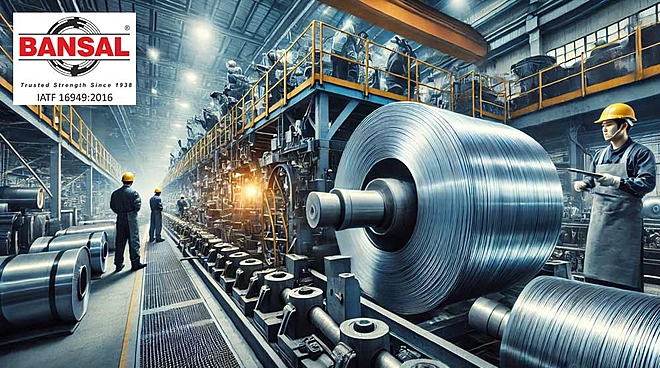 AI-generated image

Bansal Wire Industries, a steel wire manufacturer, is launching its IPO (initial public offering) on July 3, 2024. We break down the company's strengths, weaknesses, and growth prospects to help investors make an informed decision.
In a nutshell
-
Quality
: Its three-year average
ROE
and ROCE were 24.9 per cent and 14.7 per cent, respectively.
-
Growth
: Its revenue and net profit grew 5.9 and 17.3 per cent per annum, respectively, during FY22-FY24.
-
Valuation
: Post the IPO, the stock will be valued at a
P/E
and P/B of 50.9 and 3.4 times, respectively.
- Overview: About 40 per cent of demand for steel wires comes from infrastructure and automobile sectors. The government's massive capital expenditure (capex) on infrastructure like roads, highways, and railways, combined with the strong momentum in the automobile sector, will drive demand for the steel wires market where the company is primarily present in. However, the product is commoditised and the market is highly competitive with no entry barriers.
About Bansal Wire
Incorporated in 1985, Bansal Wire is a steel wire manufacturer that operates under three main segments-high carbon steel wire, mild carbon steel wire, and stainless steel wire. It offers over 3,000 SKUs (stock-keeping units) under these segments, accounting for 2 per cent of the market share in India.
The company's present capacity is around 0.26 MTPA (million tonnes per annum) across five facilities with an average capacity utilisation of 84 per cent. Bansal Wire's distribution is spread across 22 states and six union territories, with two-thirds of its revenue coming from Delhi, Haryana, Maharashtra, and Uttar Pradesh in FY24.
Strengths of Bansal Wire
-
Diversified customer base:
The company caters to more than 5,000 customers, with no customer contributing more than 5 per cent to revenue and no single sector or segment contributing more than 25 per cent to revenue (as of FY24).
- Customer retention: The company has retained almost 90 per cent of its top 300 customers (contributing more than 75 per cent of its revenue) during FY22-FY24.
Weaknesses of Bansal Wire
-
Geographical concentration:
The company's manufacturing capacity is concentrated in the national capital region or NCR. This is why more than 60 per cent of its revenue originates from the North. Since steel wires are commoditised products, regional pricing competition and additional charges like transportation make it difficult for the company to scale its operations in other regions. This is perhaps why the company's revenue growth has been muted against the industry. Its topline grew about 6 per cent annually during FY22-FY24, while the industry revenue grew 8-10 per cent per annum in the same period.
- Working capital intensive: High working capital is an industry-wide trait in the steel sector and Bansal Wire is no exception. The company has recorded an average cash conversion cycle of over 70 days between FY22 and FY24 and has had to rely on debt to meet its working capital requirements.
IPO details
| Total IPO size (Rs cr) | 745 |
| Offer for sale (Rs cr) | - |
| Fresh issue (Rs cr) | 745 |
| Price band (Rs) | 243-256 |
| Subscription dates | July 3-5,2024 |
| Purpose of issue | Loan repayment and working capital requirement |
Post-IPO
| M-cap (Rs cr) | 4,007.8 |
| Net worth (Rs cr) | 1,167.4 |
| Promoter holding (%) | 77.97 |
| Price/earnings ratio (P/E) | 50.9 |
| Price/book ratio (P/B) | 3.4 |
Financial history
| Key financials (Rs cr) | 2Y CAGR (%) | FY24 | FY23 | FY22 |
|---|---|---|---|---|
| Revenue | 5.9 | 2,466 | 2,413 | 2,198 |
| EBIT | 15.6 | 131 | 96 | 98 |
| PAT | 17.3 | 79 | 60 | 57 |
| Net worth | 37.6 | 422 | 283 | 223 |
| Total debt | 28.4 | 681 | 422 | 413 |
|
EBIT is earnings before interest and taxes
PAT is profit after tax |
||||
Key ratios
| Ratios | 3Y average | FY24 | FY23 | FY22 |
|---|---|---|---|---|
| ROE (%) | 24.9 | 21.2 | 23.7 | 29.9 |
| ROCE (%) | 14.7 | 14.5 | 14.3 | 15.4 |
| EBIT margin (%) | 4.6 | 5.3 | 4 | 4.5 |
| Debt-to-equity | 1.7 | 1.6 | 1.5 | 1.9 |
|
ROE is return on equity ROCE is return on capital employed |
||||
Risk report
Company and business
-
Are earnings before tax of Bansal Wire more than Rs 50 crore in the last 12 months?
Yes. The company reported a profit before tax of Rs 107 crore in FY24.
-
Will Bansal Wire be able to scale up its business?
Yes. Growing infrastructure demand in India, combined with the company's attempt to expand into different regions, will help it scale its operations.
-
Do Bansal Wire have recognisable brands with client stickiness?
Yes. The company retained an average of 66 per cent of its customers during FY22-FY24.
-
Does the company have a credible moat?
No. It operates in a commoditised business with many listed and unlisted competitors.
Management
-
Do any of the company's founders still hold at least a 5 per cent stake? Or do promoters hold more than a 25 per cent stake in the company?
Yes. After the IPO, the promoters' stake will be 78 per cent.
-
Do the top three managers have more than 15 years of combined leadership at Bansal Wire?
Yes. Arun Gupta, the chairman and whole-time director, has been with the company since its incorporation in 1985.
-
Is the management trustworthy? Is it transparent in its disclosures, which are consistent with SEBI guidelines?
Yes. No information to suggest otherwise.
-
Is the company's accounting policy stable?
Yes. No information to suggest otherwise.
-
Is Bansal Wire free of promoter pledging of its shares?
Yes. No shares have been pledged.
Financials
-
Did the company generate a current and three-year average return on equity of more than 15 per cent and a return on capital employed of more than 18 per cent?
No. Its three-year average ROE and ROCE were 24.9 and 14.7 per cent, respectively. In FY24, its ROE and ROCE were 21.2 and 14.5 per cent, respectively.
-
Was the company's operating cash flow positive during the last three years?
No. The company reported negative cash flow from operations (CFO) in FY22. (In case you refer to the RHP, its CFO in FY24 has been erroneously reported negative).
-
Is the company's net debt-to-equity ratio less than one?
No. The company's net debt-to-equity ratio was 1.6 times as of FY24.
-
Is Bansal Wire free from reliance on huge working capital for day-to-day affairs?
No. The business is working capital intensive and it has recorded an average cash conversion cycle of 75 days during FY22-FY24.
-
Can the company run its business without relying on external funding in the next three years?
No. Although the IPO proceeds will be enough to take care of its debt, any significant capex plans in the future may force the company to raise external funds.
-
Is Bansal Wire free from meaningful contingent liabilities?
Yes. Its contingent liabilities as a percentage of total equity was around 3 per cent as of FY24.
Valuations
-
Does the stock offer an operating earnings yield of more than 8 per cent on its enterprise value?
No. After listing, the stock will offer an operating earnings yield of 2.8 per cent on its enterprise value.
-
Is the stock's price-to-earnings less than its peers' median level?
No. The company is valued at a P/E of 50.9 times compared to its peers' median of 35.4 times.
-
Is the stock's price-to-book value less than its peers' average level?
Yes. The company is valued at a P/B of 3.4 times compared to its peers' median of 5.1 times.
Disclaimer: This is not a stock recommendation. Investors should do their due diligence before investing.
Also read: Another IPO frenzy begins
Disclaimer: This content is for information only and should not be considered investment advice or a recommendation.
For grievances: [email protected]
Ask Value Research 
 New episodes every Friday













 New Process Alert
 Seems like you've uploaded a wrong QR code. Please upload the QR code downloaded from MF Central platform.


