




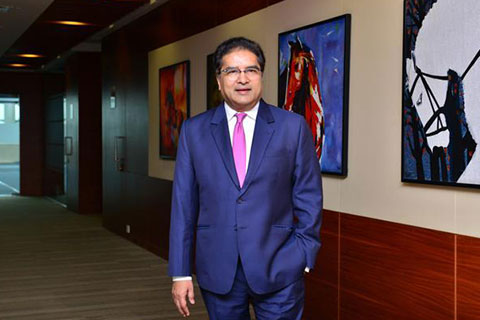
Raamdeo Agrawal, co-founder, Motilal Oswal Financial Services, started investing in equity almost three decades ago, and has not only seen the domestic equity space move from open outcry cash dealings to sophisticated, regulated digital trades on exchanges but has also been through many market and economic cycles. In all these years, Agrawal says, the most important learning has been that nothing can beat quality and patience. Agrawal spoke to Mint about how markets are placed today and shared his hits and misses over the years.
Are you concerned that markets are over-valued or is it fine as earnings would catch up soon?
There is a lot of liquidity across the globe. Clearly, there are more buyers than sellers and that's why the IPO (initial public offering) market is seeing a lot of demand as well. Second, earnings are depressed; on that base, the P-E (price-to-earnings) multiple looks high.
While two-thirds of companies are witnessing slow growth, the rest are doing reasonably well. Ideally, it should be the other way. Some of the large companies on the Nifty 50 index, like Reliance Industries, Infosys, ONGC..., these haven't moved much. And if they don't move, how will the index move ahead?
The story is happening outside the indices.
If earnings are yet to catch up, why are markets rewarding stocks?
If you see where earnings are not growing, those stock prices are also not moving. Reliance Industries, for example, has been stuck at around Rs1,000 per share for the last 1 year, even at 10-12% earnings growth. There are concerns about some parts of the conglomerate's business. The market has been fair when it comes to rewarding growth. Most of the demand is really in one-third of the market, where the change is in focus.
So far, the government has brought about many changes in the policy framework, including getting the Goods and Services Tax Bill passed. What more is needed?
First, it is important to tighten your belt and ensure there are fewer leakages and unnecessary expenditures. Second, they have to collect taxes very well. It is still easy to evade taxes; people feel that they can easily get away with it. The fear of not paying tax must come.
How much of the outperformance in your strategies for portfolio management services (PMS) comes from taking concentrated positions in a few stocks?
In any portfolio, concentrated or diversified, typically, 33% stocks will do very well, 33% will be just around market performance and the rest will perform below the benchmark. The real test is in maximising gains in the stocks that perform well. This will happen only if you own chunky positions. Where our convictions are high, allocations have to be high. If the expectation doesn't come out to be true, it will hurt us. But we have to have high positions where we believe the company will do well.
When the fund manager has only 15-17 stocks, there is a lot of time to undertake deep research and analysis. Ours is a buy-and-hold strategy, so we don't need to track everything everyday. The quality, growth, and longevity at a reasonable price starts with quality, which is non-negotiable.
We are capable of holding stocks for as long as the fund exists. Our 13-year-old strategy has stocks that have been there for as long.
You have been an investor for more than three decades. What are your biggest learnings?
I learnt in the 1990s that patience is the most important virtue for investing in the stock market. In 1980s, I was very young and had nothing. I started off with my brother's money. If you buy quality, and understand the companies, they (those stocks) keep growing. You could start with a lot of money and double it in a short period of, say, 5 years. But everybody doesn't have large sums. The other way is to start small and remain invested for 20-30 years; you will still make a lot of money.
I remember, my first multi-bagger was Vysya Bank. I bought it for Rs20 and sold it for Rs2,000 in the early 1990s. It took 4-5 years; it was a crazy story. I didn't have so much technical knowledge, it was a lot of luck that played out back then. A client identified it and also stayed on to make a lot of money. You know the stock reached Rs2,000 and I sent them to (then) Bangalore for delivery only to lose the share certificates. The stock corrected a little but thankfully by the time I got the duplicate certificates, the price came back to Rs2,000. A lot can happen thanks to patience and some luck.
Memorable mistakes?
My biggest regret is that at times I didn't have enough patience. I bought HDFC Bank in 1995-96 at Rs40 and was sure it was a multi-bagger. I bought 500,000-600,000 shares. Then there was some information that NatWest was going to exit the bank. While the information was correct, the impact wasn't much. Unfortunately, I sold the entire holding at Rs52 within 2 years. Had I stayed on, this holding would have been a fortune changer for me.
We make bad decisions also. But that happens. I bought Bharti at Rs25 and sold at Rs650 after seeing a price of Rs1,200.
The moment you buy quality, you will be at peace. If you buy good stocks and have unlimited patience, you can make a lot of money in the Indian stock market.
Some of your top holdings are trading at high P-E multiples. Are these off their peak now? Do you think it is time to move on to the next big idea?
We do move on from stocks. There are both high and low P-E stocks in the portfolio. For example, we hold HPCL (Hindustan Petroleum Corp.), which is a relatively low P-E stock.
If quality stocks are available at a low P-E, we are happy to buy. We had bought Bajaj Finance, for example, when it was at 12-15 times; now it is trading at a high P-E. Companies grow after a lot of strategic alignment; you have to let the entire cycle play out.
As long as quality is there, and when my analyst is able to spot that growth will not continue to deliver, we will re-calculate how much we are paying for a stock.
Is large size a hindrance to managing concentrated portfolios, especially in case of mid caps?
It will be false to say that the funds can be of any size and we can still continue to do what we do. As soon as there is indication that the size has become unmanageable, we cap it for both the mutual fund and the PMS strategies. However, I haven't reached that stage in any strategy. My own net worth is invested in these funds and it's not worth hurting returns just for size.
How much of the incremental assets into PMS is due to shift in distribution?
We have equal focus on both. For us nothing has changed in the way things happen and how we distribute mutual funds and PMS. But I do hear in the industry that, of late, there is more alignment towards PMS than mutual funds.
In arrangement with HT Syndication | MINT
Ask Value Research 

 New episodes every Friday

 New Process Alert
  Seems like you've uploaded a wrong QR code. Please upload the QR code downloaded from MF Central platform.


