


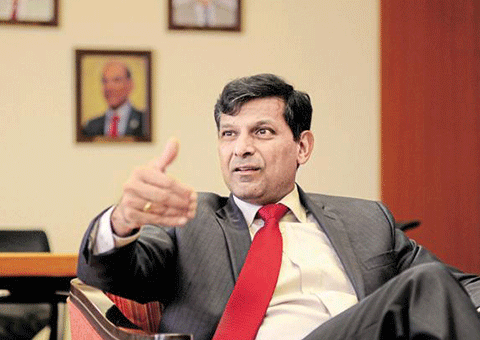
Reserve Bank of India (RBI) governor Raghuram Rajan has all but ruled out another interest rate cut in the upcoming monetary policy review on 9 August, citing the firming-up of inflation.
"This discussion keeps going on without any economic basis. You saw the CPI numbers just last week. 5.8% is the CPI inflation (in June). Our policy rate is 6.5%," he said, before adding, "So, I am not sure where people say we are behind the curve, you have to tell me that somehow inflation is very low for us to be seen as behind the curve. So, I don't really pay attention to this kind of dialogue."
Rajan was responding to a query on whether RBI has behind the curve on interest rates, during a brief interaction with reporters on Sunday.
At the same time, Rajan, who leaves office on 4 September, held out a good prognosis for the Indian economy, especially in the context of a good monsoon.
Pick-up in the rural economy on the back of a good monsoon should revive demand in the economy, Rajan said, pointing out that focus should be on structural reforms to ensure sustainability of growth.
"I think we sometimes get overly fixated with a particular growth number. 7.6 (%), 8 (%); they are all within the same sort of range of numbers. What we should be focussed on is undertaking all the actions that need to ensure that growth is strong and sustainable and that means macro stability; that means (the focus should be on) the kind of structural reforms we are doing to enhance the pace of growth."
When asked whether a review of the inflation target of +-4% under the monetary policy agreement is on the cards, Rajan said, "The government has to reflect on it and notify the target. But that's all that's on the table."
Analysts do not see a rate cut ahead anyway.
"We rule out a rate action in August policy as RBI would be closely monitoring the higher-than seasonal surge in vegetable prices and the pace of monsoons," said Kotak Mahindra Bank, in a note dated 14 July, adding RBI may cut interest rates by a further 25 basis points in the current calendar year. "Progress on monsoons and favourable base effect in second half of FY17 continue to point towards RBI achieving its near 5% inflation target by end-March 2017. Further, the expectation of additional monetary easing by major central banks amid increasing global uncertainty may provide additional policy leeway," it said.
Rajan added that passing the constitutional amendment legislation to facilitate rollout of the goods and services tax in the monsoon session will help speed up the structural reforms needed to boost growth.
"Our last projection was 7.6% and I think as the monsoon develops, as the global economy develops, clearly there will be changes in that," Rajan said while responding to a question on whether 8% growth is achievable with a good monsoon.
Rajan also ruled out any blanket guarantee to bankers from scrutiny by central investigative agencies for decisions taken by them. At the same time, he said every stakeholder agrees that commercial decisions taken by bankers in the right spirit and with the information available should be respected as the Indian banking system grapples with resolution of bad debts.
"I think bankers have expressed some concern that they should not be held liable for actions that are taken in the full spirit of what is needed; and I think everyone has respected that need that where they take actions based on appropriate due diligence, on a proper application of mind given the situation, they should have some freedom to take actions, because otherwise, we will not get the kind of clean-up, the kind of putting over-leveraged projects back on track that the economy needs," he said.
In a light aside, Rajan also said that he has no immediate plans to write a (tell-all) book along the lines of his predecessor D. Subbarao, but said he may write on academic issues once his term as RBI governor ends in September.
Subbarao, who was at the helm of RBI during 2008-13, blew the lid on the sharp differences between the central bank and the Congress-led United Progressive Alliance (UPA) over interest rates in his upcoming book, Who Moved My Interest Rate?
The revelations come in the backdrop of Rajan's abrupt decision to resign as RBI governor and a parallel allegation made by the Congress party that the National Democratic Alliance had pressured him into the decision.
In arrangement with HT Syndication | MINT
Ask Value Research 
 New episodes every Friday


 New Process Alert
 Seems like you've uploaded a wrong QR code. Please upload the QR code downloaded from MF Central platform.


