





Bond yields, which had been range bound, got a boost when the Budget revealed that the fiscal deficit target of 3.9% for FY16 would be met. The finance minister was also confident of meeting the 3.5% target for FY17. On the Budget day itself (29 February), yields moved lower by around 15 basis points (bps). One basis point is one hundredth of a percentage point. Subsequently, anticipation of another rate cut was built in.
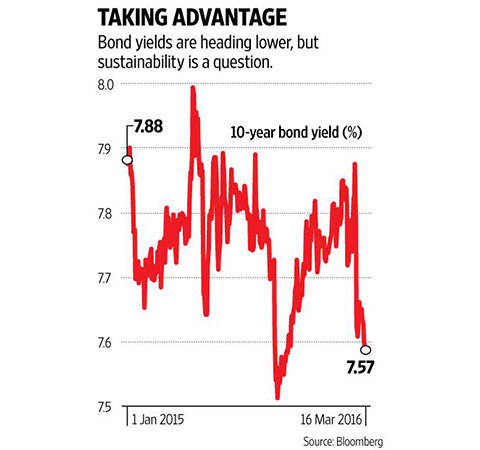
As the 10-year government security (g-sec) yield inches closer to 7.5% once again, the question is whether the move is sustainable? Is there merit for investors to time a move to duration for an opportunistic gain or is it already too late?
The last secular shift in long-term 10-year g-sec yield started towards the end of 2013 when it was 8.9-9%, and lasted around a year. By the end of 2014, the yield was lower, at around 7.8%. While 2015 started well with the expectation that yields could decisively move below 7.5% due to rate cuts, it didn't work out as anticipated. By the end of 2015, the benchmark 10-year g-sec yield remained around 7.7-7.8%, despite interim short moves.
Currently, given that inflation is also within the Reserve Bank of India's comfort zone, the hope for another rate cut has increased. This has shifted the yield decisively lower. However, for the shift to be sustainable, supply pressure needs to be under control. "Supply of paper needs to come down for spreads (between overnight rates and 10-year g-sec yield) to reduce. With the kind of expenditure we heard of in the Budget, in the next two years, the government will need to raise funds. Moreover, state loan auctions and UDAY (Ujwal Discom Assurance Yojana) bonds will keep issuances in the long maturity side heavy," said Murthy Nagarajan, head-fixed income, Quantum Asset Management Co. Ltd.
At the same time, last year, the market yield did not capture the complete impact of a repo rate at 6.75%. This, coupled with another rate cut (if it happens in April) might mean that yields go down 20-30 bps. R. Sivakumar, head-fixed income, Axis Asset Management Co. Ltd, said, "The market hasn't priced in all the RBI action yet. The steep real interest rate curve coupled with a dovish RBI means yields could soften along with rate cuts."
What should you do?
Buying into a long duration fund will give you the opportunity to take advantage of lower yields, but this is risky as lower yields aren't expected to be sustain for long. And supply at the longer end of the curve is expected to keep yields in check; investors might find there is too little time to react and take advantage. "Last year, moves (in 10-year g-sec yield) lasted 1-3 months; sometimes 6 months. If this continues this year and we don't see a secular move in yields, this can be captured well in actively managed funds where duration can be reduced quickly," said Sivakumar.
Dynamic bond funds are actively managed to take advantage of cyclical duration opportunities. But long duration funds will always maintain high exposure to long-term securities, which means returns could come off if yields move higher and it's up to the investor to move out at the right time.
In the mean time, accrual returns from shorter-term corporate bonds and money market securities remain 8-9% per annum. For investors, this is an attractive buy-and-hold strategy. For those who use debt funds for short-term goals, allocation to short-term income funds will continue to help. Accrual income from corporate bonds and money market securities is expected to remain on the higher side (notwithstanding the current spike in money market rates). But one has to be conscious of quality. "There could be downgrades in credit rating and investors should watch out for that. But there is good yield to be earned even in AAA-rated bonds," Nagarajan said. Before investing, check the historical trend of the portfolio to see that exposures are limited to good quality and high-rated securities.
Even though the 10-year g-sec yield has already moved 20 bps lower this month, it isn't too late to pick up on the duration opportunity. Actively managed dynamic bond funds may be a better choice for doing this as they can quickly shift exposure if the fall in yield isn't sustainable for long. Long duration income funds are for savvy investors willing to take the risk of change in market yield and time entry and exit accordingly.
In arrangement with HT Syndication | MINT
Ask Value Research 
 New episodes every Friday

 New Process Alert
  Seems like you've uploaded a wrong QR code. Please upload the QR code downloaded from MF Central platform.


