



One reaction to the steep fall in equities has been to paint India as a blameless soul, that the problems are all external. Indeed, there are many to choose from. But that assessment may only be partly correct. We may have ignored a problem of our own: of equity valuations running ahead of earnings growth.
Between February 2014 and March 2015, the benchmark Sensex went up by 25%, but earnings growth for the companies that comprise the index was flat in FY15 and is expected to increase by only 0.9% in FY16 ( see chart). Contrast this with what happened in 2007-08, at the fag end of the boom, when the Sensex had risen by 47% between August 2007 and January 2008. That period saw good levels of earnings growth, with FY07 Sensex earnings increasing by 33%, followed by 16% in FY08.
The plain fact of the matter is that between January 2014 and now, the rise in the Sensex is about 15%, although the growth in Sensex earnings between FY14 and FY16 is expected to be a mere 2%. The market has stubbed its toe on reality.
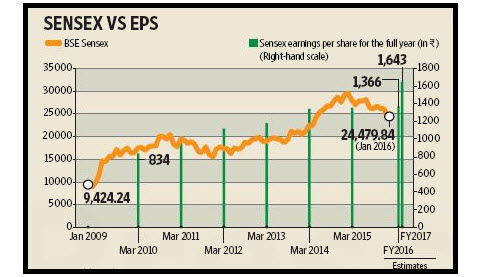 True, the expectation is that things will get better later, with earnings projected to increase by 20.3% in FY17. But that could be rather over-optimistic, what with earnings estimates still being cut. Also, global volatility may make the target difficult to achieve, as earnings growth is linked to external factors too. More than half the Sensex earnings are dependent on external factors.
The world may have started the downtrend in equities, but it also showed up India's Achilles heel. Even now equities are trading at a price-to-earnings multiple of about 18 times their past 12-month earnings. If earnings growth in the future is at risk of a downgrade, then valuations are bound to correct now.
There is another macroeconomic factor at work here-deflation or disinflation. Nominal gross domestic product (GDP) growth is decelerating. The latest numbers of gross value added at current prices show that growth fell from 14% in the first quarter of 2014-15 to 5.2% in the second quarter of 2015-16. That steep fall in nominal GDP growth has an impact on sales growth for firms and, therefore, for growth in earnings too.
In arrangement with HT Syndication | MINT
Ask Value Research 

 New episodes every Friday


 New Process Alert
 Seems like you've uploaded a wrong QR code. Please upload the QR code downloaded from MF Central platform.


