




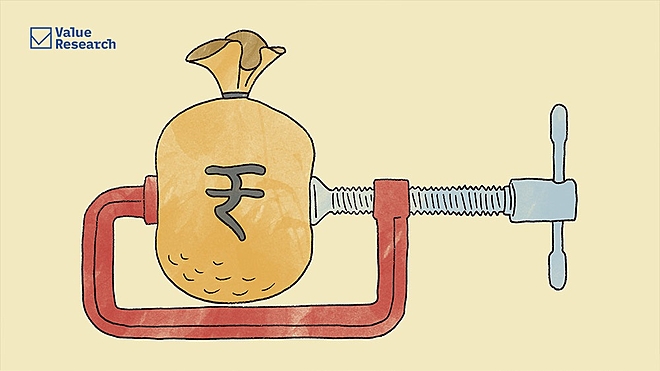
 Illustration: Anand Kumar


Over the last few days, a number of mutual fund companies have made public the results of a 'stress test' that the markets and mutual fund regulator SEBI has asked them to conduct on their small and mid-cap funds. The result has been a series of headlines in the business papers in the pattern of "6 days required for 50% portfolio liquidation of XYZ Fund" and so on. The stress test, whose methodology is not public, is designed to tell us in how many days would a fund be able to liquidate 25 per cent and 50 per cent of its portfolio.
Of course, as everyone who has any familiarity with how the equity markets work, they do nothing of the sort. If a stress test says that a fund can sell off half its portfolio in six days, it does not mean such a thing will happen. It just means that if you make an Excel spreadsheet with certain assumptions, the number six comes up as the answer. That's all, nothing more. This is not a tool for predicting what will really happen.
I don't mean this as a criticism of those who are involved in designing and conducting this test--it's more or less their job. However, the real question is what are investors supposed to do with the stress test results. As quoted in the media, "The purpose of this stress testing, conducted by AMFI on behalf of the regulator, is to educate mutual fund investors about the risks associated with market volatility and its impact on the liquidity of their equity portfolios. This information enables investors to make informed decisions about rebalancing and reallocating their investments according to their preferences."
What does 'make informed decisions about rebalancing and reallocating their investments' mean in terms of actual actions that investors should take? Does this mean that if the fund that I have invested in will take 20 days to liquidate 25 per cent while another one will take eight days, I should shift my money from the former to the latter? What if the 20-day one has a much better track record than the eight-day one? What should the investor do? What 'informed decision' should investors take? Most investors would have no clue. What these stress test results are actually doing is throwing in a completely new thing for investors to worry about without any actual contribution to their decision-making in terms of actionable.
I'll point out a few things that might help investors figure this out.
First, these stress test results are basically just a proxy for fund size. That is, for the amount (not percentage) of small or mid-cap holdings that a fund has. This is not rocket science--it should be self-evident that selling Rs 10,000 crore of small-caps will take a lot longer than selling Rs 2,000 crore. I get a pretty clean line when I generate a chart showing the correlation between small and mid-cap holdings and the stress test results. There are one or two anomalies, but nothing worth paying attention to. Therefore, if an investor is looking to these tests for guidance, it would just be 'avoid big funds'. The tiniest funds look the best, and the largest ones look the worst. I don't think this is a sensible way to choose funds.
Second, what these tests are trying to do is to look at the liquidity of small stocks in good times and draw conclusions about what the liquidity will be during a market crash. This is problematic, to say the least. All experienced market hands know that this could actually be a contrarian indicator; that is, the more liquid small stocks are worse. Surprised? The reason is that in a time like the current ones, promoters and others are generally holding tight to good companies. At the same time, the fixers and the operators are busy generating volume and rigging the dud stocks. I'm sure you understand what will happen if the markets crash.
Anyway, stress tests like this are common in all parts of global finance nowadays. As far as actual mutual fund investors go, there is no upside to paying attention to them.
Also read: Stress test results of mid-cap and small-cap funds
Ask Value Research 

 New episodes every Friday




 New Process Alert
  Seems like you've uploaded a wrong QR code. Please upload the QR code downloaded from MF Central platform.


