




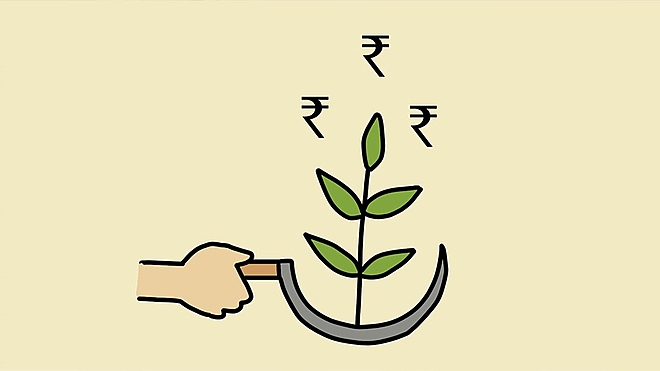
 Illustration: Anand Kumar


I'm going to give you some agricultural advice in this column. You might think that I'm not qualified to give farming advice, but I can assure you that many more of my ancestors were farmers than were investment analysts.
Here's the advice, expressed very succinctly:
- Don't shout at the crops - don't blame the crop for not growing fast enough.
- Don't uproot crops before they've had a chance to grow.
- Choose the plants that are suited to the soil and the weather.
- Irrigate and fertilise. Remove the weeds.
- There will be good seasons and bad seasons - you can't control the weather. You can only be prepared for it.
That's all about agriculture. Since the above advice will be useless for the savers and investors who are readers of my column, let's move on to investments.
Investors often make investments with false expectations - I know because I have done it often enough. When we choose an investment - be it a stock or a mutual fund - it's an act of belief, of commitment. We chose the investment, and so in a sense, we are responsible for it. No one chooses an investment with the hope that it will make modest gains or give returns about equal to the markets. Inevitably, the expectations tend to be high, and the reality for many of our investments does not meet the expectations. At this point, the natural reaction is to pass the blame on to the stocks, fund manager, advisor, or whoever. It's human nature. However, the truth is that no matter what type of investments we make, it's our money, and we are responsible. If we make a bad decision, it's better to recognise it as such, understand what happened and move on.
But how do we know if the decision was really bad? Often, we don't. Investors - the whole market, actually - tend to go through cycles of euphoria and depression. Just as we are over-optimistic about investments in the beginning, we get over-pessimistic if they don't meet our initial expectations. It's easy to fall into the trap of getting pessimistic and selling our investments early. If your initial thesis of why that was a good investment still holds, keep holding it. The problem is that most of us start with more hope than actual reasoning, but that's a problem to be solved initially, not by selling too early.
Choosing investments that are not suitable for us is another common trait. In fact, there's something quite strange about how the process of choosing investments often begins. When a saver wants to know where to invest, the worst question to start with is the obvious one: "Which investment should I choose?". However, it's the wrong one. The right question to ask first is, "What do I want from my investments and, therefore, what type of investment should I choose?" If the investment is the wrong type, then it matters little that it does well - it still doesn't solve your purpose.
Of course, choosing good investments is not enough. Good investments go bad, or your needs can change. Your portfolio may require periodic rebalancing, and underperforming investments may need to be replaced to keep your portfolio healthy and suitable for your needs.
Finally, everything can be ship-shaped with your investments, but external events can still cause some problems. Isn't it strange that investors worry about things they cannot control while ignoring things they actually can? Can you influence economic growth? Wars and conflicts? Energy prices? Interest rates? No, you can't. Can you control which investments you make and at what value? Of course, you can!
It's much better to be prepared for anything but not expect things to go smoothly. Times will be better sometimes, and sometimes they will be worse, but mostly, they will keep getting better. Our job is our investments, not the environment.
Ask Value Research 

 New episodes every Friday








 New Process Alert
  Seems like you've uploaded a wrong QR code. Please upload the QR code downloaded from MF Central platform.


