






Success has many fathers, but failure is an orphan. Like everything else in life, this line rings true in investing.
Consider the dividend yield category of mutual funds. Its success in recent months has made it a trendy option for investors. The best example of this is when SBI Mutual Fund launched a dividend yield fund earlier this year and raised Rs 3,500 crore from the public in no time.
Since they are attracting such high traction, we thought of giving you an overview of these funds.
What are they?
This type of mutual fund invests at least 65 per cent of the money in companies that announce high dividends. (Generally, cash-rich IT companies and public sector undertakings (PSUs) declare high dividends).
Their short-term performance
In the last 12 months, these funds have given solid returns, delivering a little over 27 per cent.
To understand the reason/s, we reached out to Aditya Birla Sun Life - the best-performing fund house that has given a whopping 36.57 per cent returns in the last 12 months.
Their chief investment officer (CIO), Mahesh Patil, said:
- They trimmed their holdings in IT (in 2022).
- They moved towards mid-sized public sector banks.
- They took exposure to consumer-centric companies with a global outreach.
However, please remember that these reasons worked for the Aditya Birla-managed dividend yield fund alone. The others may have different answers for their outperformance.
Reason for caution
One swallow doesn't make a summer, meaning one-year performances can never indicate a fund quality. And that holds for dividend yield funds too.
Their long-term performance. It's underwhelming.
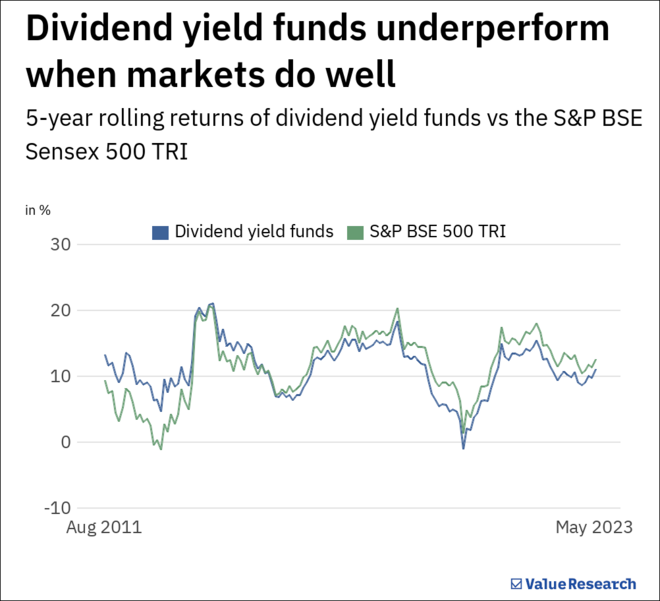
Be it their 5- or 10-year returns, dividend yield funds have underperformed the S&P BSE 500 TRI benchmark, as shown in the table below.
Dividend yield funds vs S&P BSE 500 TRI
| 5-year returns | 10-year returns | |
|---|---|---|
| Dividend yield funds | 12.69% | 14.30% |
| S&P BSE 500 TRI | 13.25% | 15.31% |
What's the reason?
One of the fund managers, requesting anonymity, said these funds have generally struggled when the markets do well, and vice versa.
Aditya Birla's Mahesh Patil also concurred: "Dividend yield as a strategy doesn't work during phases where growth stocks do well or when the markets are in a euphoric zone."
This theory is largely true. For instance, in 2011, when the markets slumped and BSE S&P 500 fell 26 per cent - dividend yield funds fared slightly better. Conversely, these funds trailed the BSE S&P 500 during the post-Covid market bounce in late 2020 and early 2021.
What you should do
Go for a more diversified equity fund instead. Flexi-caps (for aggressive investors) and aggressive hybrid funds (moderate investors) can be viable alternatives. If you wish to get the top-rated funds in these two categories, you can head to our Premium section Analysts' Choice .
Why? While checking the portfolio of dividend yield stocks, we noticed that their investments weren't very different to a normal diversified equity fund. It's just that they had an additional filter of stocks that pays high dividends. We feel this added filter can be restricting and distracting in equal measure.
Furthermore, even though these funds have low exposure to PSUs, you can't ignore the fact that they still do. That's not pretty because most PSUs have proven to be duds in the long run, at least from an investment point of view.
And lastly, if you thought these funds gave you regular income by distributing dividends at frequent intervals, that's not true either. The dividends paid by these companies are reinvested. You don't get any payouts.
Also read: What are momentum funds?
Ask Value Research 

 New episodes every Friday






 New Process Alert
  Seems like you've uploaded a wrong QR code. Please upload the QR code downloaded from MF Central platform.


