 Widely read:




The Reserve Bank of India (RBI) has raised interest rates in its recent policy to combat inflation. With yields on various debt securities rising in response, many fund managers expect the rate hike to eventually pause and reverse in the coming months, particularly as inflation trends downward and major economies' growth improves.
However, some investors may be wondering whether it's time to consider longer-term debt funds. While long-duration funds may offer higher returns in a scenario of falling interest rates, they can also be more volatile than short-duration funds. For this reason, we at Value Research continue to prefer all-weather "short-duration" debt funds.
Why long duration funds may come in action
Returns on debt funds are influenced by interest rate fluctuations. In recent months, long-duration funds provided low or negative returns due to rising interest rates. However, long-duration funds can outperform when interest rates fall. Bond prices and interest rates have an inverse relationship; as interest rates rise, bond prices fall, and vice versa.
As the outlook for major economies' growth improves and inflation is on a downward trajectory, some fund managers expect interest rates to decline, which could benefit long-duration funds. In fact, some of the top fund houses have launched long-duration funds on the expectation that the rate hike cycle may have come to an end. But it is important to note that long-duration funds can be more volatile than short-duration funds.
Debt fund returns
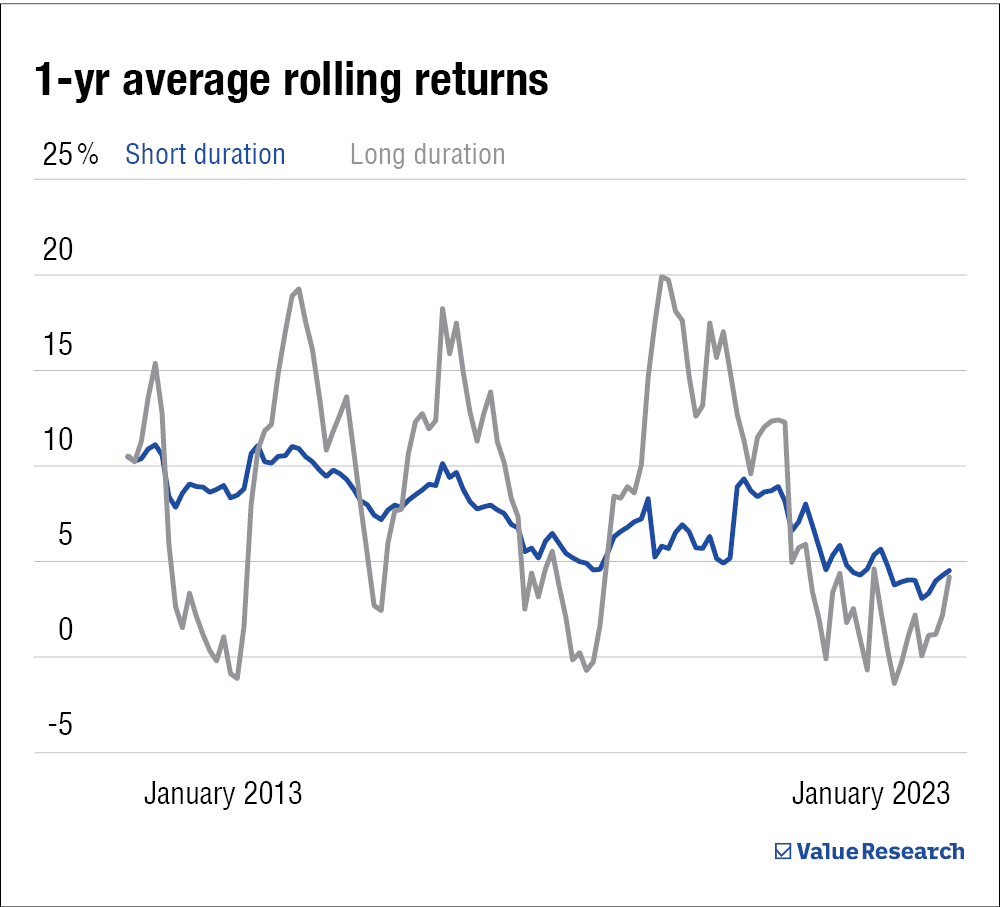
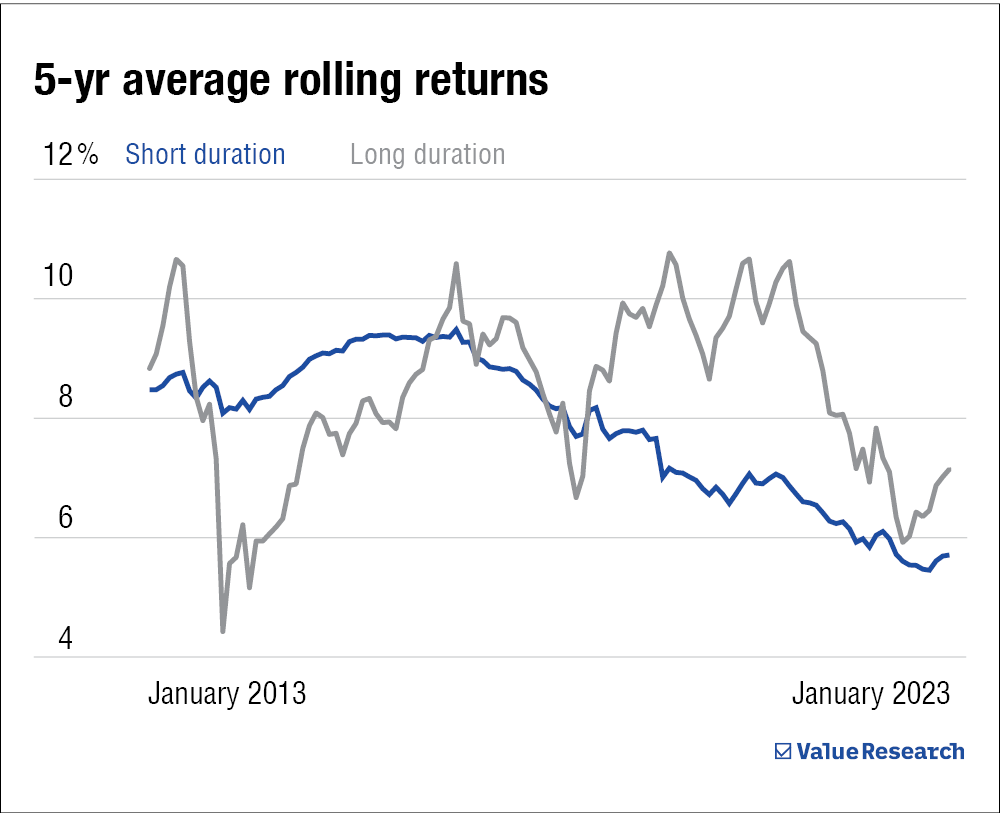
After analysing the returns of various debt fund categories over the past few years, it was found that short-term funds are less volatile than long-term and medium-to-long-term funds. Looking at the average one-year rolling returns of short-duration funds over the last 10 years, the returns ranged from 2.77 per cent to 11 per cent. In contrast, long-term funds have been quite volatile, with returns ranging from -1.7 per cent to as much as 20 per cent, while medium-to-long-term funds have returned between 1 per cent and 15 per cent (see the graphs of 1-yr and 5-yr average rolling returns).
4 Million+ copies sold! Get investment insights, market guidance, fund analysis, data stories, case studies and more. Subscribe to our digital & print magazine - Mutual Fund Insight.
Short-duration debt funds, which invest in debt with maturities ranging from one to three years, provide a good balance of returns and risks for three-year goals. Even over a five-year period, short-term debt funds have outperformed long-term debt and medium-to-long duration funds. This suggests that the limited investment mandate of short-duration funds actually works in their favour.
What you should do
Long-duration funds may become more attractive if the RBI begins to lower interest rates. These funds can be beneficial in the coming months, but investors should be prepared to sell when interest rates rise. Timing is key with long-term funds, and investors looking for evergreen debt funds may be better served by continuing to invest in short-duration debt funds.
In conclusion, while long-duration funds offer the potential for high returns, they also come with higher volatility. Short-duration funds, on the other hand, may not offer the same potential for big returns, but they do provide predictable returns and can be a good option for investors looking for a more stable investment.
Suggested read: Money magnets of 2022
Disclaimer: This content is for information only and should not be considered investment advice or a recommendation.
For grievances: [email protected]
Ask Value Research 

 New episodes every Friday








 New Process Alert
 Seems like you've uploaded a wrong QR code. Please upload the QR code downloaded from MF Central platform.


