 Widely read:



With many experts claiming equal-weighted index funds to change the face of passive investing in India, we decided to do some number-crunching to get to the bottom of the matter.
We compared them with their direct rival - market cap-weighted index - to see if there is any substance in their claims.
Now, if terms like 'equal-weighted' and 'market cap-weighted' sound Greek to you, worry not because we'll quickly explain what they are before proceeding.
Brief background
Let's say you want to invest in the Nifty index, home to 50 of the largest stocks in the country.
If you invested in a market cap-weighted index fund...
A greater percentage of your money would be invested in the larger Nifty stocks.
For instance, if Reliance Industries comprises 10 per cent of the Nifty index, the same percentage of your money will be invested in that stock.
Similarly, if a stock has 0.2 per cent weight in the Nifty, only that proportion of the money would be invested in that particular stock.
If you invested in an equal-weighted index fund...
An equal percentage of money would be invested in each of the stocks present in the index.
In your case, 2 per cent of the money would be invested in each of the 50 stocks present in the Nifty.
Now that we understand the difference, let's look at their long-term performance.
5-year performance
Assuming we create a mutual fund that replicate these two indices.
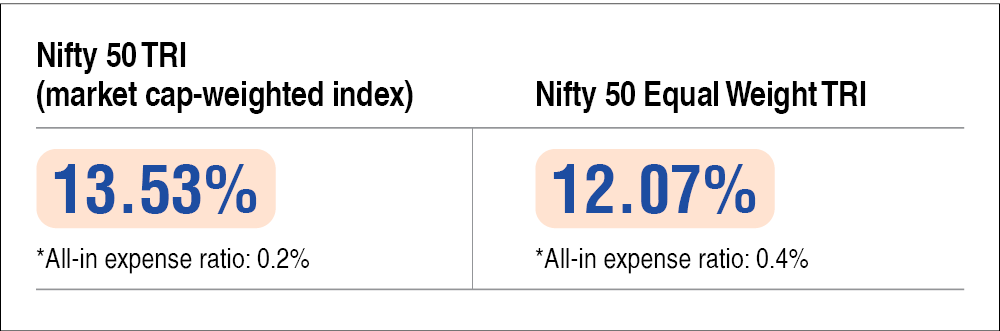
- The market cap-weighted index delivered higher returns, though with slightly higher volatility.
- But if we dig a little deeper, the two index funds' performance was also dependent on how the stock market was performing at the time.
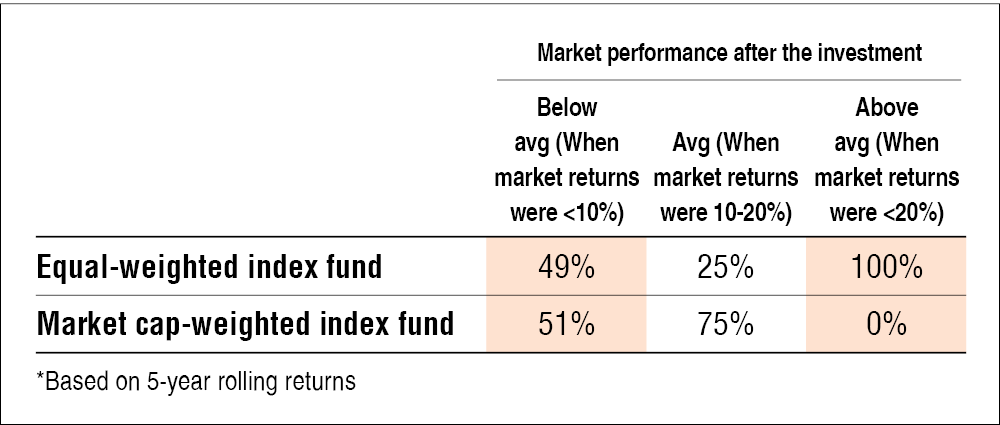
- The table shows there is no clear winner when the stock market delivered less than 10 per cent returns ('below average').
- However, there was a visible performance gap in the other two scenarios. When the stock market was delivering 'average' returns of 10-20 per cent, the market cap-weighted index fund outperformed an equal-weighted fund three out of four times.
- On the other hand, the equal-weighted index fund turned out to be a better choice every single time when the market was bullish and gunning over 20 per cent returns,
7-year performance
Assuming we create a mutual fund that replicate these two indices.
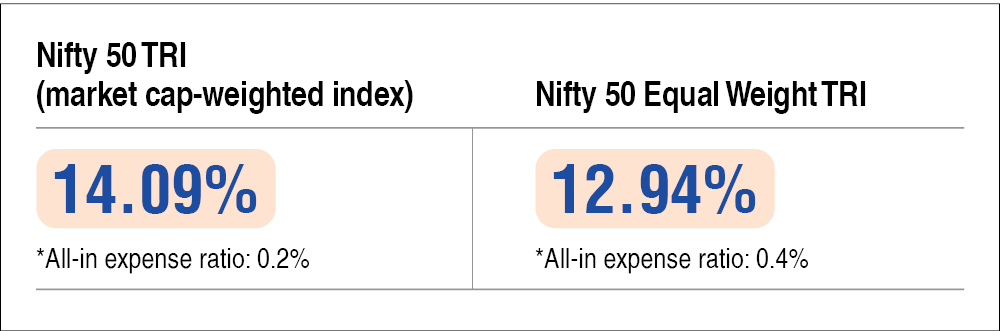
- The market cap-weighted index fund emerged victorious over a 7-year period and was also less volatile, albeit by a hair's breadth.
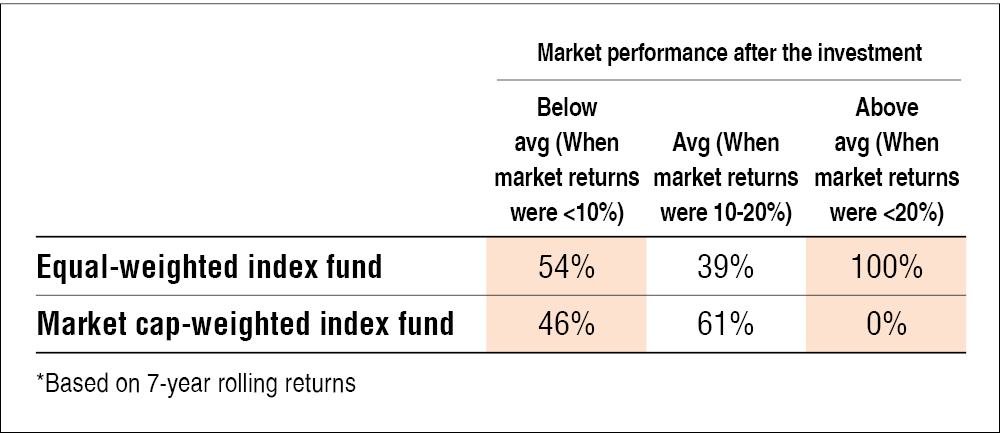
- Interestingly, even though market cap-weighted index funds did deliver better 7-year returns, its performance superiority emerged strongly when the stock market was in an 'average' state (delivering 10-20 per cent returns).
- But when the stock market was in red-hot form (posting above 20 per cent returns), the equal-weighted option was a clear frontrunner without fail.
- And when the market was in a sluggish state, generating less than 10 per cent returns, there was little to choose between the two funds.
10-year performance
Assuming we create a mutual fund replicating these two indices.
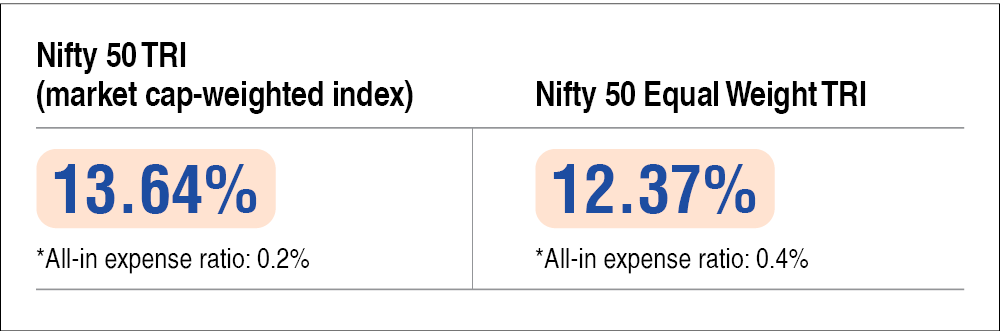
- The market cap-weighted index fund maintained its dominance in this timeframe as well.
- It pipped the equal-weighted index fund from a volatility perspective too.
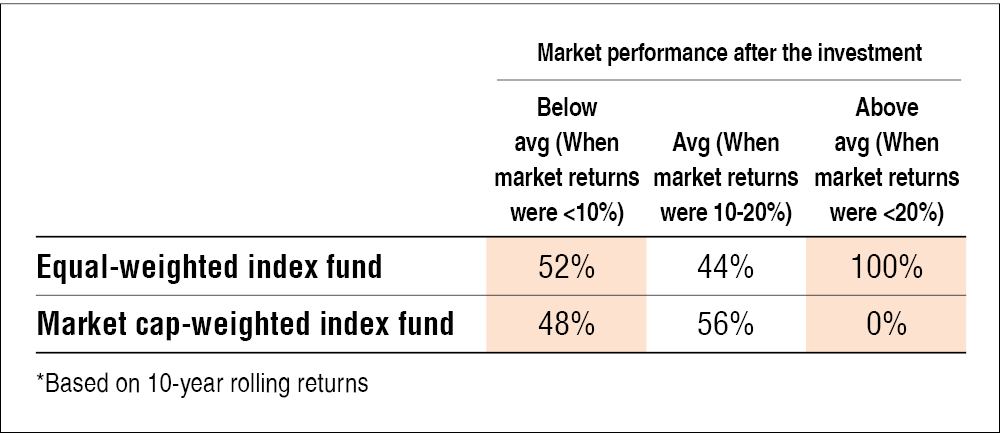
- While market cap-weighted funds had the upper hand when the markets were delivering 'average' returns, its opponents always gave higher returns when the markets were growing 'above average' (20 per cent returns and more).
Our takeaway
- Performance: Market cap-weighted index fund is the clear frontrunner when you look at the headline numbers. Be it their 5-, 7-, 10-year performance, they have always outgunned the equal-weighted fund.
- Volatility: While there's not much to choose between the two, the market cap-weighted fund has its nose ahead.
- 'Good' market performance: Equal-weighted funds have ALWAYS outperformed when the stock market is delivering more than 20 per cent returns.
That's maybe because equal-weighted funds are structurally closer to 'value' style of investing. It is contrarian in nature because they buy underperformers and sell outperformers to ensure all their stocks have equal weight.
Suggested read: All you need to know about mutual fund risk-o-meter
Disclaimer: This content is for information only and should not be considered investment advice or a recommendation.
For grievances: [email protected]
Ask Value Research 
 New episodes every Friday






 New Process Alert
 Seems like you've uploaded a wrong QR code. Please upload the QR code downloaded from MF Central platform.


