




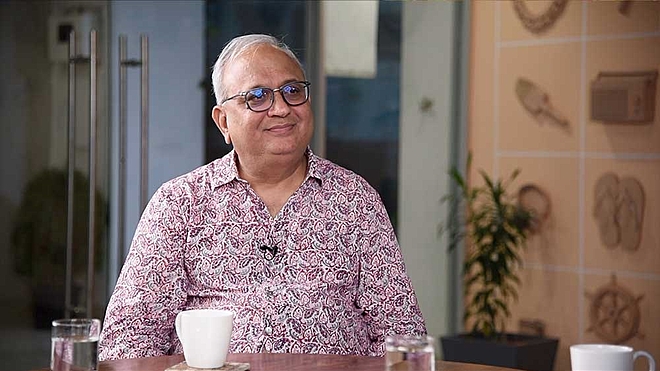
Samir Arora is the founder of Helios Capital Management (he, along with two others, founded it in 2005) and a fund manager there with three decades of experience. Earlier, he was associated with Alliance Capital, where he received various recognitions during his time as the Head of Asian Emerging Markets. In PMS AIF World's webinar, Arora gave eight golden lessons to remember. Here is a summary of them:
1. Do not fool yourself or the public
Sticking to one particular style of investing forever is fruitless. Arora criticised fund managers who claim that they do not look at inflation, interest rates and the market. While it is difficult to predict them, one can never ignore them while investing. He says, "You have to be sensitive to everything and the worst thing you can say to yourself is I don't look at the market".
2. Do not use hindsight analysis to predict the future
Most investors look at the best performers of the past decade or two and think that by investing in companies like them, they can replicate the performance. Actually, investors should look at the factors that led to such high returns. "How would you have known 25 years ago that this was a good company to buy, and how would you have imagined that these companies will do better than other companies?" Asks Arora.
3. Do not overpay
A classic lesson that every investor should keep in mind. Investment is nothing but an exchange where we receive a financial asset for money. We have to make sure that the asset is worth the price we pay and we simply cannot ignore this.
4. Learn from the masters
Arora quotes legendary investors and experts such as Warren Buffett, Seth Klarman, and Aswath Damodaran and suggests how even an excellent company can be a bad investment at the wrong price.
5. Do not be confused
While cash flows are important as earnings may not convert into real cash, in different sectors, they are already priced in. In the long term, the company is driven by revenue and earnings, and that is why in the long run, there will not be much difference between earnings and cash-flow growth. "Cash flow is basically converting earnings into cash; it is not coming out of thin air," exclaims Arora.
6. The Halo effect
The market's opinion of a company greatly depends on its price and growth. Arora mentioned 'Fortune' magazine's commentary on Cisco as an example. When Cisco's stock was doing well, 'Fortune' had a favourable view of the company but when the stock started doing badly, 'Fortune' found several problems with the company.
7. Act like the casino and not a gambler
Saying 'buy good companies and hold them for long periods' is easy but vague. Have a definition for yourself: What is a good company? What is long-term? What if a company is nearly good? He listed eight such parameters and any company that does not qualify them can be rejected. "You have to have a philosophy or a framework" to define your investment, he says.
8. Know your limits
Sometimes investors increase their time horizon too much to justify their investments in a company. This is foolish. Just looking at the metrics of best performers and saying those are the key to high returns is also bad. Also predicting growth over 10-20 years for a medium-term investment is also not reasonable. "You cannot choose five-10 companies and create a story," says Arora.
But the ultimate golden lesson that he gave is what you read in the heading of this story: "Nobody knows anything about anything beyond a point". This indicates the healthy amount of uncertainty that prevails in the market at any time and that no one really knows what will happen. Click here if you wish to watch the full video.
You can also watch our exclusive interview with Samir Arora, the first in the brand-new series of interviews, where our host, Dhirendra Kumar, will pick the brains of India's top fund managers.
This article was originally published on October 17, 2022.
Ask Value Research 


 New episodes every Friday










 New Process Alert
  Seems like you've uploaded a wrong QR code. Please upload the QR code downloaded from MF Central platform.


