





Recently S&P BSE Sensex reached its all-time high and all the investors were happy about it. So happy that we actually did a story on it! The Sensex has been the market indicator since 1986, the year it was introduced. Whenever people want to know where the market is headed or how the market has been performing, Sensex is the first thing that comes to our mind. But one question popped in our head; is Sensex the best way to know the health of the whole market?
Sensex constitutes the 30 largest stocks in BSE, but there are thousands of stocks and various indices other than Sensex which have their own price movements and external factors. Therefore, should Sensex movement really be the indicator for everyone in all scenarios?
For instance, looking at how many stocks have fallen from their 52-week highs in BSE Sensex, BSE Midcap, BSE Smallcap, and our street favourite BSE IPO, all tell a different story. Here are the results:
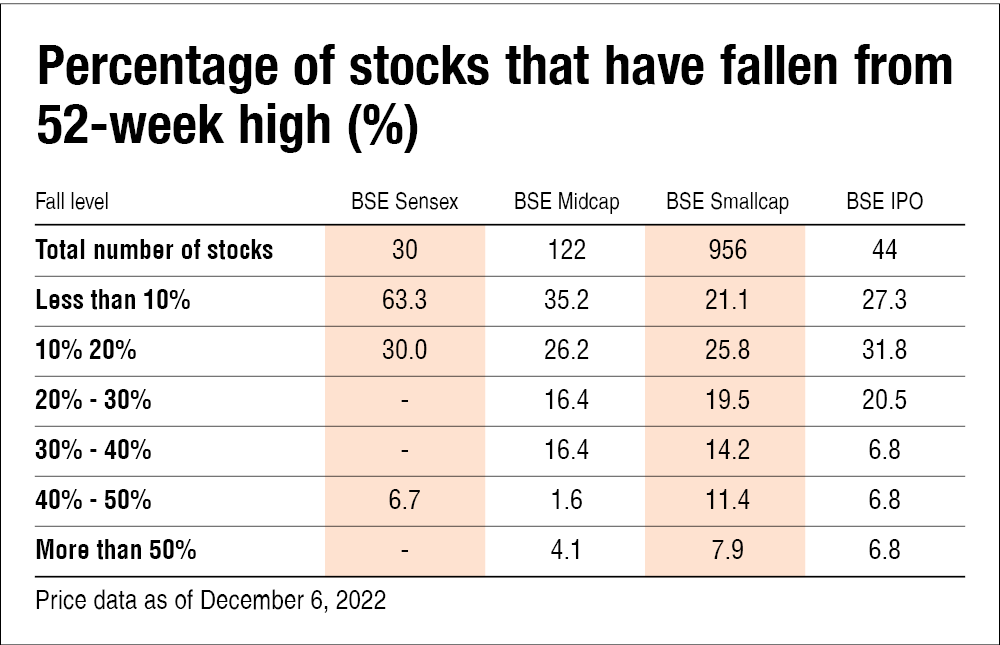
As you can see from the table, although Sensex stocks have fallen a bit from their 52-week highs, most of them have fallen less than ten per cent. Only two stocks, Tech Mahindra and Wipro, have fallen more than 40 per cent. Is it the same for other indices? Not at all. Midcap is somewhat worse with 47 stocks falling more than 20 per cent. Smallcap is much worse. 6.8 per cent of the stocks have fallen from their 52-week highs. This may seem like a small number to you until you realise 6.8 per cent is actually 76 stocks!
The conclusion we arrive at from this is also the reason why the question popped in our head. If an investor has heavily invested in small-cap and mid-cap companies, is Sensex really the best indicator for them? As trivial and elementary as this may sound, many investors still correlate their portfolio health with the Sensex movement. While the benchmark index has 30 of the largest stocks with a proven track record - both business and market-wise, we cannot say the same for mid and small-cap stocks. Thus, especially in a volatile market like the one we are facing now, it is better to compare your portfolio with relevant indices other than Sensex.
How can you do this? We at Value Research have a simple way. If you click the 'Stocks' dropdown at the top of the homepage, you will be greeted with a bunch of options. There you need to click 'Market Watch'. In that page you will be able to see all the BSE indices and their returns on a trailing, annual, quarterly, and even monthly basis. Based on which market cap or sector your portfolio is concentrated in, you can compare the returns.
Ask Value Research 

 New episodes every Friday








 New Process Alert
  Seems like you've uploaded a wrong QR code. Please upload the QR code downloaded from MF Central platform.


