




All companies have three groups of people that they need to keep happy - customers, investors and employees. These three groups have a stake in the eventual success or failure of a company, which is why they are also known as 'stakeholders'. However, the needs and demands of each stakeholder are often at odds with each other.
Let's take the case of employees. If a company overpays its staff, it is reducing its profit and taking money away from investors. However, if the company underpays its staff, it may result in a disgruntled staff providing a poor service to customers. Striking the right balance and paying employees just the right amount can be a difficult balancing act. Depending on the size of a company, employee cost can often run into thousands of crores, which means that a slight error can have huge consequences.
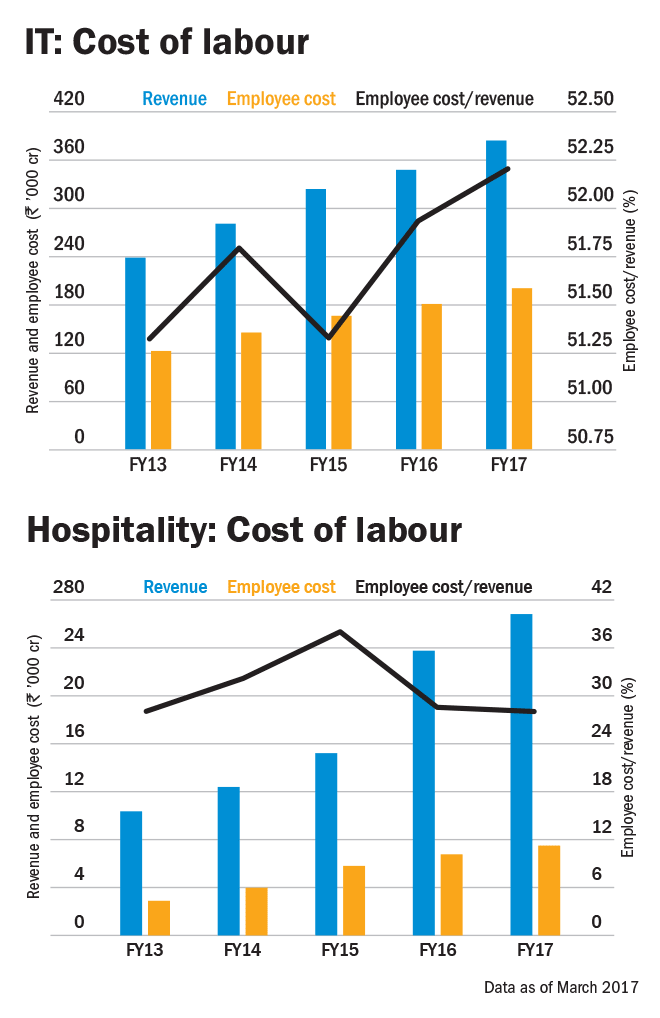
The sector that is the focus of this conversation is information technology. No other sector faces higher employee costs than the IT sector. Since people are essentially the 'raw material' of software companies like TCS or Infosys, employee costs are the biggest expense for such companies. In the five-year period from 2013 to 2017, IT companies paid an average of 52 per cent of revenue in salaries and benefits to employees.
Ranking below IT, the hospitality sector is another sector that needs to pay close attention to employee costs. Hospitality companies, like Thomas Cook or EIH, spend lavishly on salaries and benefits for employees. In the five-year period from 2013 to 2017, hospitality companies paid an average of 31 per cent of revenue in salaries and benefits to employees.
On the other hand of the spectrum, companies dealing with industrial and natural gas like Petronet LNG and GAIL India pay the lowest employee costs. What other companies spend on retaining employees, these companies spend on building and improving infrastructure. In the five-year period from 2013 to 2017, the companies in the industrial-gases sector paid an average of 1 per cent of revenue in salaries and benefits to employees.
Much of what a company pays in employee costs is specific to the sector. As such, the ratio of employee costs to revenue can be a good metric to judge the labour-market conditions faced by a particular sector.
Ask Value Research 

 New episodes every Friday



 New Process Alert
 Seems like you've uploaded a wrong QR code. Please upload the QR code downloaded from MF Central platform.


