


The stock market is one of the few mechanisms that incorporate the best of both worlds. Businesses get to raise capital through it and ordinary people get to benefit from the growth prospects of big businesses. But since reality is generally far from being perfect, it was seen that many promoters held a tight control over the listed companies.
In 2010, SEBI mandated listed companies to have a minimum public shareholding of 25 per cent. This move was aimed at increasing liquidity and institutional participation, along with putting a curb on price manipulations. Seven years down the line, SEBI is again considering increasing the minimum public shareholding to 30 per cent. The aim again is to increase liquidity in the market, which would then help in better price discovery.
This proposal is likely to impact 718 companies among the listed companies, leading to a transfer of around Rs 2.93 lakh crore or 9 per cent of the total market cap (as on November 14, 2017) from promoters to the public. Below is a list of 20 companies that are going to be impacted the most.
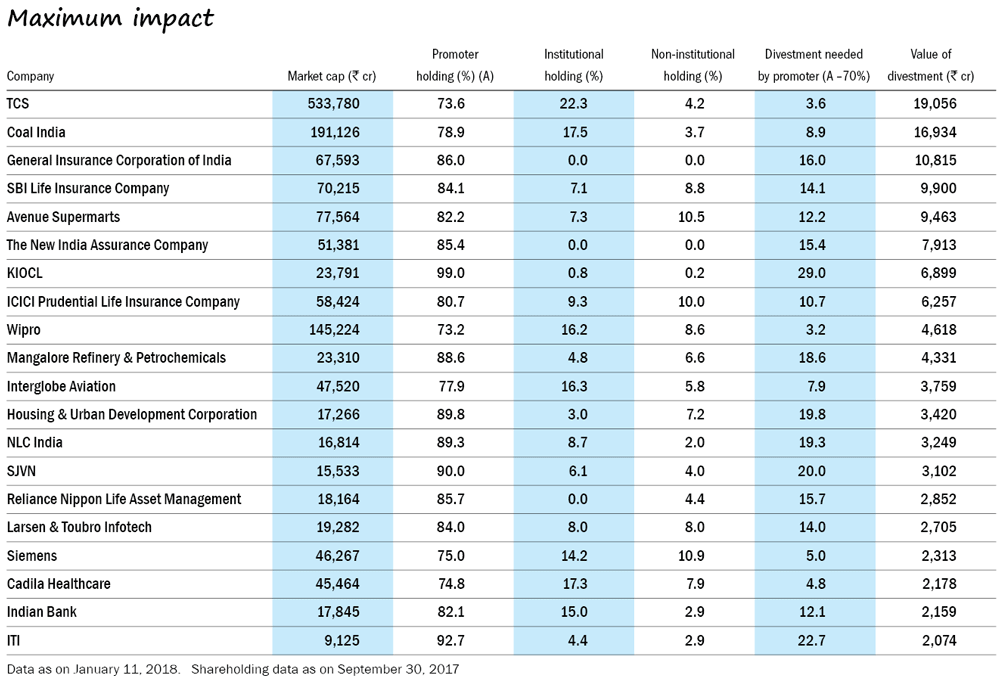
How will government-owned enterprises be impacted by this move? For public-sector undertakings, this shift would amount to more than Rs 33,512 crore as PSUs have high government holdings. This could pave way for an extended divestment exercise in the form of exchange-traded funds or offer for sale.
Ask Value Research 

 New episodes every Friday


 New Process Alert
 Seems like you've uploaded a wrong QR code. Please upload the QR code downloaded from MF Central platform.


