





No article on the real estate and housing in India fails to mention the shortage of housing stock running into millions. Yet, a look at the financials of real estate developers reveals a high financial stress. Demand has been weak for several quarters, and while new project launches have fallen, unsold inventory remains high. It appears to be a buyers' market. But is a real estate investment likely to give good returns in the near term?
Demand logic remains weak
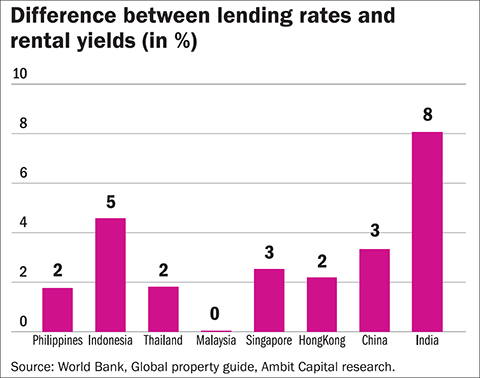
In conversations, we rarely make a distinction between 'need' and 'demand'. While the former signifies a requirement for consumers (who does not need a shelter), demand implies a 'willingness and ability to pay'. Without the latter, i.e., the ability to pay, there is no demand. Affordability remains a major issue in India. In most markets around the world, rental costs almost equal interest and principal repayments that a consumer will have to incur for a loan to purchase property. In India, this equation is severely distorted: While gross rentals rarely exceed 3 per cent in most micro markets, the interest rates for housing loans are around 10 per cent. In effect, investment in housing stocks makes sense only and only if a large dose of price appreciation is factored in.
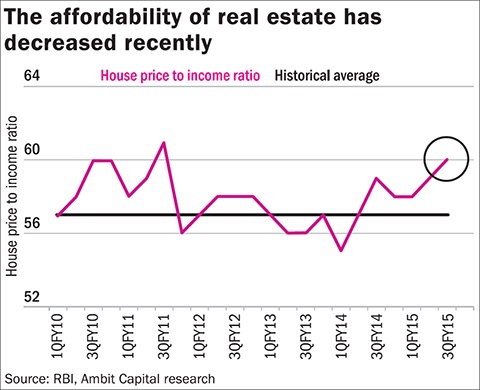
Sustained rise in real estate prices and stagnant incomes have resulted in falling affordability in recent times. Combined, this negative 'carry' (high mortgage rates compared to rents) and falling affordability have led to a prolonged slowdown. Need has not resulted in demand.
Inventory remains high
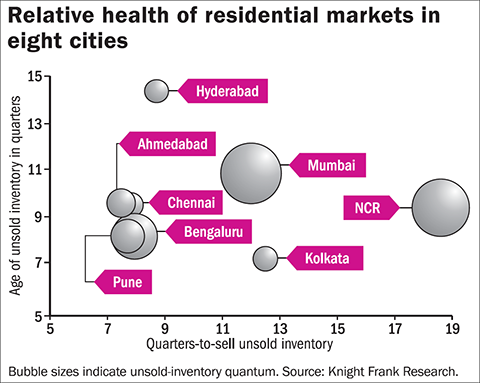
The quarters-to-sell (QTS) figures for the existing unsold inventory are well over the healthy mark of five-six quarters. This is so despite a rapid fall in new launches. In the premium segment, there was a fall of 35 per cent in new launches in H1 2015. Inventory in most top cities remains uncomfortably high.
While prices have corrected in some micro markets, the correction has not been severe enough to clear the inventory. Entry of non-traditional sources of funding can partly be blamed for this stickiness of prices. Many real estate projects are now funded by private-equity investors and through structured products marketed by wealth managers. This lowers the cost of funding for builders, thereby increasing their capacity to sustain without sales for longer periods. However, these products are quasi-debt in nature. It is possible that if sales do not pick up soon, the sector could unravel.
Further price fall could adversely impact financial markets
Over the years, the RBI has been careful to monitor the banking sectors' exposure to real estate. Despite this, an estimate by Ambit Research puts banking exposure to real estate at $142 billion, making it 15 per cent of non-food credit. Home-finance companies add up another $68 billion. In addition, direct private-equity and investor exposure could easily add another 10 per cent to the lending book. General credit growth has been subdued on account of poor economic growth, forcing lenders to look more favourably towards loans against property due to the presumed higher security. This competition between lenders has lowered loan-to-value (LTV) ratios. With property valuation remaining more an art than a science, 'value' itself is a difficult number to estimate, making the collateral flaky.
Further drop in real estate prices could put serious pressure on lenders as the quality and amount of collateral reduces. This potentially can trigger a negative spiral in prices.
Why should prices fall?
We have already seen that investment in real estate is not justifiable without assuming price appreciation. Lack of affordability impacts end-user demand. With prices falling, investor interest is already subdued. Rising stock markets offer better returns in the near term.
Another important factor is the crackdown on corruption by the government. While the impact is likely to be longer term in its nature, steps to increase transparency in natural-resource-allocations reporting of foreign holdings by individuals, a focus to implement GST are all structural changes that will impact generation of unaccounted money. On average, over 30 per cent of the value of real estate is still carried out in unaccounted money. If the generation of black money slows down, it will inevitably reduce demand for real estate.
Near-term negative, long-term positive
Fall in real estate demand will have a near-term negative impact on the economy. Housing growth has a multiplier effect on demand. Anyone buying a house will necessarily have to paint, furnish and buy consumer durables. This creates demand for a variety of products. Conversely, slowing demand will have a follow-on effect as well. If accompanied with stressed banks, the effect on the economy could be serious.
In the longer term, however, lower real estate prices and lower or negligible speculative gains on property will force more money into productive assets. Many businesses are not viable in India due to high real estate costs, organised retail being a good example. Realistic real estate prices will eventually drive end-user demand with attendant follow-on benefits.
For a stock market investor, despite apparent low equity prices of many listed development companies, investment remains a question of estimating cash-flow-generating capacity. High leverage, often through off-balance sheet structures makes this difficult to analyse. The more important question to ask, given banks' weightage in investor portfolios, is how badly banks will be affected by soft real estate markets.
Anand Tandon is an independent analyst.
This column appeared in the October 2015 Issue of Wealth Insight.
This article was originally published on November 06, 2015.
Ask Value Research 

 New episodes every Friday


 New Process Alert
  Seems like you've uploaded a wrong QR code. Please upload the QR code downloaded from MF Central platform.


