




 Anand Kumar/AI-Generated Image

Summary: Some stocks look expensive and quietly fall. Others look cheap and stay cheap for years. Both can cost you the same money, for opposite reasons. One company in this story has a clean balance sheet and a pile of cash, and still ends up on the wrong side of the line.
Every investor carries a mental shortcut for price: low P/E means cheap, buy it, high P/E means expensive, stay away. The shortcut works often enough that we trust it, which is exactly why it fails so badly when it does. A stock trading at 55 times earnings and one trading at seven times earnings can both cost an investor the same amount of money, for completely opposite reasons. The P/E is not lying in either case. The investor is asking it the wrong question.
Two separate traps hide behind these two situations, and they are nothing alike. One is a pricing problem. The other is a business problem. Confuse them, and you either sell a good company too early or hold a bad one for years too long.
The growth trap
A growth trap happens when the business itself is doing nothing wrong. Revenue is growing, margins are healthy, return on capital looks fine. The problem sits entirely in the price, which has already banked several more years of exceptional growth than most businesses manage to deliver.
Page Industries, which built and still dominates India's organised innerwear market through the Jockey brand, follows this pattern closely. Years of explosive growth, winning an unorganised market, eventually ran into simple arithmetic: a company that already owns most of a market cannot keep growing into it at the same pace. Profit kept rising. Growth merely slowed from exceptional to good. That was enough to pull the price-to-earnings multiple down.
Nothing broke in a growth trap. The business simply had to grow into a price that assumed it would keep sprinting forever.
The value trap
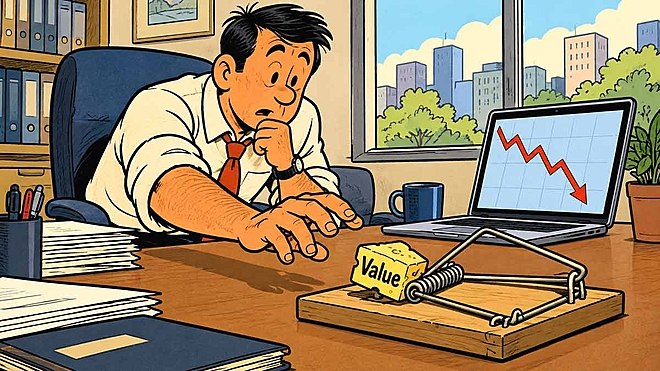
A value trap looks like the opposite setup and feels completely different to hold. The stock is cheap, and has stayed cheap for years. The temptation is to assume the market is wrong and due for a correction.
Vodafone Idea is the example most Indian investors will recognise instantly, a stock that spent years near its lowest levels while subscriber share, revenue and balance-sheet strength eroded together. For most of that stretch, the low price was not a mistake waiting to be fixed. It was the market correctly pricing a business that kept getting weaker. Government support and tariff hikes have since reopened the question of whether that verdict still holds, which is exactly the point: a value trap stays a value trap only for as long as nothing real changes inside the business.
A value trap does not even require a weakening business. Just Dial makes the sharper point precisely because its balance sheet is clean, return on capital is fine, and the company holds a cash pile worth nearly as much as the entire company. None of that has lifted its price-to-earnings ratio out of single digits, because the core local-search business has run out of growth.
| Dimension | Growth trap | Value trap |
|---|---|---|
| Starting signal | High P/E, business looks unstoppable | Low P/E, looks like a bargain |
| What is actually wrong | The price assumes too much, not the business | The business is getting weaker, not the price |
| What happens to earnings | Usually still rising, just slower than priced in | Flat or falling |
| What happens to the multiple | Comes down even while profit keeps rising | Stays low because nothing improves |
| The real risk | Paying today for results that arrive late, or never | Mistaking a weakening business for a bargain |
Four checks
Price alone tells you nothing. These four checks, run together, usually do.
| Check | What to look at | Growth trap tells you | Value trap tells you |
|---|---|---|---|
| Return on capital, three to five years | Direction of the trend | Usually still healthy, only decelerating | Usually falling steadily |
| Cash conversion | Operating cash flow against reported profit | Normal, profit shows up as cash | Often weak, profit does not turn into cash |
| Catalyst | A specific, dated reason things improve | Not required yet, growth itself is the story | Required, hope is not a catalyst |
| Balance sheet | Debt trend over the same period | Usually fine | Frequently rising, often used to paper over weak cash flow |
A worked example
To see the two traps side by side, let’s look at these three businesses.
| Company | P/E | 3Y avg. ROCE | Cash conversion | Catalyst | Verdict |
|---|---|---|---|---|---|
| Trent | 76x | 43% | Healthy | Growth is still the story | Growth trap, priced for more than it can keep delivering |
| SpiceJet | N/A | Negative net worth | Weak | Debt rating downgraded to default in July’26 | Value trap, cheap because the business keeps getting worse |
| Just Dial | 11x | 14% | Healthy | None | Value trap, since the growth is in question |
Trent passes three of the four checks. Its business is fine, its price is the problem, and price has also started correcting as growth is slowing down. SpiceJet fails on the business itself, weakening capital returns and debt the rating agencies now call unserviceable on time. Just Dial is the more unusual case: it passes capital returns, cash and debt cleanly, and still qualifies as a value trap, because a healthy balance sheet does not help a business with nowhere left to deploy it.
The one question that actually matters
Before buying a stock because it looks cheap, or avoiding one because it looks expensive, ask a single question: is the problem in the price, or is the problem in the business? If it is the price, time and patience are usually enough. If it is the business, whether it is actively weakening or simply has nowhere left to grow, no price is low enough, and no amount of waiting makes it one.
Also read: How to dodge value traps and find real gems
This article was originally published on October 06, 2026.
Ask Value Research 
 New episodes every Friday






__w120__h68__.jpg)



 New Process Alert
  Seems like you've uploaded a wrong QR code. Please upload the QR code downloaded from MF Central platform.


