
The Index Investor | 26-Sep-2026 | Ruchira Sharma

One simple plan for every age
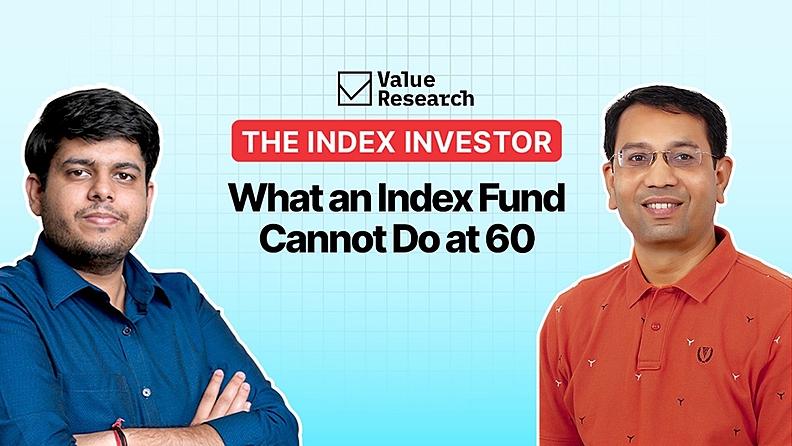
On The Index Investor, Value Research Fund Analyst Siddhant Madhav Joshi and Anup Bhaiya of Money Honey explain how a passive portfolio should change from a first SIP to retirement
Anup Bhaiya started his career in 1999. His first SIP came almost a decade later. "It took me 10 years to understand how powerful this concept of SIP was," he said. If he could start again, he would begin his SIP with his first salary.
That regret shaped my conversation with Anup, who has spent more than two decades in financial services, and Siddhant Madhav Joshi, Mutual Fund Analyst at Value Research. I asked whether one passive approach can take an investor from a first SIP at 25 all the way to retirement.
The building years
Both guests were bullish on index funds for young investors. Siddhant said index funds have repeatedly beaten most active funds in large caps and mid caps. He expects the room for alpha to shrink further as Indian markets grow more efficient.
His advice for anyone in their 20s is deliberately boring. One or two broad indices will do. Those who want more mid- and small-cap exposure can choose a Nifty 500 equal-weight index. A DIY investor could put 40 per cent in a large-cap index fund, 40 per cent in mid-caps and 20 per cent in small-caps. "The portfolio is not where this long game is won," he said. Staying consistent matters far more than the fund you pick.
Anup added a nudge. Many bright young earners invest far too little. His advice: invest as much as you can.
The crowded middle
In the 30s and 40s, responsibilities pile up. There are parents to support, children to educate, a house to buy and a retirement to plan. Anup wants investors to organise their money around clearly defined goals. A bigger salary doesn't mean you need more funds. Put the money in buckets: an emergency reserve, the home, children's education and your own retirement. Investors in these years can also add a satellite portfolio around a passive core and target the market's unloved corners.
When a goal that can't slip, such as school fees, draws near, he says that money should move from equity to debt or a conservative hybrid fund.
Where passive needs a partner
Retirement turns the job from building a corpus into drawing it down. Here both guests drew a firm line. Passive funds in India are still equity-only, so retirees need debt or hybrid funds alongside them.
Siddhant brought the numbers. Take a retiree with ₹1 crore in a broad index fund who withdraws ₹50,000 a month. That retiree barely felt the COVID crash. Markets fell 38 per cent but regained their peak in about nine months. The 2008 crisis was brutal. The Nifty 500 fell more than 60 per cent and did not reclaim its high until 2014. In his example, the corpus shrank to about ₹49 lakh.
"It is the failure of allocation and not of the passives," he said. For retirees, he suggests 35 to 45 per cent in equity and the rest in debt. With that mix, he said, the same retiree would have been back at ₹1 crore by 2014.
Anup wants every retiree to have a systematic withdrawal plan and to adjust it as markets and expenses change. The questions that matter are how much you withdraw, when you withdraw it and how long the money lasts.
The mistake that costs most
Anup has watched investors repeat the same errors for two decades. They judge success by the schemes they picked. They start late, chase narratives and ignore costs and taxes. One client, who held a bureaucratic post, had investments registered at about 10 different addresses and could not keep track of them.
For every age, he comes back to asset allocation. The product comes later. "Life is chaotic," he said. "Make sure that your financial portfolio is not chaotic."
Other Videos


The real cost of your index fund is not the expense ratio
· 1.2 Lakh Views

One sector returned 700 per cent. Here is the catch
13-Jul-2026 · 77,077 Views

Seven myths about index funds. Tested against real data
15-Jun-2026 · 64,281 Views

15% in gold. Here is what the data says it does
08-Jun-2026 · 82,919 Views

You picked an index fund. Did you pick the right one?
31-May-2026 · 86,882 Views

Gold ETFs: Should they be part of your passive portfolio?
09-May-2026 · 79,730 Views

The hidden flaw in passive portfolios
11-Apr-2026 · 1 Lakh Views

Is passive investing getting too big?
· 1.2 Lakh Views

Can factor investing really beat the market?
28-Mar-2026 · 1.2 Lakh Views

Why large-cap index funds work as your core
21-Mar-2026 · 1.1 Lakh Views

Beyond large caps: Why choose small and mid-cap index funds
14-Feb-2026 · 92,372 Views

Predictable debt investing with target maturity funds
07-Feb-2026 · 97,980 Views

Silver isn't gold: Here's why passive investors get it wrong
31-Jan-2026 · 99,717 Views

Active vs passive investing: How to find the right balance
17-Jan-2026 · 1 Lakh Views

Why doing nothing is the smartest investment strategy
27-Dec-2025 · 1.1 Lakh Views

Index funds for every goal: Short, medium & long term
20-Dec-2025 · 1 Lakh Views
 New Process Alert
  Seems like you've uploaded a wrong QR code. Please upload the QR code downloaded from MF Central platform.


