




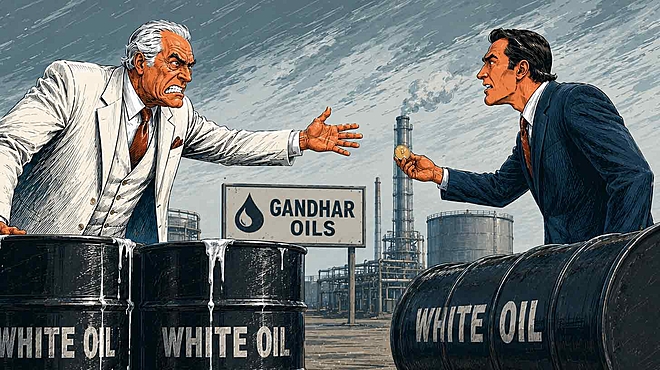
 Vinayak Pathak/AI-Generated Image

Summary: Gandhar Oil trades at 12-13 times earnings, a valuation that looks like an opportunity. It isn't. Poor cash conversion, collapsing returns and a working-capital cycle moving in the wrong direction tell a harder story.
Sixty times subscribed. That was Gandhar Oil's IPO moment in November 2023. Investors piled in for a white-oil manufacturer with global customers, low debt and exposure to personal care, pharmaceuticals and FMCG; sectors that looked more defensive than cyclical.
Yet, 18 months later, the stock trades at 12-13 times earnings. That number looks like an opportunity. It isn't.
A low price-to-earnings (P/E) ratio is only useful if the profits behind it are durable. Gandhar Oil’s are not. Revenue has stayed roughly flat. But profit after tax has more than halved, operating cash flows have been nearly absent and the returns the business earns on its own capital have collapsed. The market is not being pessimistic about Gandhar Oil’s future. It is reading the present accurately.
The post-IPO reality check
The problem is not that Gandhar's revenue has collapsed. It has not. But profitability, return ratios and cash flows have deteriorated sharply since the IPO period.
Falling metrics
Gandhar Oil has been struggling to keep its numbers steady post-IPO
| Metric | FY23 | FY24 | FY25 | Status? |
|---|---|---|---|---|
| Revenue (Rs cr) | 4,103 | 4,113 | 3,897 | Broadly stagnant |
| Operating profit (Rs cr) | 316 | 279 | 176 | Down sharply |
| Profit after tax (Rs cr) | 214 | 165 | 84 | More than halved |
| Return on equity (%) | 32 | 16.5 | 06-Jul | Collapsed |
| Return on capital employed (%) | 41 | 23.8 | 10.8 | Collapsed |
| Cash flow from operations (Rs cr) | 88 | -69 | 15 | Weak conversion |
In FY25, volumes grew about 3 per cent. Revenue still fell. Realisations, or the price received per unit, softened because of weaker FMCG and pharmaceutical demand, lower market prices and geopolitical disruptions in supply chains.
In a high-margin business, spread compression is painful but survivable. For Gandhar Oil, it is not. Net margins already sit in the low single digits. A small decline in realisation does not dent profits; it halves them. That is exactly what happened between FY24 and FY25.
This is the core problem. The business sells a lot. But what it earns on each sale is thin. And when conditions move even slightly against it, the thin margin disappears.
Personal care, healthcare and performance oils contributed 50 per cent of revenue in the first nine months of FY26. Lubricants, not a high-growth segment, contributed another 26.8 per cent. The bulk of the business sits in product pools that are low- to mid-growth or price-sensitive.
The industry story has changed
At the time of its IPO, Gandhar Oil’s investor presentation cited CRISIL projections that India's white-oil market would grow from $0.47 billion in FY23 to $0.76 billion by FY28, a compound annual growth rate of 9.9 per cent. That number supported the listing story.
Gandhar Oil’s own FY25 annual report now pegs India's white-oil market growth at roughly 2 per cent per year between 2025 and 2030. The gap between the two figures is not a rounding error. The domestic white-oil growth story is substantially weaker than the IPO narrative suggested.
There is also a structural misread in the original case. A cosmetics company growing at 15 per cent does not necessarily buy 15 per cent more white oil. It may premiumise, change formulations or shift towards natural or silicone-based ingredients. Gandhar's customers can grow without Gandhar following.
The IPO gave the clue
The original IPO structure was not a clean growth-capex story. Of the fresh-issue proceeds, about Rs 185 crore was earmarked for working capital requirements. Just Rs 28 crore was earmarked for manufacturing capacity expansion at Silvassa. A further Rs 23 crore was advanced as a loan to Texol for the repayment of a Bank of Baroda facility.
Working capital, the cash a business needs to keep running everyday operations, was the dominant need, not new capacity. That should have raised a question about the business model's cash generation.
The concern has only grown. Cash flow from operations was negative Rs 69 crore in FY24 and just Rs 15 crore in FY25, despite a profit before tax of Rs 114 crore in FY25. Inventory turnover, trade receivable turnover and trade payable turnover all moved in the wrong direction. The company needed more internal funding to maintain or reduce revenue.
A business with deteriorating working-capital efficiency and weak cash conversion deserves a lower valuation, regardless of what headline earnings show.
Utilisation is not the same as profitability
Management points to the Sharjah facility as a growth lever. It is currently running at 70-72 per cent utilisation, with a path to 90-95 per cent over the next two to two-and-a-half years.
The facility has been operational since 2017 or 2018. Running at 70 per cent after several years is not a ramp-up story. It suggests the constraint may be structural: customer qualification, pricing and demand quality, not idle capacity waiting to be filled.
More importantly, Texol Lubritech FZC, the Sharjah subsidiary, generated around Rs 758 crore in revenue in FY25 but only about Rs 7 crore in profit. A facility generating that much revenue at near-zero margins is a volume engine. The question is not whether Sharjah can sell more. It is whether incremental volume can come with materially better margins. The evidence so far is weak.
The Vadhavan question
Then there is the Vadhavan Port proposal. Gandhar Oil has bid for a terminal to store base oils and chemicals, along with a blending plant on the jetty. The proposed investment is approximately Rs 1,000 crore, subject to regulatory clearances and successful bidding.
Then there is a strategic rationale. Gandhar Oil imports base oils and is exposed to freight costs and geopolitical disruptions. A port terminal could reduce that exposure.
But Rs 1,000 crore is an enormous commitment for a company that generated Rs 15 crore in cash from operations in FY25. Freight savings alone cannot justify the investment. The project would need third-party cargo, long-term contracts and project-level financing to make economic sense. For a company still trying to restore margins and cash flows, this is a capital-allocation question that deserves close attention from investors.
Cheap, but not yet convincing
Gandhar Oil has real customers, real products and a genuine leadership position in white oils. The burden of proof has shifted, though.
Texol must become profitable, not just better utilised. Cash flow from operations must start tracking profit after tax. Realisations must stabilise. Return ratios must recover. Any Vadhavan commitment must be ring-fenced and financially sound.
Until then, the stock remains cheap. And not for the right reasons.
Should you invest in this white-oil manufacturer?
Subscribe to Value Research Stock Advisor to get more in-depth insights into the company’s financials, management and past performance. So you know whether an attractively valued stock will actually deliver over time.
Ask Value Research 

 New episodes every Friday


 New Process Alert
  Seems like you've uploaded a wrong QR code. Please upload the QR code downloaded from MF Central platform.


