
Powered by
Investors' Hangout | 08-May-2026

Retirement Corpus That Beats Inflation Over Time
A Rs 2 crore corpus at 8 per cent pays Rs 16 lakh a year. That number never rises.
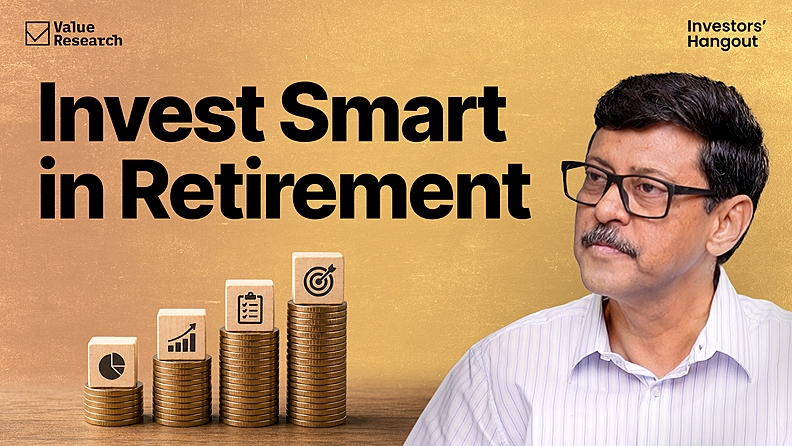
Most people retire ready to rest, but not ready for the financial shift that retirement brings. The day the salary stops, the rules of money change completely. What you do with your corpus in the first year after retirement will shape the next twenty. Understanding how to split, protect, and grow that money is what this episode is about.
Retirement does not just change your schedule. It changes the direction of your money. All your working life, the tap was on: salary came in every month, you spent some, saved some, and the corpus grew. A few times you dipped in, perhaps for a house or your child's education, but the tap stayed on. When you retire, that tap closes. You shift from the accumulation phase, where money grows, to the distribution phase, where money must sustain you.
That shift creates two distinct problems. The first is practical and immediate: many retirees receive a large lump sum, combining superannuation, PF, and other employer contributions, and have no experience managing that kind of money. The second problem is quiet and slow: the risk of outliving your savings. Think of it like a family thali, where each bowl needs to stay full for 20 years. If you put everything into one bowl and eat from it alone, you run out.
This conversation with Dhirendra Kumar covers how to divide your retirement corpus into three buckets: a safety net for emergencies, an income engine for regular monthly expenses, and a growth bucket in equity that keeps pace with inflation. It covers the three best fixed-income instruments for Indian retirees, why even cautious investors need some equity exposure, how to enter equity without fear, and the single biggest mistake he sees retirees make. The most important number in this video is Rs 16 lakh: the annual income that a Rs 2 crore corpus earns at 8 per cent, and the number that quietly becomes insufficient within three to five years without the third bucket in place.
What Rs 2 Crore in an 8 Per cent Bond Actually Gives You
Here is the worked example that makes the retirement risk concrete.
Assume you retire with Rs 2 crore. You are lucky enough to find a Government of India bond paying 8 per cent. That is the best possible fixed income scenario: no default risk, full certainty. Your annual income: Rs 16 lakh. That is Rs 1 lakh 33 thousand every month. That feels comfortable, perhaps generous, at the moment you retire.
Now here is what happens next.
Your capital stays at Rs 2 crore. That number never moves. Your income stays at Rs 16 lakh a year. That number never moves either. But your cost of living does move. Groceries, medicine, electricity, travel: every one of them costs more three years from now than today. In three years, Rs 1 lakh 33 thousand a month buys less than it does today. In five years, it buys meaningfully less. At some point, that fixed income no longer covers your fixed expenses.
When that happens, you start dipping into the Rs 2 crore principal. Once you start drawing from principal, the capital base shrinks, which means 8 per cent of a smaller number gives you even less income. You dip in again. The capital shrinks further. This cycle only travels in one direction. Dhirendra Kumar calls this the grim prospect that the third bucket exists to prevent.
The same calculation applies to Rs 1 crore. If your monthly requirement is Rs 50,000 and your portfolio earns 8 to 9 per cent, you have just enough to meet expenses but nothing left over for growth. No surplus means no compounding, which means no protection against inflation that will make Rs 50,000 feel smaller every year.
The three-bucket answer to this problem is not complicated. You split the corpus into three pools: a safety net that covers emergencies and sits untouched, an income engine in guaranteed instruments that covers monthly expenses, and a growth bucket in equity that slowly expands to offset what inflation takes away. The correct size of each pool has no universal formula. It depends entirely on your corpus and your monthly requirement.
Senior Citizen Saving Scheme, Post Office MIP, and RBI Bonds: What Each One Does
For the income bucket, three government-backed instruments exist with no default risk. Each serves a slightly different situation.
| Instrument | Payout Frequency | Suitable For | Key Limit |
| Senior Citizen Saving Scheme | Quarterly | Most retirees as the first option | Maximum deposit ceiling applies |
| Post Office Monthly Income Plan | Monthly | Retirees who need income every month | Per-account deposit limit |
| RBI Bonds | Semi-annual | Larger corpus where SCSS and MIP limits are insufficient | No upper investment limit |
The Senior Citizen Saving Scheme is the starting point for most retirees. The return is fixed, the government guarantees it, and the income arrives quarterly with no uncertainty. For anyone who has not received a pension and needs to build a reliable income stream immediately, this is where to begin.
The Post Office Monthly Income Plan serves the same purpose but pays monthly rather than quarterly. If your household runs on a monthly rhythm, as most do, this structure suits day-to-day planning more comfortably.
RBI Bonds accept larger deposits without an upper ceiling. For retirees with a substantial corpus whose income needs exceed what SCSS and Post Office MIP can accommodate, RBI Bonds cover the gap.
The caution Dhirendra Kumar returns to is this: invest enough in these instruments to cover your monthly requirement and stop there. Do not invest more than you need in guaranteed income products. Every rupee beyond your income requirement that sits in fixed income is a rupee that will not grow. The capital stays flat. The real value of that capital falls every year. Over-conservatism in the income bucket is not safety. It is a slow version of the same problem you were trying to avoid.
Why Retirees Need Equity and How to Start Without Fear
The instinct after retirement is to avoid equity entirely. A 5 per cent fall in a portfolio when you are still earning looks like a temporary inconvenience. A 5 per cent fall when you have stopped earning and have no other source of income looks like catastrophe. That fear is real and entirely understandable.
But the risk of avoiding equity is larger than the risk of holding it, because inflation does not stop when you retire.
The income bucket gives you Rs 16 lakh a year today, or Rs 1 lakh 33 thousand a month. Five years from now, that same amount covers less. Ten years from now, it covers less still. The growth bucket in equity is the only component of your portfolio that can expand to fill that gap. Its job is not to give you income now. Its job is to make sure that the income bucket you built today still works in ten years.
For retirees who have never held equity, the entry sequence matters. Start with a hybrid fund, which combines equity and fixed income in a single vehicle. The movements are steadier than a pure equity fund. You experience market fluctuations without the full force of a 100 per cent equity allocation. You learn that a 10 per cent fall does not mean your money is gone. Once you are comfortable, you can add a straightforward equity index fund. International equity, which represents roughly 95 to 96 per cent of the global listed universe outside India, is a third step for investors with a larger corpus and an established comfort with equity.
For investors already comfortable with equity and whose income need is around 3 per cent of the total corpus annually, the headroom is sufficient to hold a meaningful equity allocation without worrying that a market fall will force you to sell. If your income drawdown is higher, the equity bucket may need to be smaller, but it should still exist.
The sequence is: hybrid fund first, domestic equity index fund second, international equity third. Do not reverse the order.
Once you have watched, here is where to go next. The Steady Income fund selector shows income-oriented funds matched to different risk levels, which is useful for sizing the income bucket. The SIP Calculator lets you model how the growth bucket compounds over time at different return assumptions. The full calculators section covers corpus projections and income scenarios for different retirement situations. Free research reports covering fund selection and retirement planning are at the free reports page.
Questions About Retirement Corpus Investing
What is the three-bucket strategy for retirement in India?
The three bucket strategy divides your retirement corpus into three pools: safety, income, and growth. The safety bucket holds emergency money, fully liquid and never at risk. The income bucket goes into guaranteed instruments like Senior Citizen Saving Scheme, Post Office MIP, or RBI Bonds and covers your monthly expenses. The growth bucket goes into equity and grows over time to protect your purchasing power from inflation. The right amount in each bucket depends on the size of your corpus and what you actually need every month. There is no universal split.
Should retirees invest in equity in India?
Yes, and Dhirendra Kumar argues that avoiding equity is the greater risk. Fixed income keeps your capital constant while inflation makes your cost of living rise every year. At some point the gap forces you to dip into principal, which reduces your capital, which reduces your income, which forces you to dip again. Equity in the third bucket grows to prevent that cycle. The entry point matters: start with a hybrid fund rather than a pure equity fund, and work up from there as your comfort grows.
What is the best fixed-income option for retired investors in India?
The Senior Citizen Saving Scheme is the starting point for most retirees because it carries no default risk and pays a fixed return on a quarterly basis. Post Office Monthly Income Plan is an alternative for investors who need income monthly rather than quarterly. RBI Bonds suit investors with larger corpus sizes where the deposit limits of SCSS and Post Office MIP are insufficient. All three are government-backed. The key is to invest enough to cover your monthly requirement and not more: every rupee beyond that in fixed income is a rupee that will not grow.
How should a retired person start investing in equity?
Start with a hybrid fund, not a pure equity fund. A hybrid fund blends equity and fixed income in a single vehicle. The fluctuations are smaller, which makes it possible to stay invested without panic when markets fall. Once you are comfortable watching a hybrid fund move without fearing the worst, add a domestic equity index fund. International equity is the third step, for investors with a larger corpus and established comfort. Do not start with international equity or a concentrated equity fund. Get used to the movement first.
What is the biggest mistake retirees make with their corpus?
Putting everything in fixed deposits and staying too conservative. The interest is taxed every year. The capital stays flat. And as inflation rises, the real value of that capital, and the real income it generates, quietly shrinks every year. The second mistake is being unprepared for the vulnerability that comes with handling a large lump sum for the first time. Many retirees receiving superannuation and PF together have never managed that amount of money before. That creates an opening for bad advice. Ask what is in it for you and how it works before committing to any product.
What happens if I put all my retirement money in FDs?
Your nominal income stays fixed while the real value of that income falls every year. On Rs 2 crore at 8 per cent, your annual income is Rs 16 lakh, or Rs 1 lakh 33 thousand a month. That figure never rises. Three years from now it covers less. Five years from now it covers significantly less. When expenses exceed income, you begin drawing down principal, which reduces the capital that generates your income, forcing larger withdrawals until the corpus is exhausted. That is the precise cycle that the three-bucket strategy with equity in the third bucket is designed to prevent.
How often should I review my retirement portfolio?
Review it once a year. The three buckets are not meant to be actively traded or constantly rebalanced. The safety bucket stays liquid. The income bucket continues paying. The growth bucket compounds in the background. An annual review checks whether your income requirement has changed, whether any fixed income instruments need renewal at current rates, and whether your equity allocation has drifted from where it should be. Once a year is enough. More frequent checking, particularly of the equity portion, tends to create unnecessary anxiety without improving decision-making.
Is Rs 50,000 a month enough from Rs 1 crore at retirement?
On a Rs 1 crore corpus earning 8 to 9 per cent, Rs 50,000 a month is achievable today but will not remain sufficient. The number looks right at the moment of retirement. But if the portfolio does not generate more than 8 to 9 per cent, there is no surplus for capital growth. No growth means no protection against the inflation that will make Rs 50,000 buy less every year. The answer is to invest the corpus in a way that generates enough return to cover the Rs 50,000 requirement and still leave something over to compound, so the corpus itself grows rather than stays flat.
Disclaimer: This page is based on a video by Dhirendra Kumar, founder of Value Research, who has tracked Indian markets since 1992. Value Research is an independent, SEBI-registered investment research platform. This content reflects the video's analysis and is not a personalised investment recommendation.
Other Videos


Your Gold Doubled. Should You Trim It?
26-Jun-2026 · 4,620 Views

4 Reasons to Sell a Fund. A Market Fall Isn't One.
19-Jun-2026 · 8,759 Views

Flexicap vs Multicap. One Can Run Out of Room.
12-Jun-2026 · 24,939 Views

SIP For Your House Help. SEBI Is Making It Possible.
05-Jun-2026 · 4,012 Views

No 10-year SIP has ever lost money in 40 years.
29-May-2026 · 1.8 Lakh Views

You feel safe when prices are already high.
22-May-2026 · 69,781 Views

PM's Gold Appeal: Should You Sell Your Gold Fund?
15-May-2026 · 12,131 Views

Stopping Your SIP to Stay Safe Is Your Costliest Move
01-May-2026 · 42,436 Views

You invest Rs 30 lakh. The market adds Rs 70 lakh.
24-Apr-2026 · 13,384 Views

3-Star Fund? Selling Won't Protect You
17-Apr-2026 · 10,132 Views

Where to Park Your Money After Selling a House
10-Apr-2026 · 50,355 Views

Why Gold Failed Its Biggest Test
03-Apr-2026 · 15,360 Views

3 Things to Do Before April 1
27-Mar-2026 · 52,558 Views

SEBI's New Rules: What They Mean For You
20-Mar-2026 · 46,700 Views

War, Wealth & What To Do
13-Mar-2026 · 30,365 Views

Women & Wealth: Why Earning Isn't Enough
06-Mar-2026 · 10,326 Views
 New Process Alert
  Seems like you've uploaded a wrong QR code. Please upload the QR code downloaded from MF Central platform.


