 Widely read:


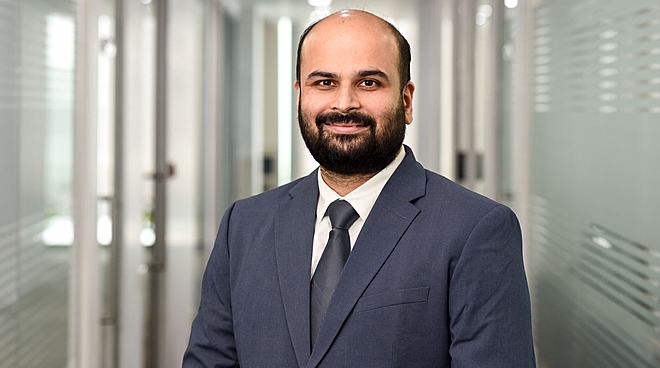
Summary: The current crisis rhymes with Russia-Ukraine, says Hiten Jain. But India's exposure is more sensitive this time. His advice on how to invest right now is specific and worth hearing before you act.
Amid rising geopolitical tensions and a sharp uptick in crude prices, Hiten Jain believes the current market correction reflects uncertainty rather than a breakdown in fundamentals. The fund manager at Invesco Mutual Fund argues that such phases are best approached with gradual investing rather than bold lumpsum bets.
At Invesco, Jain oversees six schemes with assets of around Rs 10,800 crore, including the Invesco India Technology Fund. His Financial Services, Focused and Largecap funds carry four-star ratings from Value Research. He has over 17 years of experience across equity research and fund management, including a stint at CRISIL covering technology and banking.
In this conversation, Jain explains how his investment framework blends top-down themes with bottom-up stock selection and why he is willing to back new-age businesses with long growth runways despite near-term profitability gaps.
After the recent correction, valuations in the Indian market appear to have moderated. How do you assess the market at this stage? Are fresh opportunities emerging, and what key risks should investors watch for?
Obviously, the stock markets have corrected. In a way, it somewhat rhymes with what happened about two years back when the Russia-Ukraine war began. At that time, there were serious concerns about crude oil prices, and it took about 6-9 months for things to stabilise. Not so much for the war itself, since it lasted much longer and still continues to some extent. However, the impact on crude prices gradually decreased over time.
This time again, because of the conflict involving Iran, we are seeing a sharp increase in crude prices. India, as an importing nation on the crude front, tends to be significantly impacted. As a result, there has been a meaningful stock market correction. At the same time, it is very difficult to take a firm view at this stage because one does not know the intensity of the challenge or how long the situation will continue. But in terms of potential impact, India could be more affected this time compared to the Russia-Ukraine episode.
While the headline number for crude is still closer to $100, it could move higher. Another important factor is the Strait of Hormuz, from where nearly 50 per cent of our LNG (liquefied natural gas) imports come. That makes the situation more sensitive for India. If the situation escalates further, there could be a serious impact on the LNG front. In fact, we have also seen the government taking certain steps regarding LPG because it is an essential fuel for everyday consumption.
Hence, the situation is somewhat precarious on certain fronts. But at the same time, these are also periods when investors should ideally take advantage of valuations and gradually increase their equity allocation.
From that perspective, I believe that over the next 1-2 months, investors should spread their investments. I would not recommend going for a lumpsum investment immediately because, as I mentioned earlier, the situation remains uncertain. If the conflict persists, it could have a significant impact on inflation, the current account deficit and the currency. For emerging markets as a whole, capital outflows could also accelerate.
How would you describe your personal investment philosophy when evaluating companies? What are the key factors you focus on before taking a final investment decision?
It has been about 10 years since I joined Invesco, and the firm has a very robust investment framework that we call the stock categorisation framework. Because I have spent so much time working within this framework, it has also become the way I naturally think about investing.
Broadly, it is a combination of a top-down and bottom-up approach. From a top-down perspective, we try to identify the strong themes emerging in the economy, as well as sectors or areas with a long runway for growth in the country. Once those themes are identified, the next step is to find the best vehicles through which we can participate in those opportunities.
Within the stock categorisation framework, we broadly classify stocks between growth and value. Within growth, we also look for leaders: large companies with strong returns on equity, healthy cash flows and robust balance sheets. At the same time, we identify companies capable of growing faster than the broader market, gaining market share and benefiting from a long runway for growth.
So, effectively, the focus is on a mix of high-quality businesses with strong competitive moats and companies with high terminal value or a long growth runway. These are typically the kinds of businesses that capture my attention.
I also believe that it is very difficult to consistently time cyclical businesses. Because of that, I generally stay away from highly cyclical sectors, where identifying the top and bottom of the cycle can be quite challenging.
From that perspective, I prefer companies where I can stay invested for a longer period, allowing the underlying business to compound and grow faster than the country's nominal GDP growth, thereby creating meaningful wealth for investors over the long term.
You haven’t shied away from new-age companies in your technology fund, and they hold a significant place in your portfolio. In companies such as these, where profitability and cash flows are either absent or inconsistent, how do you evaluate their future and value them?
In some ways, it appears to be in contrast with what I mentioned earlier about focusing on high-ROE companies. But one should also remember that within our stock categorisation framework, the growth bucket has multiple sub-categories. One of them is what we internally call the ‘Star’ category.
This category identifies businesses with entrepreneurs who have a strong long-term vision, and that may be relatively small today but have the potential to become very large over time. These businesses typically have the ability to grow at very high rates, and as they scale up and establish a competitive moat, operating leverage begins to play out, eventually leading to profitability.
This category became particularly relevant post-Covid, when we saw the emergence of several exciting new businesses, many of which were homegrown start-ups and platform-based companies. These companies have largely focused on gaining traction, adding customers, increasing engagement and building scale in terms of volumes.
Because many of these businesses are platform-centric, once a strong moat is established, profitability often follows from scale. Unlike traditional businesses, they may not require large incremental investments in plant and machinery or capacity expansion. As a result, if we can identify the core value proposition or competitive edge of such businesses, we need to take a longer-term view and treat profits as an eventual outcome rather than an immediate prerequisite.
Even for us, this required a shift in thinking. When these companies first emerged during the Covid period, we were quite circumspect because this was a relatively new category of businesses for many investors. I have been in the markets for about 15 years, and earlier we had not analysed businesses of this type in depth. But over time, we began to study their characteristics more closely.
What we realised is that companies may not necessarily report high profitability or high return on equity in the early stages, but that does not automatically mean they cannot create wealth over the long term. These businesses need to be evaluated through a different lens, focusing on scale, network effects and the long-term opportunity.
As I mentioned earlier, our investment framework already had a category, the Star category, designed to capture exactly these kinds of companies. That framework helped us identify and participate in some of these businesses relatively early in their growth cycle.
Looking back at the fund's performance, which types of companies or sub-sectors within the broader technology ecosystem have contributed the most to returns, and how has that shaped the way you construct the portfolio today?
It was about one-and-a-half years ago that we launched our technology fund. The fund's basic premise was that we should move beyond the traditional mindset of equating technology solely with IT services. In India, the IT services sector has been a very important sector for many years. These companies have grown consistently, generated significant employment and created a strong global reputation. Because of that history, investors in India often tend to associate technology primarily with IT services.
However, in global markets, the technology universe is much broader. It includes not only software services but also hardware and several other technology-driven segments. Therefore, we defined technology in a broader sense, any business where technology forms the backbone of the model and enables the company to drive high growth while building strong competitive moats can effectively be classified as a technology business.
As active fund managers, it is important to identify these trends early. The index, by design, is usually a lagging indicator; companies enter the index only after they become large and successful. But active managers, especially those managing a sectoral fund, need to identify emerging trends much earlier.
With that philosophy, when we launched the technology fund, we began building the portfolio with a broader definition of the sector. As of today, roughly 50 per cent of the fund is invested in traditional IT services companies, while the remaining 50 per cent is spread across consumer tech, fintech, industrial tech and hardware.
Globally, spending on hardware is actually larger than spending on software. In India, hardware has historically been a small segment because we lacked a strong manufacturing ecosystem. But that is slowly changing. Initiatives such as Make in India and production-linked incentive (PLI) schemes have begun to give a boost to sectors such as electronic manufacturing services (EMS). As a result, even the IT hardware side is beginning to see strong growth, and we consider that an important part of the broader technology ecosystem.
So, the fund is positioned with this broader mindset. That said, we do not follow a rigid allocation in which a fixed percentage must go to IT services, hardware or other segments. Instead, the portfolio is largely an outcome of the investment universe that emerges from our framework and research process. If our investment framework allows us to identify attractive companies across these sectors and sub-sectors, we are willing to invest in them accordingly.
What were some of the typical calls that worked well for the fund over the past year or so?
While IT services faced some pressure for several reasons, many of which, to be fair, were not entirely anticipated, the other segments outside the conventional IT space played a meaningful role in supporting the fund’s performance. Areas such as fintech, industrial tech and even certain hardware-related businesses contributed positively and helped offset the pressure the portfolio faced due to its exposure to IT services.
Even within the IT services space, I would say we benefited from good stock selection. We focused on identifying companies that had invested early in emerging technology areas and were positioning themselves ahead of the curve. As a result, these companies grew faster than the broader industry despite the sector slowdown.
Because of this positioning, many of the stocks we held corrected much less than the broader IT index, helping cushion the overall impact on the fund’s performance. So, the combination of diversification beyond traditional IT services and selective stock picking within the sector helped the fund navigate what would otherwise have been a challenging phase for technology stocks.
ALso read: 'Next 3-6 months appear conducive for staggered investment'
Disclaimer: This content is for information only and should not be considered investment advice or a recommendation.
For grievances: [email protected]
Ask Value Research 
 New episodes every Friday









 New Process Alert
 Seems like you've uploaded a wrong QR code. Please upload the QR code downloaded from MF Central platform.


