 Widely read:


Summary: Watching a slowing train tempts people to jump early. Investing feels much the same today. This piece explores why modern markets make waiting harder, how speed distorts behaviour and why long-term wealth is built not by acting faster, but by choosing when not to act.
In my early days in Mumbai, I often stood near the door of a local as it slowed into the station. Not stopped. Just slowing. The platform would come into view, and people would lean forward, bags tightening on their shoulders. Almost every time, someone would say it casually, half-joking, “Abe train rukega tab utarega kya?”
It always made me smile. It collided with everything I had grown up hearing. Chalti train se mat utaro. Wait for the full stop. Let it finish what it is meant to do. And yet, in that moment, the crowd felt more convincing than childhood advice. Standing still felt risky; moving early felt sensible.
The train, of course, did what it always does. It stopped fully. At the same spot. On the same platform. Unaffected by who leaned out early and who waited inside. Nothing about the system had changed. Only our comfort with waiting had.
Investing today feels like that moment between slowing and stopping. Portfolios are built with more information than before. Risks are assessed, diversified and monitored. Expected outcomes are framed within ranges, not guesses. The process is better mapped than it has ever been. And yet, investors intervene more. Not because the destination has changed, but because standing still while the journey is in progress has become harder to tolerate. What looks like uncertainty is not ignorance, but discomfort with watching a system work without reassurance.
The waiting game
The moment on the platform does not reveal not confusion, but a coordination failure inside us. One part leans forward, driven by urgency. Other recall rules, and a third follows a system.
The emotional brain reacts first. It feels risk as pain, not probability, and instinctively shortens its horizon. The rational brain considers asset allocation and cycles. It writes the plan in calm moments and accepts volatility as the price of long-term returns. Alongside them sits the system. The conflict is no longer just between emotion and reason. It is between human impatience and execution without feeling—by model, algorithm or AI.
This tension persists even as fundamentals remain stable. India’s nominal GDP grows in high single to low double digits, with earnings and balance sheets broadly tracking it. Yet equity markets still see repeated 15-25 per cent drawdowns. During these phases, holding periods compress sharply, even though long-term payoffs remain back-loaded.
Behaviour reflects this mismatch. During sharp drawdowns, equity SIP discontinuations rise sharply, even when earnings assumptions remain intact. Net equity redemptions cluster closer to market lows than highs. These are not responses to new information, but to discomfort created by price movement.
The three-clock problem
What feels like a behavioural failure is often a timing failure. Modern markets run on three clocks. Trouble begins when one is forced to match another.
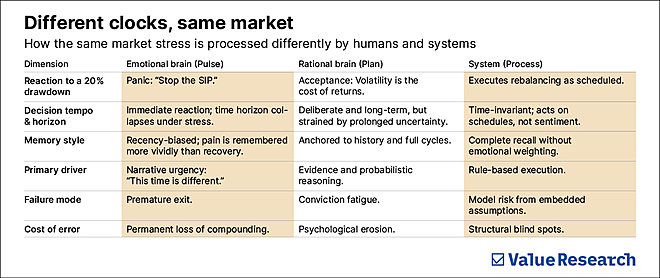
Markets, systems and humans all process time differently. The rise of algorithmic and AI-driven execution has created a dominant force—the Silicon Brain. It reacts without delay, compressing cycles that once took years into weeks, while human investors still operate through biology, memory and emotion.
In faster markets, prices adjust instantly while conviction does not. Strategies built for full cycles now unfold under continuous observation, where being early feels indistinguishable from being wrong. Tools designed to reduce choice often increase intervention, simply because constant visibility invites action. Most investors don’t fail from a lack of information. They fail because they see too much.
The urge to jump off a “slowing train” often comes from fear of being stranded. In portfolios, this happens when emergency cash and long-term wealth sit in the same mental bucket. Separating survival money into something boring and safe satisfies the brain’s need for security. When markets fall, today’s survival already feels protected, allowing long-term capital to stay invested.
The behavioural gap is a timing error. When the human clock tries to run at the market clock’s speed, the gears strip. Execution handed to the fastest responder reacts instantly, but compounding suffers. Separating execution from impulse does not remove emotion; it reduces the moments when emotion decides.
The gap in the engine
The most expensive move in finance is jumping from a slowing train because silence feels like failure. The behavioural gap is not a failure of temperament, but a mismatch between market speed and human biology. We cannot rewire emotions, but we can design systems that reduce the need for constant intervention.
Over decades, markets have repeatedly corrected and recovered. Investors who stayed seated consistently reached the next high. What breaks people is rarely a single sharp loss; it is endurance without visible resolution.
In an AI-driven world, you cannot win by being faster. Speed is a commodity; latency is the luxury. Separating clocks is not slowness—it is choosing a different timeline altogether.
Wealth grows in the gap between the event and your response, allowing the compounding engine to finish its work. What looks like patience from the outside is often just better architecture underneath.
Arpit Nayak is part of the sales team at WhiteOak Capital Mutual Fund. He enjoys writing to simplify investing by providing clear insights and focusing on the behavioural aspects of financial decisions. He believes that smart choices come from clarity, not complexity.
Also read: The compounding comedy
Ask Value Research 
 New episodes every Friday











 New Process Alert
 Seems like you've uploaded a wrong QR code. Please upload the QR code downloaded from MF Central platform.


