




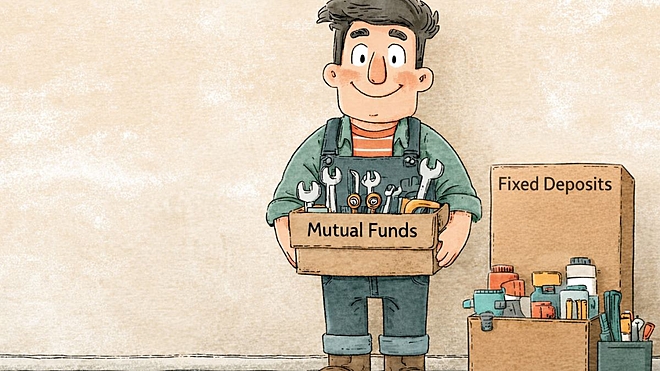
 Aditya Roy/AI-Generated Image
Summary: Choosing between fixed deposits (FDs) and mutual funds is a never-ending dilemma for Indian investors. However, no one asset class is inherently better than the other. We explore why and the question you should actually be asking.
You talk about mutual funds, and there’s always someone who will raise their hand and ask, “Simple batao – FD better hai ya mutual fund?” What they want is a one-word verdict: “Mutual funds!”, with guaranteed double-digit returns. Real life is less dramatic. FDs (fixed deposits) and mutual funds are not enemies. They’re tools. One is a screwdriver, the other is a power drill. If you don’t tell me what you’re trying to build, “Which is better?” is the wrong question.
FD comfort
An FD gives you a fixed interest rate, a promise from the bank that you’ll get your money plus that interest back at maturity and the comforting feeling that your money is ‘growing nicely’. The problem is that this comfort is partly an illusion. The FD rate, say 7 per cent, looks neat on paper, but three things quietly chew it up: tax, inflation and time.
Tax hits first. FD interest is taxed at your full slab. If you’re in a high tax bracket, that attractive 7 per cent may become more like 4.9 per cent after tax. Then comes inflation. If your cost of living is rising at roughly the same rate as your post-tax FD return, you’re not growing; you’re running to stay in the same place. Over 10–15 years, even a small gap between inflation and your FD return turns into a big shortfall.
Put Rs 10 lakh in an FD at 7 per cent for 10 years. Before tax, it becomes about Rs 19.7 lakh. After tax, depending on your slab, it may be closer to Rs 16 lakh in your hands. Now think what that amount will actually buy you 10 years later.
I’m not saying FDs are bad. They’re excellent for short-term money and essential when capital safety is non-negotiable. But as engines of long-distance wealth creation, they are underpowered.
Equity engine
When I compare FDs and mutual funds, I mainly mean equity mutual funds, because comparing FDs with pure debt funds is just a debate between two slow scooters. An equity mutual fund gives you ownership in a large basket of companies. There is no guaranteed return in any specific year, but over longer periods, a well-chosen equity fund has a high probability of outperforming an FD.
Year to year, it can look ugly. A fund can be up 25 per cent one year and down 15 per cent the next. Stretch your view to 10–15 years, and the jagged line of an equity fund has historically sloped much steeper than the flat-ish FD line.
Suggested read: FD vs Mutual Fund: Which is the smarter choice?
Put the same Rs 10 lakh into a decent, diversified equity fund as a lumpsum. Over 10 years, using an illustrative 12 per cent average return, it could reasonably grow to around Rs 31 lakh. The gap between this and the FD outcome is what ‘mutual funds usually beat FDs in the long term’ actually means.
Two things drive this: first, compounding at a higher average rate – an extra 3–4 percentage points a year makes a huge difference over 15–20 years. Second, tax efficiency – mutual fund gains are taxed differently from FD interest, especially over the long term, and goal-based withdrawals can keep the tax bite modest.
At Value Research Fund Advisor (VRFA), when we build goal-based plans with mutual funds, asset allocation becomes the key. Think of it as choosing where your money sits on the comfort-to-growth spectrum. The same goal can look very different depending on whether the money is entirely in debt mutual funds, entirely in equity funds or in a sensible mix of the two. The long term difference, even with reasonable assumptions, is often large enough to change how people think about ‘risk’.
Discomfort premium
If equity funds are so powerful, why doesn’t everyone dump FDs and rush into them? Because mutual funds come with discomfort, and humans hate discomfort. With FDs, your balance only goes up – slowly, but up. With equity funds, it goes up, down, sideways and then suddenly up again. The price of a higher long-term return is short-term volatility.
Over one to three years, a good equity fund can easily underperform FDs. You may see a 10–30 per cent fall on paper during a bad phase. If your goal is very near – next year’s school fees, a home down payment in two years – you don’t have the time to wait for a recovery. For such goals, the FD ‘wins’ not on return, but on suitability.
That’s why, inside VRFA, we never chant “equity mutual funds are always better than FDs or similar options”. For each goal, we ask: How far away is it, can this money afford to bounce around in value and what is your genuine risk tolerance? Only then do we decide the asset allocation between equity and debt funds. The aim is not to eliminate safety. It is to put safety in the right place, and not expect it to do the job of long-term wealth creation.
Real returns
Most comparisons stop at something like, ‘FD returns 7 per cent, equity fund returns 12 per cent’. That’s half the story. You really need to think in three layers. First is the nominal return, which is the number on the brochure. Second is the post-tax return, or what’s left after the government takes its share. Third is the real return, that is, what remains after both tax and inflation. That third number decides whether you can truly afford your future.
For instance, suppose inflation over the next 10 years averages 6 per cent. Your FD, after tax, effectively earns about 4.9 per cent. Your real return is roughly minus 1 per cent. A well-chosen equity fund that averages 12 per cent over the same period, even after tax, may give you a real return of about 5 per cent. Over time, that difference is the gap between “I’ll be okay” and “I wish I’d done this differently.”
At VRFA, we build the portfolio with inflation in mind. Some part of the money has to beat it, or the goal keeps moving away. That is why equity funds are in the mix, if your risk appetite supports it. The question is not “How much will this grow?” It is “Will this be enough when the time comes?” On that test, playing it safe all the way usually does not work for long-term goals.
The right mix
So, do mutual funds really beat FDs over the long term? If you use equity funds mainly for long-term goals of 10 years or more, combine them with the right amount of debt for stability and behave sensibly during bad years, then yes, historically they have outpaced FDs by a wide margin more often than not.
But if you treat mutual funds as a two-year ‘FD upgrade’, jump in and out based on market noise, or use 100 per cent equity for a two-year goal, then no, they probably won’t beat an FD for you, and the funds will be blamed for behaviour that wasn’t their fault.
Inside VRFA, we don’t aim to create heroic all-equity plans for everyone and say, “Dekho, kitna high return ban sakta hai.” We build portfolios in which lower-volatility debt funds handle short-term or non-negotiable cash, while equity and hybrid mutual funds work together for medium- and long-term goals.
In the end, the right question isn’t “Are mutual funds better than FDs?” It is, “For this goal, at this time, with my temperament, what mix of safety and growth options gives me the best chance of success?” Once you start asking that, the answer stops being a slogan and starts becoming a proper plan.
This column was originally published in The Times of India
This article was originally published on January 08, 2026.
Ask Value Research 
 New episodes every Friday





 New Process Alert
  Seems like you've uploaded a wrong QR code. Please upload the QR code downloaded from MF Central platform.


