 Widely read:


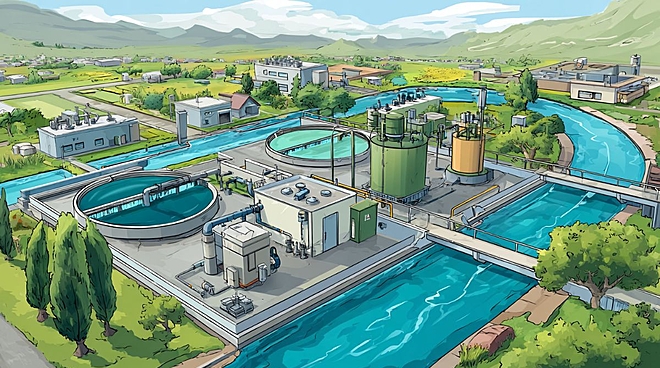 Aditya Roy/AI-Generated Image

Summary: Enviro Infra’s growth numbers look hard to ignore. Revenues are rising fast, margins look healthy, and expansion plans sound ambitious. Yet the market remains cautious. This story digs into the business to understand what lies beneath the surface—and why delivering on the next phase may be harder than the numbers suggest.
Fast growth almost always draws attention, especially when it comes from a newly listed company operating in a sector backed by sustained government spending. But markets also tend to hesitate when that growth looks demanding to sustain beyond headline numbers. That tension is what makes Enviro Infra Engineers worth examining closely.
Listed in late November 2024, the company has delivered striking growth on paper. Between FY20 and FY25, revenue compounded at around 58 per cent annually, while profit after tax grew even faster, at roughly 120 per cent. Margins remained healthy and valuations did not appear stretched. Yet the stock has not been rewarded with the kind of premium such numbers often command.
Rather than reading this as scepticism alone, it is more useful to ask a simpler question: what level of execution does this growth assume, and how forgiving is the business model if timelines or cash flows slip?
A solid business with operational intensity
At its core, Enviro Infra is a water and wastewater infrastructure contractor. It builds sewage treatment plants, water supply schemes and distribution networks—projects that are essential, policy-backed and likely to see steady demand for years.
In FY25, most of the company’s revenue came from EPC contracts, with smaller contributions from hybrid annuity projects and operations and maintenance. Management has also outlined renewables as a second growth engine. But for now, the water business remains the dominant driver of scale—and of execution risk.
How water EPC really works
EPC—engineering, procurement and construction—sounds straightforward. In practice, it is a business defined by sequencing and timing. Contractors win tenders, execute projects across multiple milestones, raise bills as work progresses and then wait for payments to be released.
Water EPC is structurally working-capital-intensive. Materials, labour and subcontractors are paid upfront. Cash inflows depend on certifications and fund releases, often from government or municipal bodies. Delays are not exceptions; they are part of the operating environment.
Enviro Infra’s own offer documents acknowledge this clearly. Growth in EPC is not just about winning orders. It is about executing them efficiently while keeping cash flows under control.
Order book comfort, but not complacency
The company’s EPC order book has seen sharp expansion over the past few years:
- FY22: Rs 170 crore
- FY23: Rs 1,497 crore
- FY24: Rs 2,126 crore
- FY25: Rs 1,185 crore
Two things stand out.
First, the decline in FY25 compared with FY24 is not automatically a red flag. Faster execution can reduce year-end backlog. But it does mean the company must continue winning fresh orders at a healthy pace to sustain growth.
Second, management has indicated typical project durations of 18 to 24 months. That makes the order book a one-to-two-year revenue pipeline, not a long-term cushion.
Management has guided for annual growth of 35 to 40 per cent while maintaining EBITDA margins above 20 per cent. For an EPC contractor, that pace usually requires an order book of around 1.5 to 2 times annual revenue. At the end of FY25, Enviro Infra’s EPC order book was only slightly higher than that year’s revenue. Growth, therefore, depends on consistent order inflows and smooth execution, with little room for disruption.
Where the pressure really builds: Cash flows
This is where EPC stories are truly tested.
Between FY20 and FY25, Enviro Infra’s cumulative operating cash flow was close to flat, despite strong reported profits. In simple terms, accounting profits have not yet translated into sustained cash generation.
Receivables offer further context. Trade receivables rose to about Rs 206 crore in March 2025 from roughly Rs 104 crore a year earlier. While receivables as a proportion of revenue have improved over time, the absolute numbers remain significant.
Given that most customers are government or municipal entities, payment delays are structural rather than incidental. As growth accelerates, working capital requirements typically rise in tandem. This often means higher borrowings, larger bank guarantees or periodic reliance on external funding.
None of this makes the water business unattractive. It simply means execution discipline matters enormously, because growth must be financed well before it is collected.
Renewables ambition, early-stage reality
Alongside water EPC, Enviro Infra has outlined renewables as a second growth engine. The ambition is clear. The current scale is still modest.
In Q2 FY26, renewable revenue was around Rs 1.7 crore. At the same time, management has spoken about scaling this segment to Rs 200 crore and eventually to Rs 500 crore. To support this ambition, the company has highlighted two solar projects:
- A 40 MW project in Odisha, with a tariff of Rs 4.10 per unit, of which 24 MW was operational at the time of disclosure
- A 29 MW project in Maharashtra, with a tariff of Rs 0.88 per unit, targeted for completion by June 2026
To assess how these projects translate into revenue, it helps to step back and look at basic solar economics.
Solar numbers put in perspective
A solar plant does not operate round the clock. At a typical capacity utilisation factor of around 25 per cent, 1 MW of solar capacity generates roughly 2.19 million units annually.
On that basis:
- A 29 MW plant generates about 6.4 crore units a year
- A 40 MW plant generates close to 8.8 crore units a year
Together, the two projects would generate roughly 15 crore units annually at full stabilisation.
Applying the disclosed tariffs, the Maharashtra project would generate around Rs 5 to 6 crore a year, while the Odisha project would contribute roughly Rs 35 to 36 crore. Even under steady-state assumptions, combined annual power-sale revenue appears closer to Rs 40 to 45 crore. This helps explain why the Rs 200 crore revenue aspiration looks ambitious at the current project scale.
Subsidies help, but timing still matters
Part of the discussion around the Maharashtra project involves state financial assistance of around Rs 3.2 crore per MW, amounting to roughly Rs 93 crore for a 29 MW plant.
This support is meaningful, but it is not annual operating revenue. It is released in tranches, linked to construction milestones and post-commissioning performance. In accounting terms, it is a conditional, back-ended cash flow rather than a steady earnings stream.
Timing also plays a role. Only 24 MW of the Odisha project is currently operational, with the balance expected by April 2026. The Maharashtra project is targeted for completion by June 2026. This naturally shifts a meaningful portion of renewable earnings into FY27 rather than FY26.
The investor question
None of this suggests that Enviro Infra lacks opportunity. The water business benefits from strong structural demand. Renewables could become a meaningful contributor over time.
But both businesses share a common reality. Growth must be funded before it is realised. In water EPC, that means managing working capital and collections. In renewables, it means aligning project completion, subsidies and steady-state generation. When growth accelerates, even small mismatches can compound quickly.
Indian markets have seen this dynamic before. Suzlon Energy was once viewed as a flagship beneficiary of India’s renewable push. When execution pressures and balance-sheet strain emerged, shareholder outcomes suffered for years.
The parallel is not about outcomes, but about mechanics. Infrastructure stories often look strongest when conditions are favourable. The real test comes when timelines slip or capital gets stretched.
Ambition is not the problem. Execution is the filter. For investors, the key question is not whether Enviro Infra can grow, but how smoothly that growth can unfold when multiple moving parts need to align at the same time.
To find high-growth opportunities that are backed by strong execution and sound fundamentals, explore Value Research Stock Advisor. Our analyst-recommended stock list filters out the noise and helps long-term investors focus on businesses with durable moats, financial strength and growth potential. If you want to invest with clarity, not hype, this is a great place to start.
Disclaimer: This content is for information only and should not be considered investment advice or a recommendation.
For grievances: [email protected]
Ask Value Research 
 New episodes every Friday











 New Process Alert
 Seems like you've uploaded a wrong QR code. Please upload the QR code downloaded from MF Central platform.


