 Widely read:


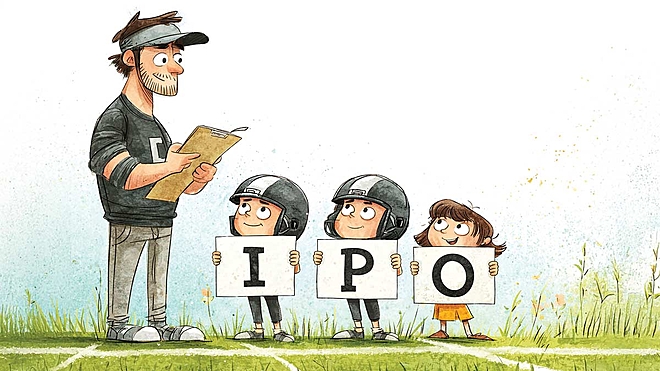
Summary: IPOs are marketed as rare opportunities, but most are timed to benefit sellers rather than new investors, with pricing and hype engineered long before retail buyers arrive. True clarity emerges only after listing, when quarterly results separate sustainable businesses from well-packaged narratives. The real edge in IPO investing is patience, scepticism and selective participation — not chasing listing-day excitement.
Summary: IPOs are marketed as rare opportunities, but most are timed to benefit sellers rather than new investors, with pricing and hype engineered long before retail buyers arrive. True clarity emerges only after listing, when quarterly results separate sustainable businesses from well-packaged narratives. The real edge in IPO investing is patience, scepticism and selective participation — not chasing listing-day excitement. The first thing an IPO sells is belief. A promising story, impressive numbers, confident management and a chorus of voices insisting that this one is different. For a brief moment, the market suspends disbelief. The assumption is simple: if a company is entering the markets, it must be ready, valuable and worth owning. The reality is less flattering. Most IPOs do not create immediate wealth. Many destroy capital as well. What is presented as early access to growth is often a transaction designed to suit the seller’s chosen price. The excitement is orchestrated. The urgency is manufactured. The real test of a business begins after listing, when numbers replace narratives, time replaces hope and markets act as judge and jury. This guide is an attempt to strip away the noise and examine IPOs for what they truly are: sales events conducted at moments most favourable to the seller, and help you decide more calmly when, if ever, an IPO deserves your money. As excitement rises, step back Consider a simple question. How does someone with little interest in markets – a software engineer, a college student, a retiree – know about an upcoming IPO? The answer is straightforward. By the time an issue opens, it is everywhere. Go anywhere on social media and the new IPO will be promoted as an unmissable opportunity. Influencers, advertisements, TV panels, grey-market gossip and oversubscription counters flash like cricket scores, creating the sense that the whole country is lining up to participate. This level of visibility has very little to do with the underlying business and everything to do with manufacturing sentiment. When an IPO is subscribed 50, 100 or 200 times, it creates a powerful illusion of validation. It feels as if collective intelligence has spoken. Surely, so many people cannot all be wrong. But oversubscription tells you only one thing: how many people applied for the shares. It tells you nothing about the quality of the business, the sustainability of its profits or the returns it may generate over time. How the IPO machinery works At the moment of launch, an IPO is not an investment decision; it is a sales event. Investment bankers are not fiduciaries for retail investors. They are salespeople acting on behalf of sellers. Their job is not to offer the public a bargain. Their job is to secure the highest possible price while ensuring the issue succeeds. The glossy presentations, the breathless commentary and the manufactured urgency all serve a single objective: to overwhelm judgment and prompt immediate action. Even impressive subscription numbers do not guarantee a rewarding outcome. Innova Captab’s Rs 570 crore IPO was subscribed 55 times. Its listing gain was a modest 1.8 per cent. Yes, the stock recovered later and eventually delivered better returns, but those who entered purely for listing gains would have been disappointed. In other cases, the results are far worse. Credo Brands was subscribed over 50 times, listed with a negligible gain and today, trades 66 per cent below its issue price. These are not statistical oddities. They are reminders of a behavioural trap. Investors respond to noise rather than structure. FOMO replaces analysis. The more people speak excitedly about an IPO, the more certain it feels – not because the underlying business has changed, but because the noise has become louder. But popularity is not analysis. Hype is not insight. And certainty, when aggressively marketed, is rarely a signal of opportunity. Whenever an IPO becomes the talk of the town, it’s time to step back. The right question is not how many people are applying, but why the sellers are choosing this moment to sell – and at this price. If that question makes you uneasy, it is often a sign that caution, not excitement, is the appropriate response. Understanding this dynamic is crucial: the frenzy is constructed, not earned. The louder the buzz, the more careful an investor should become before committing capital. IPO pricing isn’t market-driven A useful way to understand IPO pricing is to step away from markets for a moment and think about ownership. Suppose you own a small restaurant and want to raise Rs 10 crore by issuing new shares. At present, you own 100 shares, which represent complete ownership of the business. You have three options: Issue 100 additional shares at Rs 10 lakh each, leaving yourself with 50 per cent ownership Issue 50 shares at Rs 20 lakh each, retaining 67 per cent ownership Issue 30 shares at Rs 33.3 lakh each, which would leave you with roughly 77 per cent ownership Which option would you choose? Obviously, the third one. You raise the exact same Rs 10 crore while giving away the least ownership. It is common sense. That is exactly how promoters think when they price an IPO. The price is not determined by what is fair to incoming investors. It is determined by what preserves the maximum value for those who are selling, while still appearing attractive enough to ensure that the issue gets subscribed. How the number is arrived at Nothing about that pricing is decided by real demand and supply. It is not market discovery. The price is a negotiated outcome – a sales pitch. Promoters and investment bankers work together to push the valuation as high as possible without triggering outright rejection. The public is invited only after this price has been carefully engineered, marketed and packaged as an opportunity. This is where retail investors often misunderstand the process. Many assume that the IPO price reflects the market’s judgment. It does not. The price is set by people who know the business intimately, armed with every relevant detail. Retail investors, meanwhile, receive a 400-page red herring prospectus written in dense legal and accounting language. Ironically, the moment that demands the greatest clarity is when clarity is hardest to find. The numbers expose this illusion starkly. Over the past five years, 76 IPOs were priced at price-to-earnings (P/E) multiples of 50 or more. Of these, 33 delivered negative returns even for investors who bought at the IPO price. In other words, nearly 43 per cent of expensively valued IPOs destroyed wealth almost immediately. This highlights the risk inherent in high valuations. The wiser thing to do, thus, is simply to wait. Krsnaa Diagnostics, which was listed in August 2021 at a P/E of 78, offers a useful illustration. Investors who received allotment are still sitting on losses of around 22 per cent. Yet those who waited six months before buying would be up about 22 per cent. Wait a year, and the gain rises to roughly 61 per cent. That is what genuine price discovery looks like. Not a valuation negotiated behind closed doors, but the verdict delivered over time by thousands of real buyers and sellers in the open market, revealing true investor sentiment, actual demand and the real market consensus on value. Who the IPO really serves There’s another question most retail investors rarely pause to ask: Where does the IPO money go? A company coming to the market at a P/E of 60 may still be defensible if every rupee raised is deployed back into the busin
This article was originally published on January 01, 2026.
 New episodes every Friday











 New Process Alert
  Seems like you've uploaded a wrong QR code. Please upload the QR code downloaded from MF Central platform.


