 Widely read:


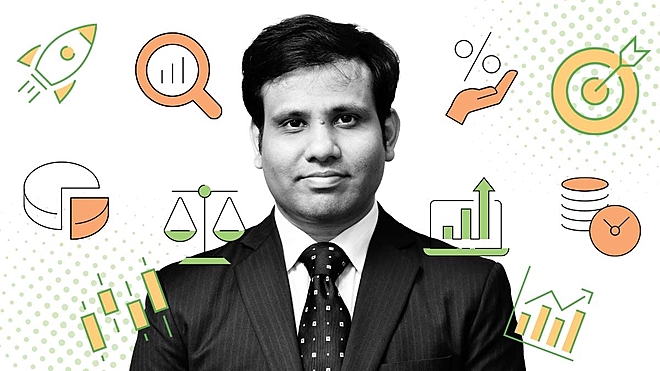

Summary: With markets moving higher but earnings still catching up, stock picking has become less about optimism and more about discipline. In this conversation, ICICI Pru’s senior fund manager explains how he tracks earnings cycles, times entry points and rotates sectors when valuations and fundamentals align.
With markets pushing higher, Vaibhav Dusad doesn’t pretend valuations are comfortable everywhere. He notes that while headline revenue growth has held up, underlying earnings growth has been modest for several quarters, making the next phase of upgrades crucial. The Senior Fund Manager at ICICI Prudential AMC oversees five schemes with assets of around Rs 1,19,265 crore. Two of his schemes stand out on Value Research’s ratings: ICICI Prudential Focused Equity Fund (four stars) and ICICI Prudential Large Cap Fund (five stars).
In this conversation, Dusad explains how he tracks earnings revision cycles, buys only at disciplined entry points and rotates sectors when policy, relative performance and earnings inflection points align.
Corporate earnings have improved, and the macro outlook looks supportive. At the current levels, do you think valuations are justified? Or do earnings still need to catch up, especially in sectors where expectations seem stretched?
If you look at what has happened over the last couple of quarters on a broad basis, revenue growth has been north of 6-7 per cent. However, if you strip out commodity-related benefits or exclude commodity-linked sectors, earnings growth has also been fairly tepid, again around 7-8 per cent. This has been the trend for the past three to four quarters.
What is interesting, however, is what happened in the last quarter. The intensity of earnings downgrades for FY26 and FY27 has moderated. We saw a fair bit of earnings downgrades after the Q1 results, but that trend eased in Q2. Markets, meanwhile, have moved up over the last few months. Having said that, market expectations from companies are clearly that earnings should pick up going forward. If earnings do improve meaningfully, there is room for some further re-rating in the markets.
Looking ahead at earnings drivers, the base has now largely normalised. Although the base had been slightly weak since last year, we saw disruptions due to multiple elections at the centre and state level, which led to delays in capex and other activities. Another important factor over the last six months has been the RBI's ample monetary support. Liquidity conditions, which were fairly tight around this time last year, have eased and rate cuts could be an important driver for GDP growth in the coming quarters.
The government has also taken two key measures: cuts in income tax and, more recently, reductions in GST rates. These steps should support a gradual pickup in consumption. Finally, while government capex may remain somewhat constrained, private capex has been weak but could pick up with a lag of a few quarters as consumption improves and capacity utilisation rises.
Delivering consistent performance in the focused equity category is challenging given the portfolio's concentrated nature. Despite 2024-25 being a turbulent year for the market, how has your fund managed to post exceptional performance? What do you feel were the key contributors? What is the underlying framework or discipline that enables you to deliver continuous outperformance?
My approach has been predominantly bottom-up, which becomes especially critical in a fund like the Focused 30, where portfolio concentration is high.
My thinking has always been anchored in absolute returns. I focus on how much absolute return a stock can potentially deliver rather than just relative positioning. A key part of my process is closely tracking the earnings revision cycle on both the downgrade and the upgrade side. This helps identify inflection points and avoid prolonged earnings disappointment.
One aspect that has worked particularly well for the Focused fund is disciplined buying. I am very selective about entry points and tend to buy stocks only in specific situations. I firmly believe that half the battle is won if the buying price is right. As external investors, many factors are beyond our control, but the entry price is something we can control, and I have tried to be very disciplined on that front.
The second important pillar of the strategy is my view of the portfolio as a whole. I divide it into two parts: a structural component and a cyclical component. The structural part consists of companies with the ability to compound earnings at a mid-teens rate over the medium term. The cyclical part, on the other hand, has a shorter investment horizon of one to two years. I typically enter these stocks during downcycles or early recovery phases and look to exit once earnings peak and further upgrades appear limited. This combination of disciplined buying, portfolio construction and a deep understanding of earnings revision cycles has helped drive consistent performance.
Your focused fund has made some sharp, well-timed sector rotations in recent years. What specific triggers lead you to exit or enter sectors quickly?
That is an interesting question. If you observe the portfolio over a slightly longer timeframe, say the last three to four years, it was heavily tilted towards Capital Goods until December 2023, when allocations to the sector were quite high. Since then, I have gradually pivoted the portfolio towards a more consumption-oriented positioning. Today, you will see exposure across several consumption-related sectors, a conscious shift.
This rotation is driven by multiple factors. One key consideration is government policy direction and the outlook for those policies. Another important factor is the earnings outlook for a sector, including how that sector has performed relative to the broader market.
Similar to my stock-level approach, sector decisions are also guided by the earnings cycle. When I believe sector earnings have bottomed out, downside risks to earnings are limited and the probability of earnings upgrades is improving, I start increasing exposure. A combination of policy signals, relative performance, and a clear view of the earnings cycle helps me navigate sector entries and exits in a timely manner.
Compared to peers, you’ve been more measured in taking mid- and small-cap exposure in four out of the five funds managed by you. Is that primarily a valuation call that seems favourable in large caps now, or does it reflect your view of the risk–reward in this cycle?
I think your observation is correct. Over the last three years, my investments have had a clear large-cap bias, and even within mid caps, the exposure has largely been to larger, more established names. If you look at small caps over the last one to two years, they have underperformed large caps. However, over a three-year period, small caps have outperformed large caps by around 20-25 per cent, but there is still room for further correction.
Valuation has certainly been an important consideration. Small caps were trading at valuations that were discounting very high earnings growth, which I felt was difficult to sustain. If you look at the post-Covid period from 2021 to 2023, a significant part of the small-cap rally was driven by earnings upgrades coming from margin expansion. I believe those elevated margins are not sustainable over the long term. At some point, companies will have to sacrifice margins to drive growth, and I think we are in that phase now. Broadly speaking, while there will always be company and sector-specific exceptions, this dynamic made me cautious on small caps.
The second factor is the stage of the economic cycle. The period from 2021 to 2023 was marked by accelerating GDP growth and expanding economic activity. Currently, we are in a mid-to-late stage of the economic expansion, with growth steadier and the economy in a consolidation phase. In such an environment, unless small-cap valuations become meaningfully attractive and the risk–reward turns clearly favourable, it is difficult for them to consistently outperform large caps on parameters such as revenue growth and margin delivery.
That said, I am less negative on small caps now. I could gradually turn constructive in select pockets, but this would be very stock-specific rather than a broad-based call.
You’ve been managing money for many years now. How would you describe your core investment philosophy today, and how has it evolved as markets have changed? When you look at a potential stock, what does your selection framework actually look like?
My approach has remained fairly simple over time. It is predominantly bottom-up, and I think of myself as more of an absolute-return investor. A key anchor for me is the earnings revision cycle. I focus on where earnings are being downgraded and, more importantly, where there is scope for earnings upgrades. I have a relatively numerical and analytical orientation and follow a disciplined risk–reward framework.
I tend to run relatively concentrated portfolios and have very little anchoring to the benchmark. I am comfortable investing across growth and value stocks, ranging from new-age companies to commodity businesses. I also prefer businesses with high promoter holding and management teams that can generate free cash flows from their core operations and reinvest them to strengthen the business and deepen moats.
From a stock-selection perspective, I usually get interested in situations where there has been some form of dislocation, either due to macro factors or company-specific issues. Steady-state businesses where everything is going well are typically not my starting point. Once I identify a dislocation, the second step is to understand the reasons behind the underperformance and assess how long it might take for the business to mean-revert. Some issues are structural, while others are temporary, and that distinction is critical. I also look for clear catalysts that can drive improvement going forward.
The third important filter is valuation. Current market prices must be discounting the pessimism or uncertainty surrounding the business. If that is not the case, I am not interested. If all these factors align, I will then take a call on investing. If the recovery or earnings upgrade cycle is still two to three years away, the stock may remain on my watchlist rather than be added to the portfolio immediately.
In terms of how my philosophy has evolved, it has largely been shaped by past mistakes and successes over the last six to seven years. One key learning has been to avoid businesses with dual leverage, where both operating leverage and financial leverage are high. I also tend to avoid companies with heavy manufacturing bases outside India, prefer export-oriented businesses and avoid high-fixed-cost setups in the US and Europe.
Another area of caution is high-ROCE sectors such as Technology, Pharma and FMCG. If companies in these sectors take on leverage, I tend to avoid them. Lastly, I am cautious about businesses with complex promoter structures involving multiple generations, unless there is very clear leadership. These filters have become an important part of how my investment philosophy has matured over time.
You’ve outlined your investment philosophy and how it has evolved over the years. Given your current large-cap bias and bottom-up approach, do you believe this is an environment where timing the earnings cycle and spotting valuation dislocations, especially in large-cap companies, is possible, considering the broader market scenario?
Yes, to an extent. There are always specific reasons why stocks correct sharply. In many sectors today, valuations are fairly stretched, so even a small disappointment can trigger multiple rounds of corrections. Often, these corrections tend to overshoot on the downside.
I look for such opportunities where I believe the correction has been excessive. As I mentioned earlier, once an earnings downgrade cycle starts, the key question for me is whether an earnings upgrade cycle is possible over the medium term. If the answer is yes, that creates an opportunity. Such situations do emerge from time to time, including within large-cap companies.
As for small caps, my primary reason for investing there is growth. I look for companies with the potential to grow much faster over the next few years than large caps. That is what drives my interest in the small-cap segment.
Let’s talk about your innovation-oriented portfolios. You often hold large banks, established IT names and pharma leaders. How do you define ‘innovation’ in this context? Since innovation can be subjective, what is ‘innovative’ for you, and how do you distinguish your approach from other innovation-focused funds?
We were among the early funds in the industry to launch an innovation fund. The core philosophy I follow is to invest in companies that can consistently gain market share over time. In my view, sustainable market-share gains are not possible without some form of in-house innovation. That innovation can take many forms, such as product innovation, business model innovation, cost structures or process improvements.
Innovation is one of the fundamental drivers that allows companies to win market share in a competitive landscape. Take large private banks, for example. They have consistently attracted premium, salaried customers and have outperformed mid-sized private banks and PSU banks. A key reason for this is their leadership in technology investments and the strength of their digital platforms. This enables them to attract better customers, which then creates a virtuous cycle, cross-selling products like credit cards, personal loans and home loans to the same customer base.
Over the last five to six years, another important trend has been the use of proprietary AI and machine-learning-based lending models by large private banks. Since the introduction of GST, data on SMEs has improved significantly. Initiatives like account aggregators and digital payments have also expanded data availability for retail lending. Banks that have invested in these technologies can leverage data more effectively, resulting in better underwriting standards and lower credit costs. This allows them to gain market share sustainably over time.
In pharma, innovation takes different forms. It is reflected in incremental R&D spending on specialty pharma and complex generics. These efforts help companies gain market share, whether in domestic markets or in regions like the US and Europe. Across sectors, my definition of innovation is closely linked to a company’s ability to build durable competitive advantages, leveraging data and technology and consistently take market share from competitors over the long term.
Innovation themes are generally thought to play out over long periods, since these are far-fetched bets that investors take and expect to be realised at some point in the future. However, your innovation fund — contrary to intuition — has a relatively high turnover. Does that mean you are taking more active bets than your peers? Can you share your approach to portfolio churn in your fund?
Turnover, in my case, is largely a function of my views on sectoral cycles. When it comes to innovation, my framework is that innovation happens across all sectors, including traditional ones. For example, innovation in autos is playing out through electric vehicles. Any company that identifies a fast-growing niche within its sector and invests in it is, in my view, participating in innovation.
A power company investing in solar and battery energy storage systems, a defence company investing in electronic warfare, or an IT company investing heavily in cloud and AI technologies are all examples. Today, many IT companies are also developing proprietary platforms and AI solutions. These new initiatives typically grow much faster than their core businesses, and companies investing behind such themes form part of the innovation universe.
The second bucket within the Innovation Fund consists of digital-native platform companies, businesses that are built around digital ecosystems. These also clearly qualify as innovation-led businesses.
Portfolio churn also reflects shifts across sectors that participate in innovation. Take capital goods, for instance. There are multiple innovation themes there as well as technologies related to HVDC (High Voltage Direct Current) systems, high-speed rail, anti-collision systems and other advanced engineering solutions. These are newer technologies and form part of the broader innovation ecosystem.
So, for me, innovation is not limited to pure-play disruptors. It also includes companies closely involved in enabling innovation, whose growth is driven by faster end-market acceleration. The portfolio is therefore a combination of these different buckets.
Our innovation fund’s style is more growth tilted than being value oriented.
In the large-cap space, generating alpha has become increasingly difficult. Yet the ICICI Prudential Largecap Fund has consistently outperformed over the last three years. What, in your view, are the key drivers of this performance? What structural edges or research frameworks have helped the fund stay ahead of peers and the benchmark?
We follow a barbell approach in the large-cap fund. On the one hand, we focus on value stocks; on the other, on quality growth stocks. What we consciously avoid is the growth at a reasonable price (GARP) approach.
On the value side, the idea is to bet on mean reversion. On the growth side, we focus only on companies with a demonstrated track record of profitability and market-leading growth. Both attributes need to be present, and we are very selective in this bucket.
From a sectoral perspective, we typically take four to five large sector calls in the fund. This means being meaningfully overweight or underweight in select sectors, which also plays an important role in generating alpha over time.
Turning to IT after the correction driven by weak global tech spending and uncertainty around generative AI, what signals matter most to you before taking a call on the sector?
As you would have observed, we moved from a significant underweight to a meaningful overweight position in IT across several funds, before the sector rally.
The rationale was fairly straightforward. US corporates have seen more than six to eight quarters of consolidation in technology spending, most of which is operational in nature. Such a prolonged slowdown felt excessive to me.
What has also happened is that a large part of technology budgets has shifted towards AI hardware, GPUs and cloud infrastructure. My view was that, to monetise these investments, corporates would now need to build applications and solutions on top of this hardware. This requires restructuring organisational data, modernising software stacks, migrating applications to the cloud and building AI-enabled solutions, areas where IT services companies play a critical role.
While the outlook remains uncertain and factors such as US rate cuts are still pending, the call on IT was based on expectations of a recovery in services spending following significant sector underperformance. A minor additional factor was the possibility of currency tailwinds, which could front-load some returns.
Finally, looking ahead in an AI-driven world, do you see Indian companies across IT, engineering, manufacturing, platforms or design emerging as global leaders?
Over the last 20 years, India has seen significant success in pharmaceuticals and IT services. Today, Indian pharma companies are not only strong in the US but are also gaining market share in Europe, Africa, Latin America and Southeast Asia.
AI has the potential to significantly accelerate innovation. In pharma, it can reduce the cost and time involved in drug discovery, development and clinical trials. This gives both large and niche Indian pharma companies an opportunity to fast-track innovation and launch products for global markets. We have already seen early signs of this, and over the next decade, this trend could accelerate further.
In IT services, AI is shortening software development cycles and reducing the cost of creating new code. This enables companies to build new solutions and take them global. I believe that over the next 10 years, many IT services companies will evolve in this direction. On the private side, several unlisted SaaS companies in India are already developing software domestically and selling it globally, and AI will likely accelerate this trend.
Another interesting area is digital payments. India’s early success with UPI and digital payments has created homegrown platforms with the potential to expand globally. Some companies are already expanding into the Middle East and parts of Asia, and there is scope for broader global adoption.
Defence is another promising area. India is among the largest defence spenders globally, and companies have developed capabilities in areas such as electronic warfare and software-defined radios, which offer export opportunities. With European defence factories capacities stretched due to geopolitical developments, they are today in need of companies based outside Europe for their weapon supplies. Indian manufacturers could increasingly fill this demand gap and supply to global markets, including Europe, over the next five to 10 years, especially under the ‘Make in India’ framework.
Beyond these, sectors like automotive and two-wheelers have already demonstrated strong export capabilities. In several of these areas, AI will have direct and indirect implications, creating opportunities for Indian companies to emerge as global players over time.
Also read: Growth is stronger, earnings are catching up: HSBC Mutual Fund's Venugopal Manghat
Disclaimer: This content is for information only and should not be considered investment advice or a recommendation.
For grievances: [email protected]
Ask Value Research 
 New episodes every Friday








 New Process Alert
 Seems like you've uploaded a wrong QR code. Please upload the QR code downloaded from MF Central platform.


