




 Adobe Stock
Momentum investing works on the subtle art of backing winners while they still have room to run. The idea behind it is simple: stocks that rise tend to keep rising. Behaviour does a lot of the heavy lifting here. Herding, fear of missing out and a slow uptake of fresh information keep trends alive.
The idea is not folklore. Mark Carhart’s 1997 four-factor model put momentum on firm academic ground. Since then, quant models, institutional flows and risk frameworks have reinforced it.
But momentum is fragile. It races ahead on straight tracks and slips at the first bend. Without a stabiliser, speed can outrun stamina. So the real question for investors is simple: how do you keep pace without courting a fall? The answer lies in pairing momentum with strength — in other words, with quality.
The quest for consistency with speed
Momentum thrives on what the market rewards today; quality ensures those rewards last. One captures price action, the other protects it through strong balance sheets, steady cash flows and sound governance.
The trouble with pure momentum is its short memory. It chases performance but seldom checks the foundation beneath it. A focus only on resilience, meanwhile, risks missing an opportunity. The craft of investing lies in combining the two, chasing returns without losing stability.
History proves the point. Momentum strategies often post high annualised returns but also the sharpest swings. They shine in bull markets and stumble in reversals. Quality smooths the ride, acting as ballast when tides change. The blend captures leadership while keeping fragility at bay.
Rotation meets resilience: Why it works
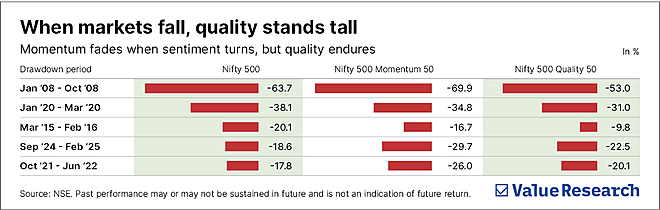
A quick look at the table titled ‘When markets fall, quality stands tall’ reveals that during major drawdowns such as 2008 or 2020, quality portfolios in India fell 8 to 10 percentage points less than the broader market or pure momentum indices, acting as proof that financially sound businesses weather market storms much better than those that rely solely on demand.
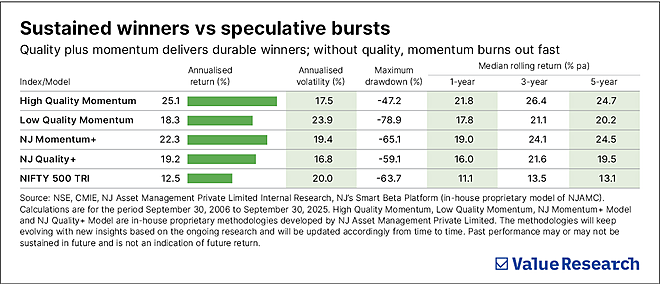
That endurance is not luck; it is earned. High-quality firms sustain momentum because their earnings justify their prices. Take a look at the table titled ‘Sustained winners vs speculative bursts’. The High Quality–High Momentum portfolio outperforms not only its low-quality counterpart but also pure momentum and pure quality. It delivers 25.1 per cent annualised returns with 17.5 per cent volatility and a milder 47.2 per cent max drawdown, combining superior performance with stronger resilience.
In short, quality keeps the engine cool while momentum provides acceleration. One ensures control; the other delivers thrust. Together, they turn market momentum into something rarer: consistency.
The Indian context
India’s markets are fertile ground for momentum. Sector churn, liquidity bursts and retail enthusiasm can turn sparks into rallies—and fizzle out just as fast. Quality steadies this motion. Blending the two brings the best of both worlds: the stability of fundamentals with the agility to capture opportunity.
This mix has historically outperformed single-factor portfolios, producing smoother returns with smaller drawdowns and lower volatility. It is a strategy that moves with the market without being at its mercy.
First quality, then agility
While momentum is thrilling, it is transitory; quality may be slower, but it is persistent. The edge lies in combining them to capture upside while staying anchored to fundamentals.
For NJ Asset Management, this dual-factor approach is rule-based and data-driven. Quality forms the foundation, and momentum adds the tactical edge. In investing, speed can take you ahead, but strength keeps you there. Together, they do more than deliver returns; they build wealth that lasts.
Nirmay Choksi is the Director and Head of Investment at NJ Asset Management Private Limited. The views expressed above are his own.
Ask Value Research 

 New episodes every Friday











 New Process Alert
  Seems like you've uploaded a wrong QR code. Please upload the QR code downloaded from MF Central platform.


