




 Aditya Roy/AI-Generated Image
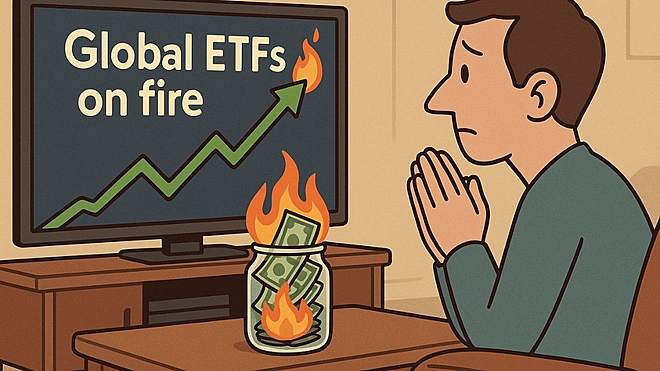
Summary: Global ETFs have opened a gateway to invest beyond Indian borders. But what happens when that gateway starts charging a premium? Many of these funds are now trading well above their fair value and history shows that they can change the math in unexpected ways.
Would you pay Rs 1.17 for a rupee’s worth of stock? That is, in effect, what many investors are doing when they buy global exchange-traded funds (ETFs) listed in India.
These funds are designed to mirror foreign indices, yet several now trade well above the value of their underlying portfolios, known as indicative net asset value (iNAV). The gap is striking. On a recent day, the Nippon India ETF Hang Seng BeES had an iNAV of Rs 449 but traded at Rs 537, a premium of almost 20 per cent. For an instrument built to track an index, that is a wide divergence.
Under normal circumstances, an ETF’s market price and iNAV move almost in lockstep. When prices rise above the fund’s actual value, authorised participants create new units and sell them, restoring alignment. But this mechanism broke down once fund houses hit SEBI’s US$7 billion overseas-investment ceiling, which froze new unit creation. With supply capped, prices began to reflect scarcity rather than fundamentals.
A costly affair
Fuelled by higher demand, all global ETFs are trading at a premium
| ETF | NAV (Rs) | Closing Price (Rs) | Premium (%) |
|---|---|---|---|
| Mirae Asset NYSE FANG+ ETF | 142 | 169 | 19.6 |
| Mirae Asset S&P 500 Top 50 ETF | 58 | 69 | 19.4 |
| Motilal Oswal Nasdaq Q50 ETF | 87 | 102 | 17.8 |
| Motilal Oswal Nasdaq 100 ETF | 217 | 241 | 11.2 |
| Mirae Asset Hang Seng Tech ETF | 25 | 30 | 18.8 |
| Nippon India Hang Seng BeES | 449 | 537 | 19.6 |
| Data as of Oct 6, 2025 | |||
These premiums are not isolated spikes; they appear across almost every global ETF available in the market. With new supply constrained and investor appetite for global exposure still strong, prices have drifted far from their intrinsic value.
A small premium can be justified in a market where access is limited. But when ETFs built to track indices start trading like scarce stocks, the question becomes unavoidable: how much premium is reasonable?
What our exercise found
To determine what level of premium is reasonable, we analysed over 10 years of daily price data (January 2015–October 2025) for six major global ETFs. The goal was to understand how far their market prices typically diverged from their indicative net asset values (iNAVs), and for how long such divergences lasted.
The findings show that prices generally stayed within a 0–5 per cent band above iNAV for most trading days. However, in roughly one-fourth of the observations, these ETFs traded at premiums exceeding 10 per cent, often during periods when new unit creation was suspended or when investor optimism about global markets surged.
% of times Global ETFs traded in the respective premium/discount range
| Premium Band (%) | Mirae Asset Hang Seng TECH ETF | Mirae Asset NYSE FANG+ ETF | Mirae Asset S&P 500 Top 50 ETF | Motilal Oswal NASDAQ 100 ETF | Motilal Oswal Nasdaq Q50 ETF | Nippon India ETF Hang Seng BeES |
|---|---|---|---|---|---|---|
| <0 | 13.4 | 34.2 | 39.1 | 28.4 | 29.1 | 30.5 |
| 0-5 | 47.4 | 37.2 | 33.9 | 49.5 | 46.4 | 35 |
| 05-Oct | 10.3 | 6.4 | 4.4 | 7.1 | 11.8 | 15.3 |
| Oct-20 | 25.9 | 16.8 | 18.8 | 12.4 | 11.3 | 17.8 |
| > 20 | 3 | 5.3 | 3.9 | 2.6 | 1.4 | 1.4 |
The data confirm that premiums above 10 per cent are neither rare nor lasting. They tend to arise when supply is artificially constrained, and they typically vanish once new flows resume or sentiment stabilises.
Based on this historical evidence, we developed a practical framework to help investors decide when a premium is acceptable and when it becomes excessive.
A thumb rule
A guide for investors for global ETFs at various levels of premium
| If the premium band | Interpretation |
|---|---|
| 0–3% | Normal variation |
| 3–5% | Caution zone — check liquidity |
| 5–10% | Stretched — wait for cool-off |
| >10% | Overheated — avoid buying |
These ranges are not mathematical cut-offs but empirical markers of investor behaviour. Premiums beyond 5–7 per cent have rarely proved sustainable. Most have reverted within weeks or months. Paying such a markup is essentially an upfront haircut on returns, the cost you bear before your investment even begins to perform.
Global ETFs are available at discounts, too
Premiums are only half the story. Global ETFs have also spent long stretches trading below their iNAV — sometimes by wide margins. Our analysis shows that in schemes such as the Mirae Asset S&P 500 Top 50 ETF, discounts appeared on nearly 40 per cent of trading days over the past decade.
This means investors who buy at steep premiums risk not only short-term losses when sentiment fades, but also the possibility of seeing the same fund trade at a discount later. The premium you pay today can easily become the return you surrender tomorrow.
Premiums are often magnified by low trading volumes. A quick test before you buy any ETF, your trade size should be less than one-thousandth of the ETF’s average daily turnover, which is basically, on average, how many ETF units change hands daily in a week or a month. For instance, if an ETF trades worth Rs 5 crore a day (which is the volume of the ETF traded daily), your exposure shouldn’t ideally exceed Rs 5 lakh to remain reasonably safe from liquidity risk. Otherwise, your own order may push the price higher, making you part of the premium problem.
Do Indian ETFs behave similarly?
Not really. Indian ETFs that track indices like the Nifty 50 or Sensex can freely create and redeem units, which keeps their market prices closely aligned with their NAV. Any deviation that appears is usually small — within 1–2 per cent — and tends to correct within a day.
Global ETFs, on the other hand, operate under SEBI’s overseas investment cap. Once fund houses hit this limit and new unit creation is halted, these ETFs begin to behave like closed-end funds. Their prices start reflecting temporary supply and demand imbalances rather than movements in the underlying markets.
That is why investors need to approach global ETFs differently. A small premium may be tolerable if liquidity is healthy, but paying more than 10 per cent above iNAV has rarely been rewarded. History shows that such premiums eventually fade, leaving investors who chased them worse off.
Great investments start with the right entry price. Check the live premiums of global ETFs on Value Research Online — because knowing when not to buy is half the job done.
Also read: International ETFs: A golden opportunity or a premium trap?
Ask Value Research 

 New episodes every Friday











 New Process Alert
  Seems like you've uploaded a wrong QR code. Please upload the QR code downloaded from MF Central platform.


