 Widely read:


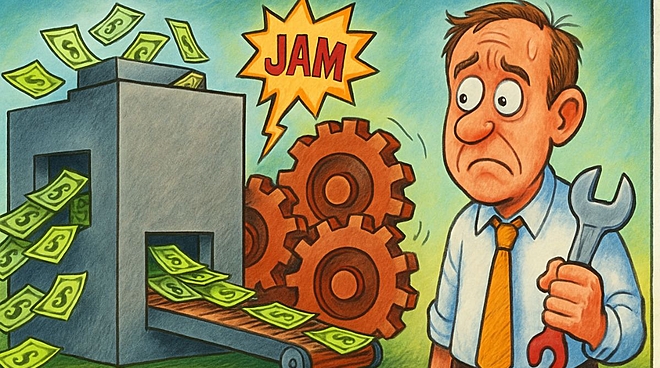 Aditya Roy/AI-Generated Image

Summary: Most investors chase earnings but not all profits translate into cash. Learn how poor cash conversion could erode returns of even profit making companies.
Every investor loves a company that reports rising profits. It signals growth, market share and hopefully future returns. But profits can also be misleading. On paper, they may look dazzling; in reality, they may never make it to the company’s bank account. And when profits don’t translate into cash, shareholders end up paying the price.
This is why cash flow matters more than accounting profits. And one simple ratio—CFO-to-EBITDA—can help you separate genuine wealth creators from profit mirages.
The acid test: CFO-to-EBITDA
EBITDA or earnings before interest, tax, depreciation and amortisation shows how much money a company earns from its operations before non-cash charges (like depreciation) and non-core costs (like interest and taxes). It’s good for gauging operating profitability across companies and industries.
CFO (cash flow from operations) reflects the actual money flowing into the company’s coffers from its day-to-day business after adjusting for receivables, payables and inventory.
If a company is truly making money, a healthy chunk of its EBITDA should show up as CFO.
Our rule of thumb: at least 60 per cent (0.6x) of cumulative EBITDA must turn into cash consistently, ideally over a long period of at least five years. Anything less should raise eyebrows.
Three cautionary tales
History offers some striking examples. A handful of companies reported earnings growth but failed to back it up with cash. Those who ignored the warning signs of poor CFO-to-EBITDA paid a steep price.
- PC Jeweller: While PC Jeweller reported consistent profits, its five-year cumulative CFO-to-EBITDA was a poor -0.06 by FY20, essentially signalling that the company was consuming cash rather than generating it. For a jeweller, where working capital discipline is critical, this was an ominous sign. Investors who held on would have seen the stock shrink 5 per cent annually in the years since.
- GE Power: GE Power’s financials showed a similar gap. Its five-year CFO-to-EBITDA stood at -0.19 in FY20. That meant profits were simply not translating into cash flow, suggesting structural issues in receivables or project execution. The stock has since eroded 12 per cent a year.
- Shemaroo Entertainment: Shemaroo’s five-year CFO-to-EBITDA was 0.37x by FY20, well below the comfort threshold, meaning while the company was booking profits, cash collection lagged sharply. The stock has delivered a staggering decline of 19 per cent per annum since.
Each case highlights a brutal truth: profits without cash support are unsustainable. Investors who had checked this simple ratio could have avoided serious wealth destruction.
Why this ratio matters
A consistently low CFO-to-EBITDA often points to problems such as:
- Aggressive revenue recognition: Companies eager to show growth book profits before cash is actually received.
- Bloated working capital: Rising receivables or inventory tie up cash even as profits look fine on paper.
- Poor cash discipline: Weak collection practices or lax contracts prevent profits from becoming liquidity.
However, note that this metric doesn’t apply to banks, NBFCs or insurers (BFSI), since their business model runs differently. In real estate and infrastructure, project timelines can temporarily skew cash flows, giving a misleading picture. Context is essential.
Your takeaway
The lesson is simple. Don’t stop at profit growth. Check whether those profits are backed by real cash. If a company’s CFO-to-EBITDA is consistently below 0.6, treat it as a red flag. No matter how attractive the profit numbers, the business may be a mirage.
When profits and cash move in tandem, investors can trust the story. When they diverge, history shows the ending rarely favours shareholders.
Where to find wealth compounders that ace both profit and cash?
At Value Research Stock Advisor, we look beyond reported earnings to test the true quality of a business. Our approach removes companies that only look strong on paper and instead zeroes in on those that deliver cash-backed growth. That’s how we help long-term investors separate mirages from real money-makers. Join Stock Advisor and find our recommendations that measure up on both yardsticks and more.
Also read: Maruti: What a dip in Valuation Score means for the stock
Disclaimer: This content is for information only and should not be considered investment advice or a recommendation.
For grievances: [email protected]
Ask Value Research 
 New episodes every Friday












 New Process Alert
 Seems like you've uploaded a wrong QR code. Please upload the QR code downloaded from MF Central platform.


