 Widely read:


 Anand Kumar
Summary: Volatile yet rewarding, mid-cap funds often defy neat patterns. This narrative weaves market behaviour, memory and a cricketing analogy to show why patience, perspective and timing matter far more than the headlines and how staying disciplined through chaos reveals the real story of compounding.
Memory doesn’t keep minutes, it keeps stories. It holds sharp moments and lets the ordinary fade, reshaping the ending so we can carry it more easily. That’s why a perfect holiday can feel spoiled by a rainy last day, or a punishing trek remembered fondly because of the summit view. The unremarkable sets the stage for everything that follows.
Investing works the same way. Most people forget the consistent years of compounding. They remember 2008 and 2020, the highs that thrilled, the lows that made them question everything. In our minds, extremes overshadow the slow, gradual gains that actually build wealth.
Fast, then slow
I came across a word called Zenosyne, the sense that time moves faster as we age. A bad quarter feels endless, yet years pass in a blink. We live setbacks in slow motion and recall recoveries in fast forward.
A 15 per cent fall in a year feels dangerous. A few consistent quarters feel safe. But history shows that over three years, equity fund outcomes can differ by 15–18 per cent. But stretch the horizon to seven or 10 years, and the odds of loss are near zero. Time softens volatility and reshapes outcomes.
Risk unfolds in two stages: first in the shock, then in its impact on subsequent decisions. Most convictions are just stubbornness in disguise. The rarest edge isn’t foresight, it’s restraint. Freedom from FOMO is wisdom.
Built for the moment
I’ve always felt cricket humbles even the best-laid plans. Openers set the tone, finishers close, yet sometimes circumstances demand otherwise.
I still remember the 2022 IPL, when Hardik Pandya, usually a finisher, walked in at number three after an early wicket. Unusual at first, he batted with composure, 67 off 48, to carry Gujarat Titans to a win. What made it striking was the backstory—years earlier, he had tried this role for the Mumbai Indians without success. This time, it worked not because he had magically transformed, but because the game demanded exactly what he was built for.
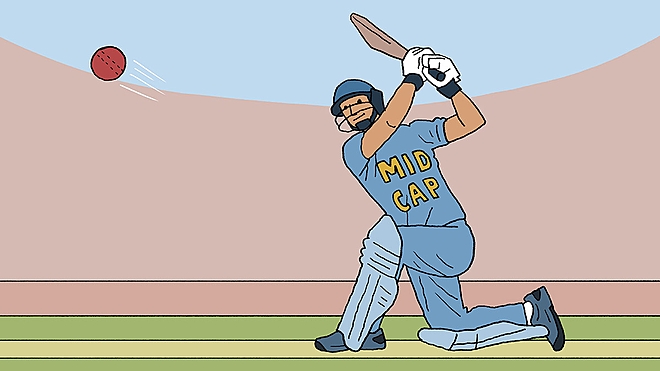
If we think about this in the world of investing, mid-cap funds carry the same tension: impressive yet unpredictable. They can seize the spotlight, yet volatility remains part of the script. They’re intriguing not just for highs or lows, but because their trajectory depends on when you catch them.
Like a finisher stepping up early, mid caps can briefly light up the field and then waver. They’re compelling, not because they always deliver, but because each phase reveals a different side of their potential.
Shifts on the distant line
Over several years, the market unfolds differently from what the daily movements suggest. Mid caps illustrate this, with seven-year CAGRs (annual returns) near 14.8 per cent, worst-decile returns around 7 per cent and median recovery close to 24–26 months. Stretching to 10 years, average CAGR rises to 15.5 per cent, upside capture 2.5 times, downside 1.8 times, with most SIPs ending positive, as what seems chaotic over shorter spans gradually takes shape. What I call “longevity efficiency” reflects how patience and disciplined alignment allow cycles to settle, revealing patterns more coherent than raw numbers alone may not fully capture. Large caps offer calm, gradual growth, while these segments move faster and less predictably, seen from different angles. Recent years have tested these traits, with SMID (small and mid cap) ranging from –18 per cent to +45 per cent and –25 per cent to +50 per cent, respectively. Momentum-driven entries surged, highlighting volatility. These fluctuations brought structure and steady participation into sharper focus. Results hinge less on market crosscurrents and more on how decisions unfold over time.

Even within this short span, patterns surface in how disciplined approaches respond, a movement reflected in our Whiteoak Mid Cap Fund, which recently marked three years since launch. Investor participation has remained steady and, even at this early stage, measured actions are beginning to align with the longer-term dynamics of mid caps.
Hidden weight
Markets, like cricket, rarely unfold as we anticipate. A single ball can feel decisive, the rhythm stumbles, yet its true impact often becomes clear only in hindsight. Thrilling moments excite, setbacks make you second-guess and long stretches fade, leaving our minds to hold the drama, not the ordinary moments. In the end, we carry the story not as it happened, but as we lived it.
But markets aren’t just driven by numbers; they’re shaped by how we perceive the moment, navigate decisions and react to volatility. What feels dangerous is often the market revealing our own biases. Mid caps hold up a mirror revealing impulses or leaving questions we notice later. This isn’t about claiming one category stands above another. Insight lies in the small details we often miss.
Because markets, like a finisher stepping in unexpectedly, rarely reveal themselves in the obvious moves. The moments that matter are the subtle choices only clear in hindsight.
My maths teacher at school would sometimes scribble on the board: “Two plus one is maybe not the same as one plus two.”
We laughed at it, certain it was wrong. Over time, I’ve come to see it differently. It wasn’t about numbers, but about perspective, how we search for neat patterns in things that rarely stay that simple. Pain and gain, risk and reward, effort and outcome may seem symmetrical on paper, yet in practice, they are often slightly asymmetrical, one way or the other.
Arpit Nayak is part of sales team at WhiteOak Capital Mutual Fund. He enjoys writing to simplify investing by providing clear insights and focusing on the behavioural aspects of financial decisions. He believes that smart choices come from clarity, not complexity.
Ask Value Research 
 New episodes every Friday











 New Process Alert
 Seems like you've uploaded a wrong QR code. Please upload the QR code downloaded from MF Central platform.


